
What Is the Scuba Weight Calculator?
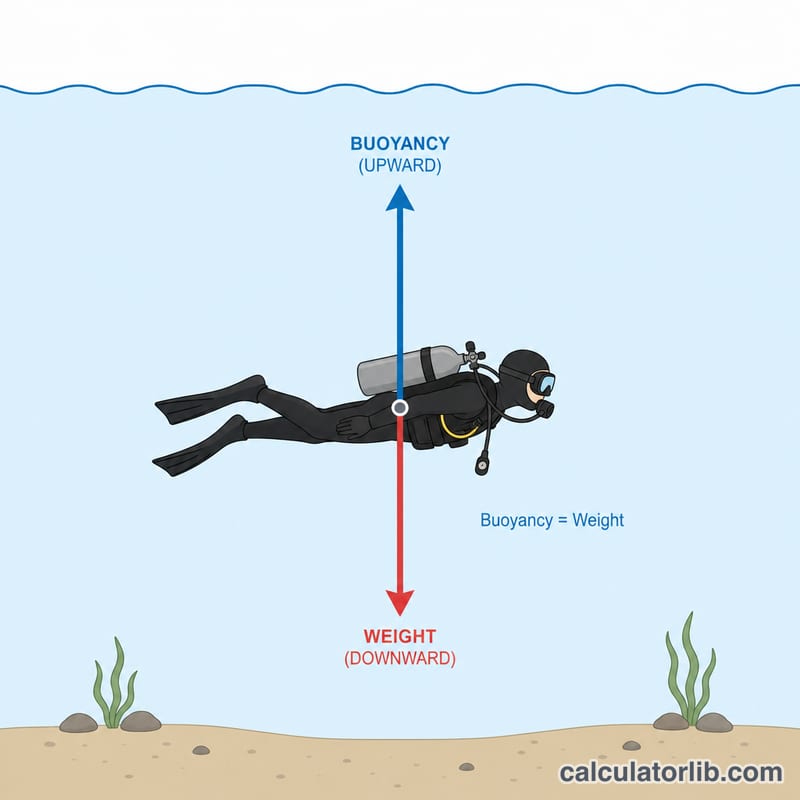
This tool gives a quick starting estimate of how much lead weight you should carry for a scuba dive. Getting your weighting right is one of the most important parts of buoyancy control: too little and you can't descend or hold a safety stop, too much and you'll fight to stay level and burn through air. The result here is an approximation to bring to the pool or shallow water for a proper weight check — it is not a replacement for a buoyancy check supervised by a certified instructor.
How to Use It
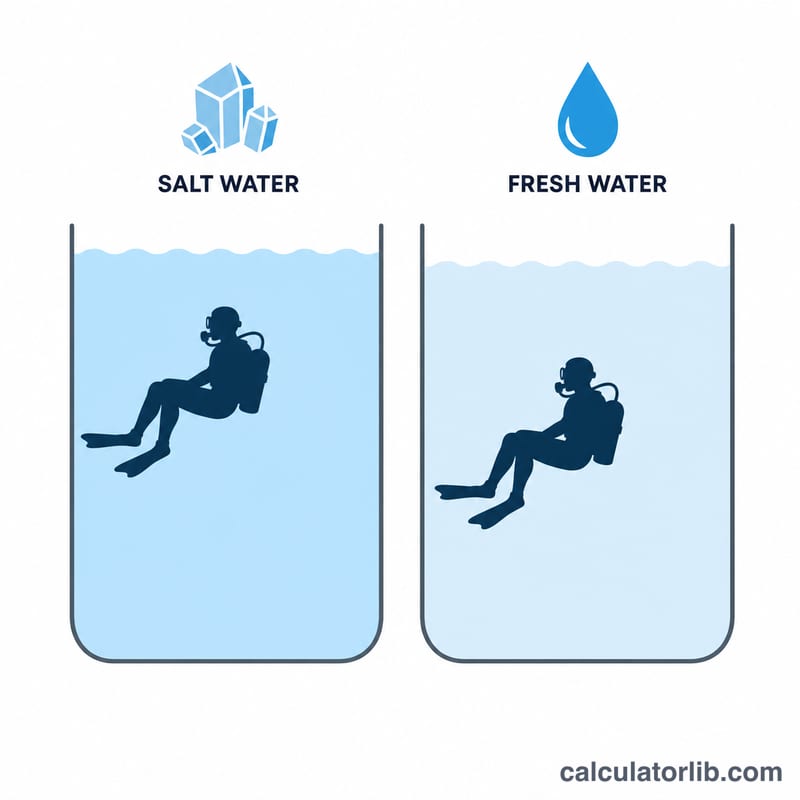
Enter your body weight in pounds, choose whether you'll be diving in saltwater or freshwater, and select the exposure suit you plan to wear. The calculator multiplies your body weight by a water density factor and adds a typical allowance for the buoyancy of your suit. Saltwater is denser than freshwater, so you float more easily and need more lead.
The Formula Explained
The estimate uses $$\text{Weight} = \text{BodyWeight} \times f + \text{SuitAllowance}$$ The factor \(f\) is about \(0.10\) (10%) in saltwater and \(0.07\) (7%) in freshwater. The suit allowance accounts for the extra buoyancy of neoprene: roughly +0 lbs for no suit, +2 for a shorty/3mm, +5 for a full 5mm, +7 for a 7mm, and around +12 for a drysuit (which varies widely with undergarments).
Worked Example
A 180 lb diver in saltwater wearing a full 5mm wetsuit:
$$180 \times 0.10 = 18 \text{ lbs}$$plus 5 lbs for the suit = 23 lbs as a starting point. The diver would then fine-tune this with an in-water check, removing weight until they hover at eye level with an empty BCD and a near-empty tank.
FAQ
Is this exact? No — it's a starting estimate. Always perform a proper weight check in the water.
Why more weight in saltwater? Salt makes water denser, increasing buoyancy, so you need more lead to sink.
Does tank type matter? Yes. Aluminum tanks become positively buoyant when empty, so many divers add 2–4 lbs beyond this estimate. Steel tanks need less.