
What Is Save Percentage?
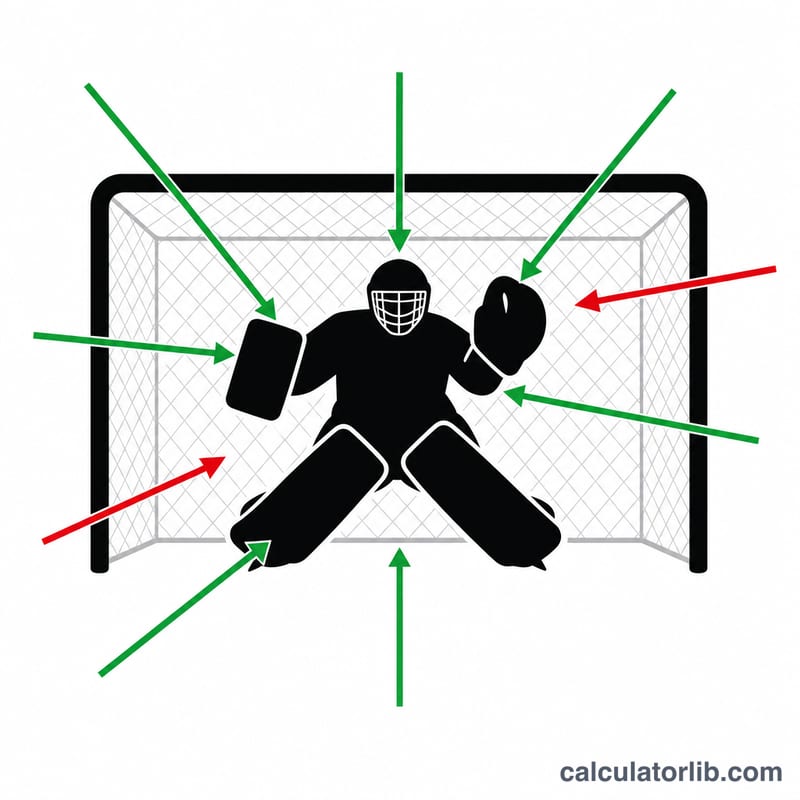
Save percentage (SV%) is the headline statistic used to measure a goaltender's effectiveness in hockey, soccer, lacrosse, and other goal-based sports. It expresses the proportion of shots on goal that the goalie successfully stops. A higher SV% means a more reliable last line of defense. In the NHL, elite goalies typically post a SV% around .920 or higher, while a number below .900 is considered weak over a full season.
How to Use This Calculator
Enter the total shots against (every shot on goal the goalie faced) and the goals allowed (shots that got past). The calculator subtracts goals from shots to get the number of saves, then divides by shots against. The result is shown as a three-decimal figure (the standard hockey notation, e.g. .920) along with the equivalent percentage.
The Formula Explained
The math is simple: SV% = Saves ÷ Shots Against, and Saves = Shots Against − Goals Allowed. So the combined formula is:
$$\text{SV\%} = \frac{\text{Shots Against} - \text{Goals Allowed}}{\text{Shots Against}} \times 100$$
Because the result is a ratio between 0 and 1, it is conventionally written without a leading zero — .915 rather than 0.915 — and read aloud as "nine-fifteen."
Worked Example
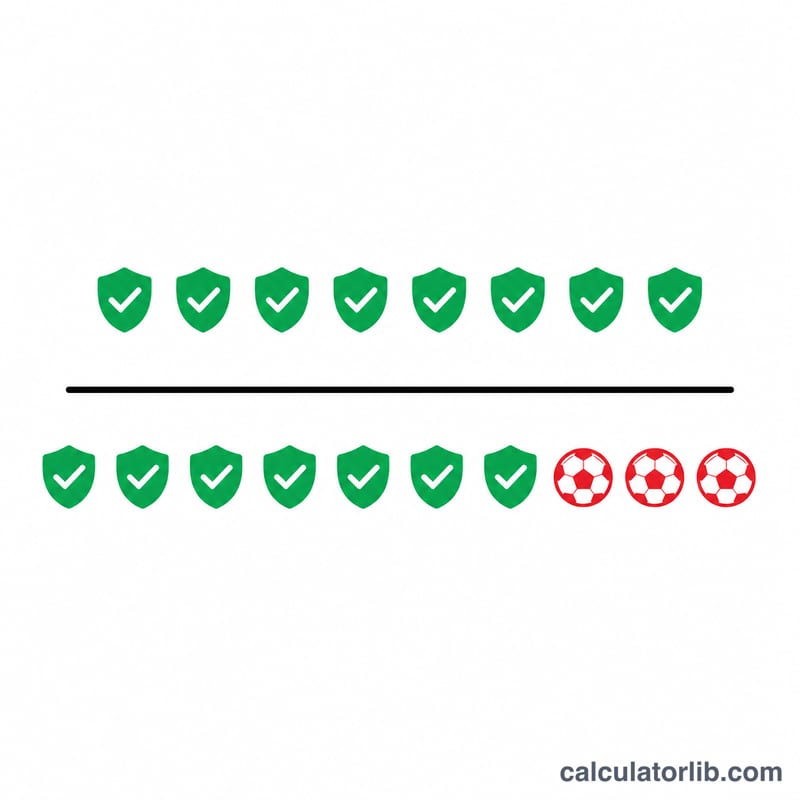
Suppose a goalie faces 30 shots and allows 2 goals. Saves = \(30 - 2 = 28\). $$\text{SV\%} = \frac{28}{30} = 0.9333, \text{ or } .933$$ That is an excellent single-game performance, equal to stopping 93.3% of all shots faced.
FAQ
What is a good save percentage? In professional hockey, .910–.920 is solid and anything above .925 is elite. Standards vary by league and sport.
Does save percentage include empty-net goals? Typically no — empty-net goals are not charged against a goalie's SV% in official stats, since the goalie is off the ice.
How is SV% different from goals-against average? SV% measures the share of shots stopped, while goals-against average (GAA) measures goals allowed per 60 minutes of play. SV% is independent of how busy the goalie is.