
What Is the Percentage of Amount Calculator?
This calculator answers the everyday question "what is X% of Y?" Enter a percentage and an amount, and it returns the exact part that the percentage represents, plus the remainder left over. It works for money, quantities, scores, measurements — anything numeric. The math is universal, so it applies in any country and currency.
How to Use It
Type the percentage in the first field (for example, 15) and the amount in the second field (for example, 200). The result instantly shows the part (30), along with the original values and the remainder (170). You can use decimals in both fields, such as 7.5% of 49.99.
The Formula Explained
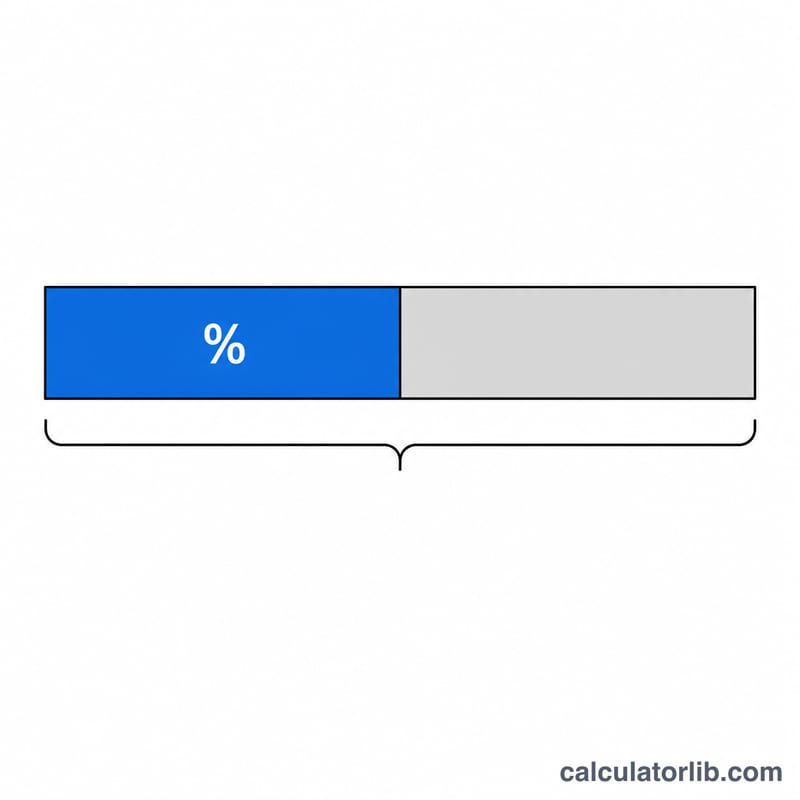
A percentage is simply a fraction out of 100. To find a percentage of a number, you convert the percent to a decimal by dividing by 100, then multiply by the amount:
$$\text{part} = \frac{\text{percent}}{100} \times \text{amount}$$The remainder is the leftover portion: $$\text{remainder} = \text{amount} - \text{part}$$ This is handy for tips, discounts, taxes, commissions, and splitting totals.
Worked Example
Suppose a jacket costs 200 and you have a 15% off coupon. The discount is $$(15 \div 100) \times 200 = 0.15 \times 200 = 30.$$ The remainder — the price you actually pay — is \(200 - 30 = 170\). So the 15% discount saves you 30.
FAQ
How do I find what percentage one number is of another? Use the reverse: divide the part by the whole and multiply by 100. For instance, 30 is \((30 \div 200) \times 100 = 15\%\) of 200.
Can the percentage be more than 100? Yes. 150% of 80 is \((150 \div 100) \times 80 = 120\), which is larger than the original amount.
Does this work for negative numbers? Yes — the formula handles negative amounts or percentages, simply producing a signed result.