
What is the Darcy-Weisbach Pressure Drop Calculator?
This calculator estimates the pressure drop (head loss) of a fluid flowing through a circular pipe due to friction with the pipe wall. It uses the Darcy-Weisbach equation, the most widely accepted relationship in fluid mechanics for both laminar and turbulent flow. The tool is universal and works in SI units (metres, kilograms, seconds).
How to use it
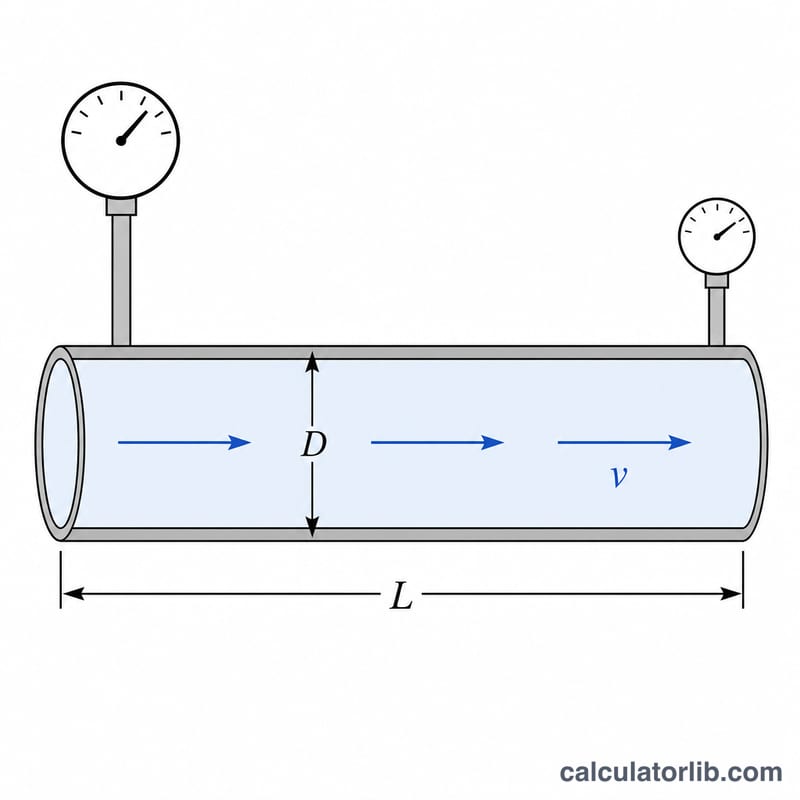
Enter the Darcy friction factor (f), pipe length (L) in metres, internal diameter (D) in metres, fluid density (ρ) in kg/m³ and average flow velocity (v) in m/s. The calculator returns the pressure drop in pascals, kilopascals and bar, plus the equivalent fluid head loss in metres.
The formula explained
The Darcy-Weisbach equation is $$\Delta P = \text{f} \cdot \frac{\text{L}}{\text{D}} \cdot \frac{1}{2}\, \rho\, \text{v}^{2}$$ The friction factor \(f\) captures the combined effect of pipe roughness and Reynolds number (it can be read from a Moody chart or computed from the Colebrook equation). The term \(\frac{1}{2}\rho v^{2}\) is the dynamic pressure of the flow. Head loss is found by dividing \(\Delta P\) by \(\rho g\), where \(g = 9.80665 \text{ m/s}^2\).
Worked example
For \(f = 0.02\), \(L = 100 \text{ m}\), \(D = 0.1 \text{ m}\), \(\rho = 1000 \text{ kg/m}^3\) and \(v = 2 \text{ m/s}\): $$\Delta P = 0.02 \times \frac{100}{0.1} \times 0.5 \times 1000 \times 2^{2} = 0.02 \times 1000 \times 0.5 \times 1000 \times 4 = 40{,}000 \text{ Pa} = 40 \text{ kPa} = 0.4 \text{ bar}$$ The head loss is \(\frac{40000}{1000 \times 9.80665} \approx 4.08 \text{ m}\).
FAQ
Where do I get the friction factor? For laminar flow (Re < 2300) \(f = \frac{64}{Re}\). For turbulent flow use a Moody chart or the Colebrook-White equation based on relative roughness and Reynolds number.
Does this include minor losses? No. This equation gives only the major (friction) loss along a straight pipe. Add minor losses from fittings, valves and bends separately.
Why is velocity squared? Frictional pressure loss scales with the kinetic energy of the flow, which is proportional to \(v^{2}\), so doubling the velocity roughly quadruples the loss.