
What is the Darcy-Weisbach equation?
The Darcy-Weisbach equation is the most widely accepted formula in fluid mechanics for calculating the head loss caused by friction as a fluid flows through a pipe. The result, expressed as a height of fluid (meters), represents the energy lost per unit weight of fluid over the pipe length. It applies to laminar and turbulent flow of any Newtonian fluid and is valid across all pipe materials, making it more universal than empirical formulas like Hazen-Williams.
How to use this calculator
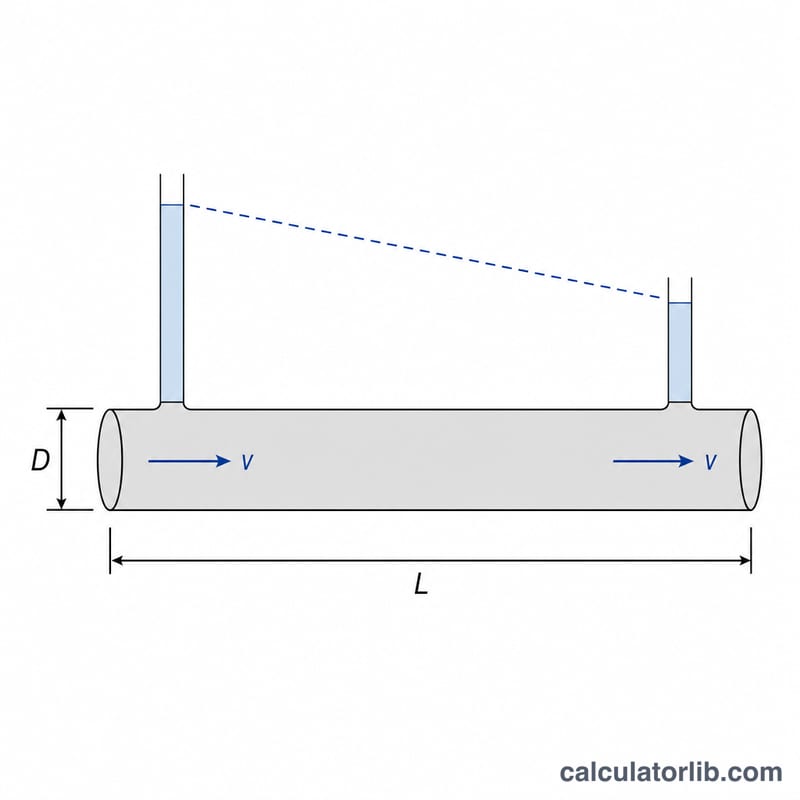
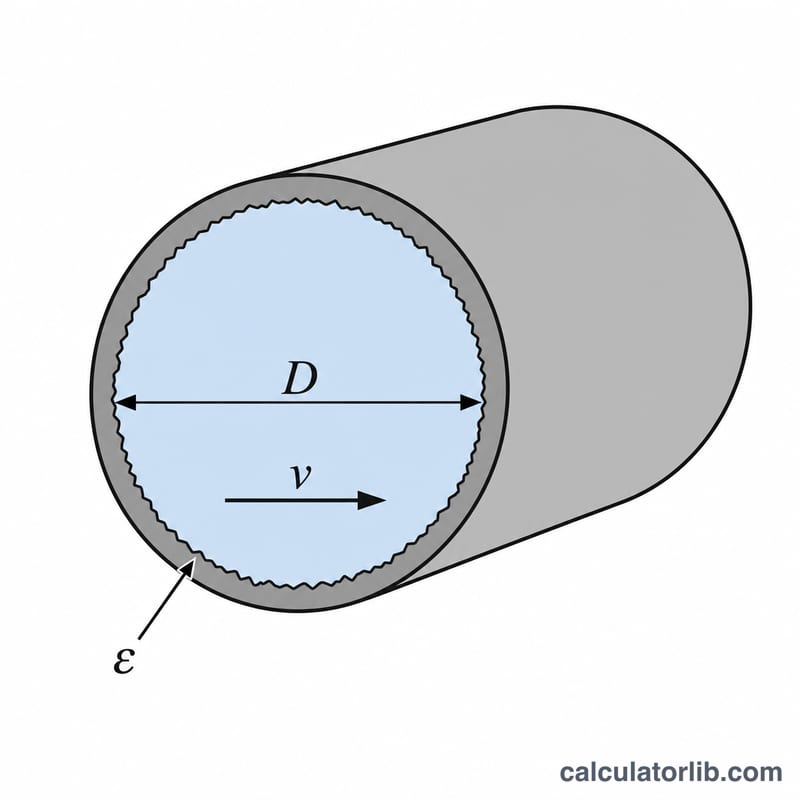
Enter five values: the dimensionless Darcy friction factor (f), the pipe length (L) in meters, the internal pipe diameter (D) in meters, the mean flow velocity (v) in m/s, and the gravitational acceleration (g, normally 9.81 m/s²). The calculator returns the friction head loss hf, along with the L/D ratio and the velocity head for reference.
The formula explained
The equation $$h_f = \text{f} \cdot \frac{\text{L}}{\text{D}} \cdot \frac{\text{v}^{2}}{2\,\text{g}}$$ multiplies three intuitive pieces: the friction factor \(f\) captures how rough and turbulent the flow is, the geometric ratio \(L/D\) scales loss with relative pipe length, and the velocity head \(v^2/2g\) represents the flow's kinetic energy as a height. The friction factor itself depends on the Reynolds number and relative roughness, often found from the Moody chart or the Colebrook equation.
Worked example
Suppose \(f = 0.02\), \(L = 100\) m, \(D = 0.2\) m, \(v = 2\) m/s and \(g = 9.81\) m/s². Then \(L/D = 500\), velocity head $$\frac{4}{19.62} \approx 0.2039 \text{ m},$$ and $$h_f = 0.02 \times 500 \times 0.2039 \approx 2.039 \text{ m}.$$ Roughly two meters of head are lost to friction along this run of pipe.
FAQ
What units should I use? This calculator uses SI units: meters and m/s. Keeping L and D in the same length unit is essential since their ratio must be dimensionless.
How do I find the friction factor? Use the Moody chart, the Colebrook-White equation, or approximations such as Swamee-Jain, based on the Reynolds number and pipe relative roughness.
Does it work for any liquid? Yes. Because head loss is expressed as a height of the flowing fluid, the Darcy-Weisbach form is independent of fluid density for the head-loss result, though density matters when converting to pressure loss.