
What is the Drag Force Calculator?
The Drag Force Calculator computes the aerodynamic (or hydrodynamic) resistance a body experiences when moving through a fluid such as air or water. It applies the classic drag equation used throughout physics and engineering, returning the drag force in newtons along with the dynamic pressure of the flow.
How to use it
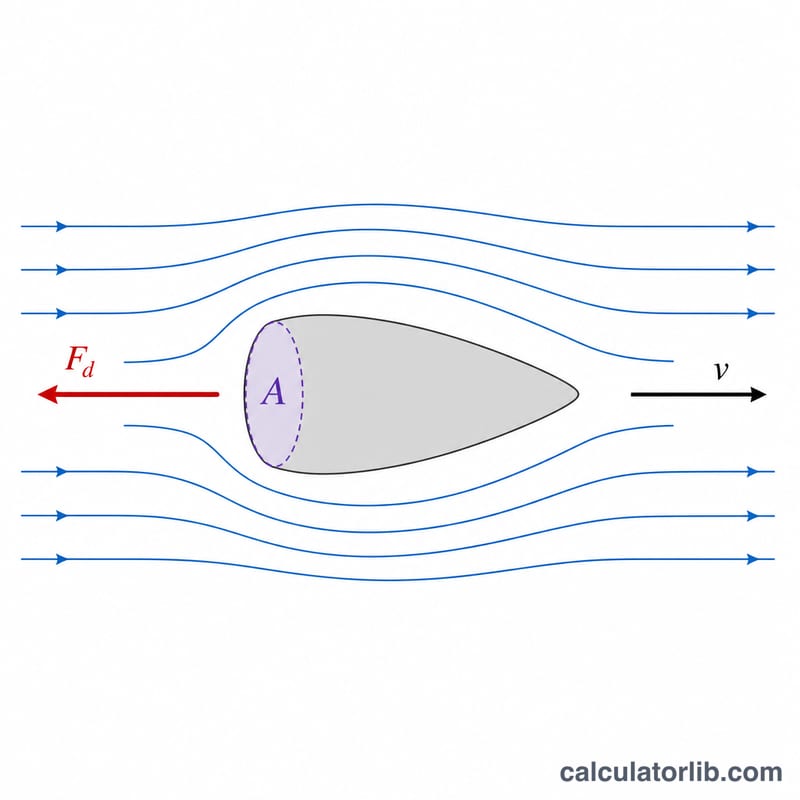
Enter four values: the fluid density \(\rho\) (about 1.225 kg/m³ for air at sea level, ~1000 kg/m³ for water), the relative velocity \(v\) in metres per second, the dimensionless drag coefficient \(C_d\) of the object, and the reference (frontal) area \(A\) in square metres. The calculator instantly returns the drag force.
The formula explained
The drag equation is $$F_d = \frac{1}{2} \cdot \rho \cdot v^2 \cdot C_d \cdot A$$ Drag scales linearly with density and area but grows with the square of velocity — doubling speed quadruples drag. The drag coefficient \(C_d\) captures the shape's aerodynamic efficiency (≈0.04 for a streamlined airfoil, ≈0.47 for a sphere, ≈1.05 for a cube). The term \(\frac{1}{2}\rho v^2\) is the dynamic pressure of the fluid.
Worked example
A car travelling at 30 m/s (108 km/h) in air (\(\rho = 1.225\) kg/m³) with \(C_d = 0.5\) and frontal area \(A = 2\) m²: $$F_d = 0.5 \times 1.225 \times 30^2 \times 0.5 \times 2 = 0.5 \times 1.225 \times 900 \times 0.5 \times 2 = 551.25 \text{ N}$$
FAQ
What units does this use? SI units throughout — density in kg/m³, velocity in m/s, area in m². The result is in newtons.
What is a typical drag coefficient? Around 0.25–0.35 for modern cars, 0.47 for a sphere, and roughly 1.0–1.3 for a flat plate facing the flow.
Does this work for water? Yes — the equation is valid for any fluid. Just use the appropriate fluid density (about 1000 kg/m³ for fresh water).