
What is the Force Calculator?
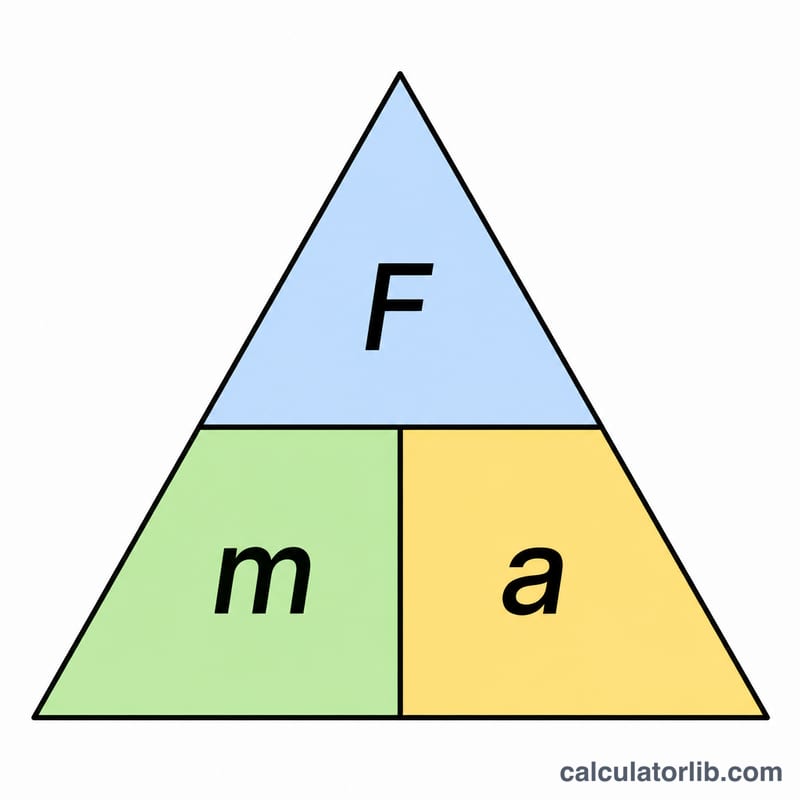
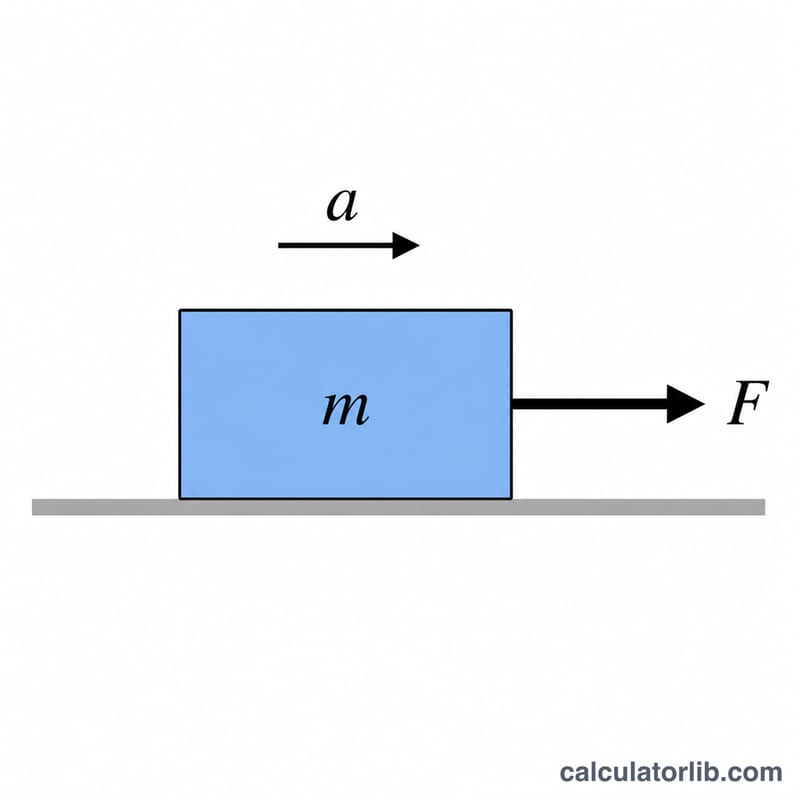
This calculator applies Newton's second law of motion, \(F = m \cdot a\), the relationship that connects the net force acting on an object to its mass and the acceleration that force produces. Because the equation has three variables, you can solve for any one of them when the other two are known. The tool handles force, mass, and acceleration, and lets you choose units independently on each variable.
How to use it
First pick what you want to solve for using the "Choose a Calculation" dropdown. Enter the two known quantities, select their units, and the calculator returns the unknown in the unit you select for that variable. The "Significant Figures" option lets you round the answer to a fixed number of figures, or leave it on "auto" for full precision.
The formula explained
Internally every input is converted to SI base units (newtons for force, kilograms for mass, meters per second squared for acceleration) using exact scale factors. The unknown is computed in SI — \(F = m \cdot a\), \(m = \frac{F}{a}\), or \(a = \frac{F}{m}\) — and then converted back into the unit you chose. Because the conversions are symmetric, mixing non-SI input and output units always yields the same physically correct answer.
Worked example
Solve for force with \(m = 1500\ \text{lb}\) and \(a = 10\ \text{ft/s}^2\), output in pound-force. Convert: $$m = 1500 \times 0.45359237 = 680.39\ \text{kg}$$ $$a = 10 \times 0.3048 = 3.048\ \text{m/s}^2$$ Then $$F = 680.39 \times 3.048 = 2073.82\ \text{N}$$ Converting to pound-force: \(2073.82 / 4.4482216 \approx 466.2\ \text{lbf}\).
FAQ
Can force or acceleration be negative? Yes. A negative sign simply indicates direction, such as deceleration. Mass, however, must be a positive real number.
Why do I get an error? Solving for mass requires acceleration to be non-zero, and solving for acceleration requires mass to be non-zero, otherwise the formula divides by zero.
What is a newton? One newton is the force needed to accelerate a one-kilogram mass at one meter per second squared (\(1\ \text{N} = 1\ \text{kg}\cdot\text{m/s}^2\)).