
What is the Linear Actuator Force Calculator?
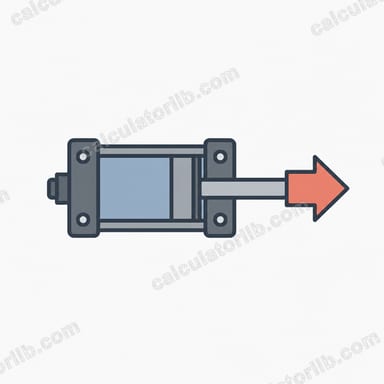
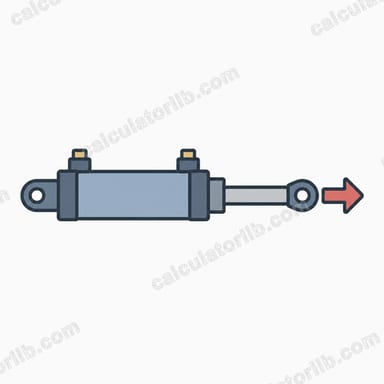
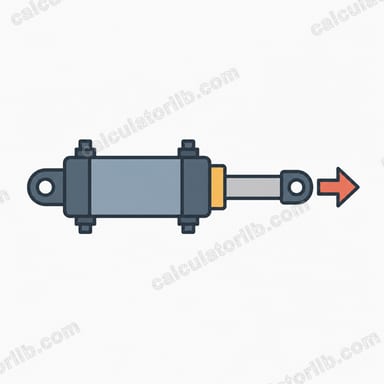
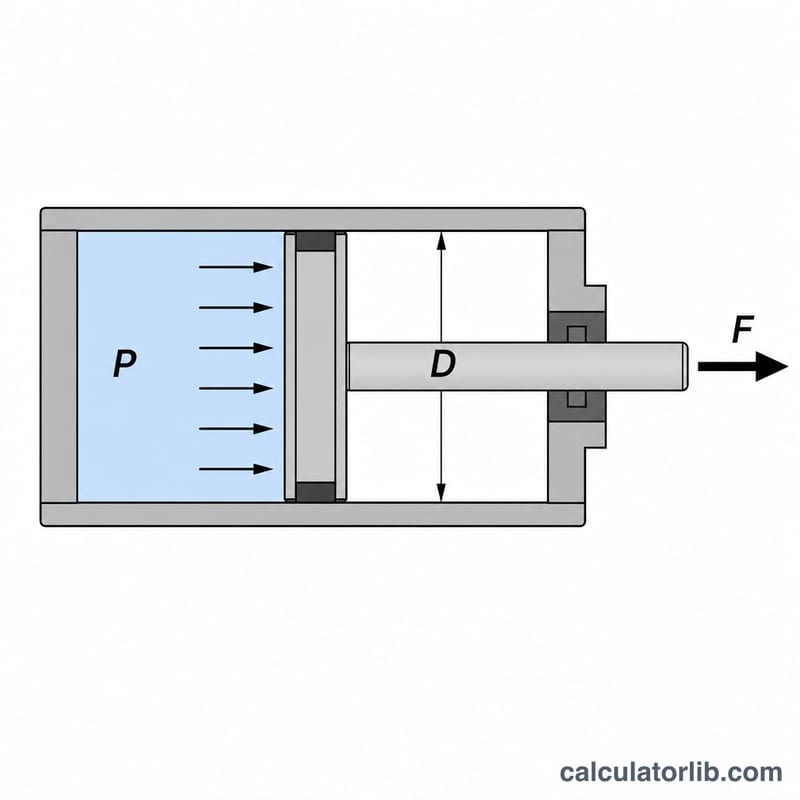
This tool estimates the theoretical output (thrust) force of a hydraulic or pneumatic linear actuator — such as a cylinder or ram — based on the fluid pressure acting on its piston. The piston converts pressure into a usable mechanical push force, and the larger the bore and the higher the pressure, the greater the force produced.
How to use it
Enter the operating pressure and choose its unit (bar, psi, kPa or MPa). Then enter the bore (piston) diameter in millimetres. The calculator returns the extension force in newtons, with handy conversions to kilograms-force (kgf) and pounds-force (lbf), plus the computed piston area.
The formula explained
The governing equation is \(F = P \times A\), where \(A\) is the circular piston area, $$A = \frac{\pi}{4} \cdot D^{2}.$$ Pressure is converted to pascals and the diameter to metres so the force comes out in newtons (\(1\ \text{Pa} \times 1\ \text{m}^{2} = 1\ \text{N}\)). This gives the ideal force on the full-bore (extension) stroke. The retraction force on a rod-side cylinder is lower because the rod reduces the effective area — that case is not modelled here.
Worked example
A pneumatic cylinder runs at 6 bar with a 50 mm bore. $$A = \frac{\pi}{4} \cdot (0.05)^{2} = 0.0019635\ \text{m}^{2}$$ $$P = 6 \times 100000 = 600{,}000\ \text{Pa}$$ $$F = 600{,}000 \times 0.0019635 \approx 1{,}178\ \text{N}$$ (about 120 kgf or 265 lbf).
FAQ
Does this include friction losses? No — it is the theoretical force. Real cylinders deliver roughly 85–95% of this due to seal friction.
Why is retraction force different? On the rod side, the piston rod subtracts area, so the same pressure yields less force.
Which pressure should I use? Use the regulated operating pressure your system supplies to the actuator.