
What is the Cycling Calories Burned Calculator?
This tool estimates how many calories (kcal) you burn while riding a bicycle. It uses the internationally recognized METs (Metabolic Equivalent of Task) method from the Compendium of Physical Activities. You choose your cycling intensity by speed, enter your body weight and how long you rode, and it returns total energy expenditure. The calculator is universal and not tied to any single country.
How to use it
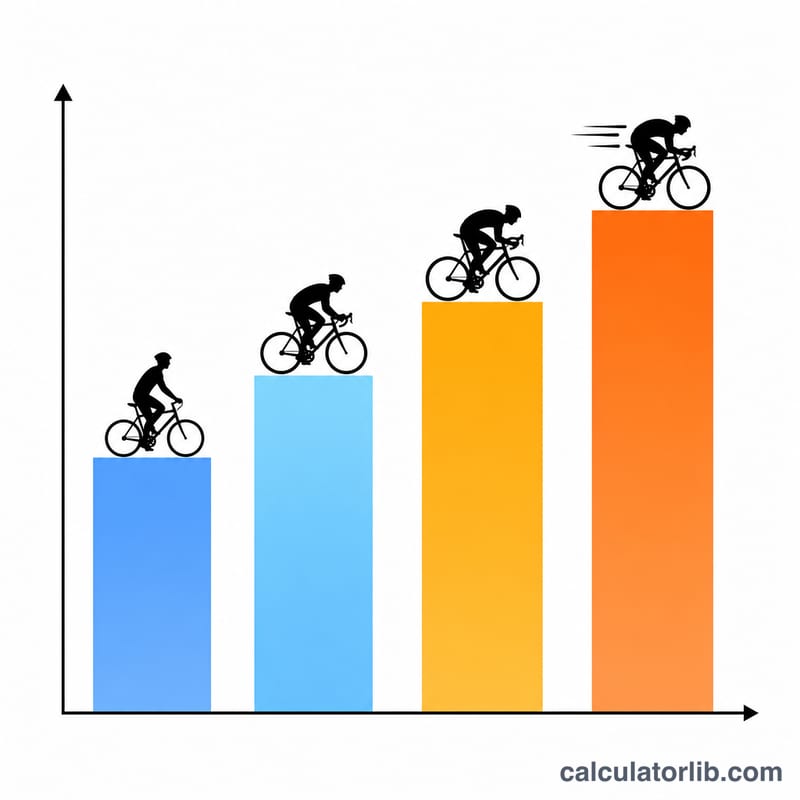
1. Pick a "Cycling intensity" option that matches your typical speed - the option already carries the right METs value. 2. Enter your duration in minutes. 3. Enter your body weight in kilograms. The result shows the estimated calories burned plus the METs value used.
The formula explained
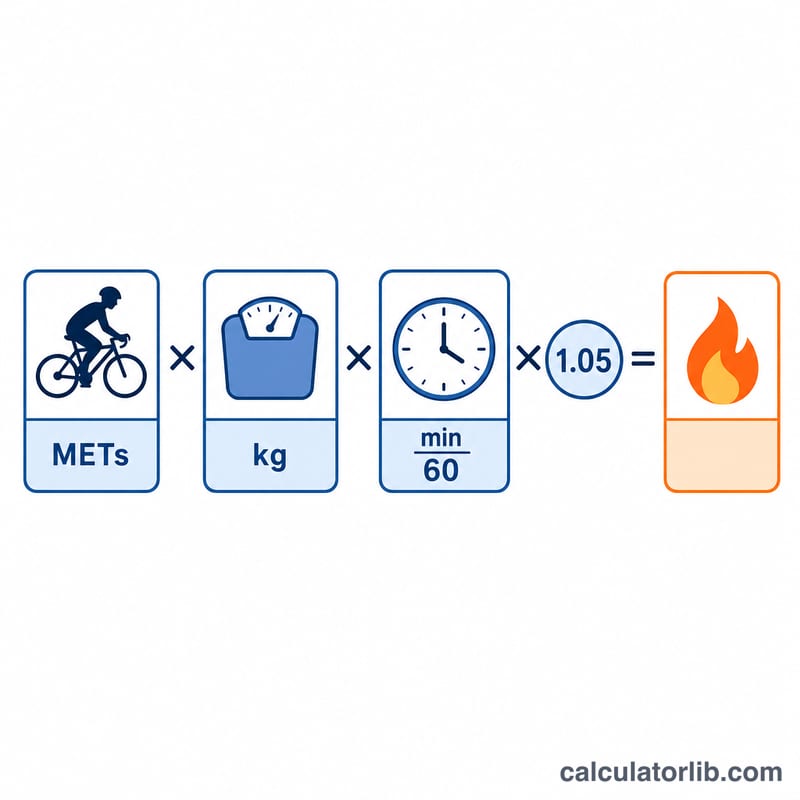
The core equation is: $$\text{calories} = \text{METs} \times \text{weight(kg)} \times \text{time(hours)} \times 1.05$$ Because most people track ride time in minutes, the calculator first converts minutes to hours by dividing by 60. The constant 1.05 reflects the standard rule that 1 MET burns about 1.05 kcal per kilogram of body weight per hour. METs values rise with speed: slow city riding is around 3.5 METs while a fast road effort can exceed 15 METs.
Worked example
Suppose you ride at about 15.1 km/h (5.8 METs) for 90 minutes and weigh 60 kg. Convert time: \(90 / 60 = 1.5\) hours. Then $$5.8 \times 60 \times 1.5 \times 1.05 = 548.1 \text{ kcal}$$ So a 90-minute steady ride burns roughly 548 kcal.
FAQ
Is this gross or net calories? It is gross energy expenditure during the ride, including your resting metabolism, not only the "extra" calories above rest.
Why are road bike numbers sometimes lower? Aerodynamic, efficient road bikes can require less effort at a given speed, so real burn may be lower than the table suggests. Some riders estimate around 70% of the listed value.
How accurate is it? It is an approximation. Wind, terrain, tire pressure, rider fitness and gear all affect the true figure, so treat the result as a useful estimate rather than an exact measurement.