
What Is a Torsion Spring Calculator?
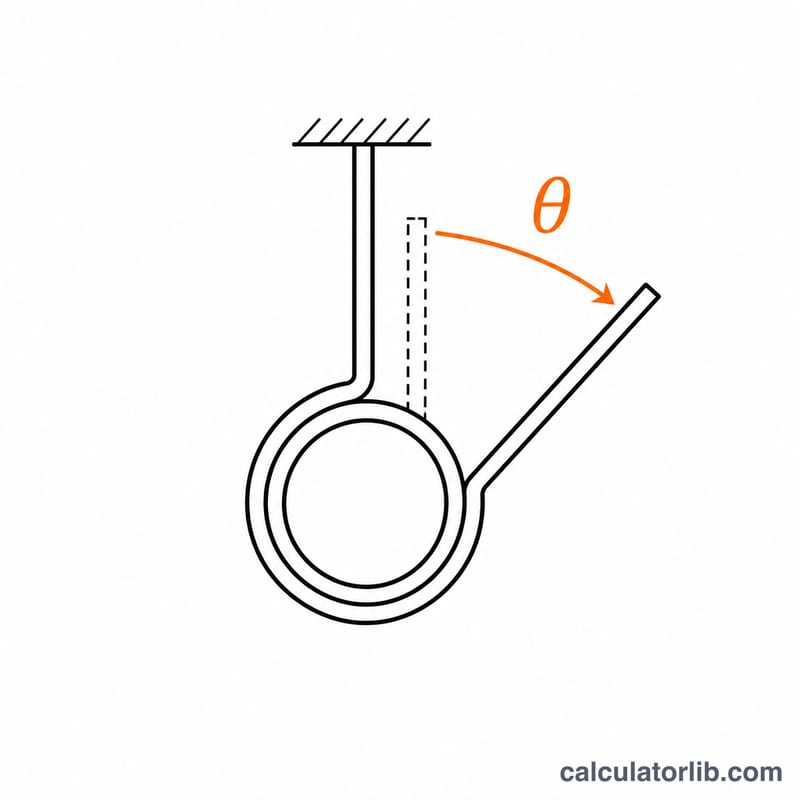
A torsion spring stores energy when twisted about its axis, exerting a torque proportional to the angle of deflection. This calculator finds the torsional spring rate — the torque the spring produces per full revolution (turn) of angular wind-up. It works for round-wire helical torsion springs and is unit-agnostic as long as you keep consistent units (E in MPa with dimensions in mm gives a rate in N·mm per turn).
How to Use It
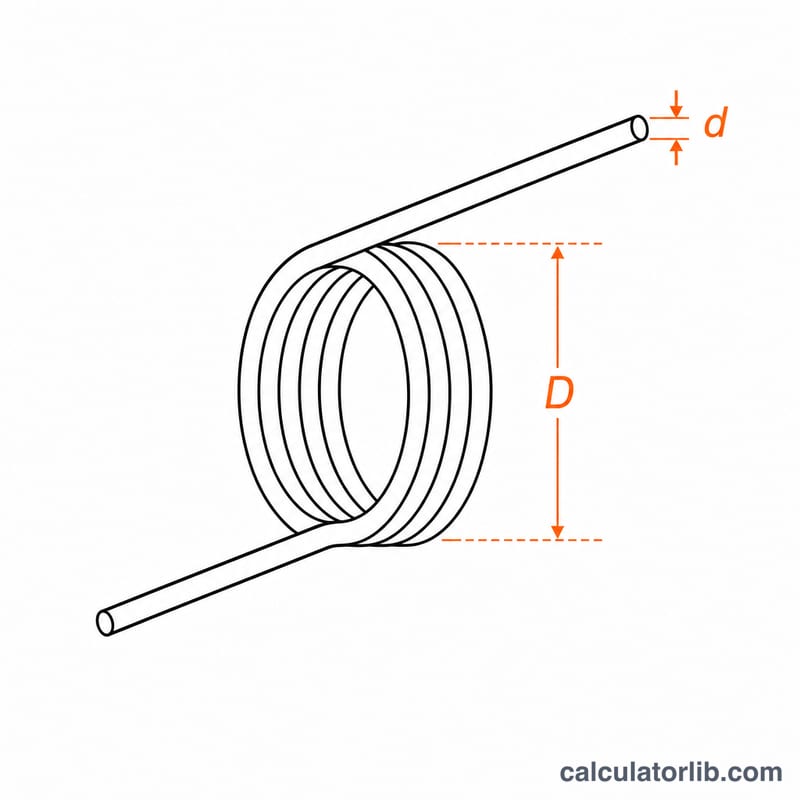
Enter the wire's modulus of elasticity E (about 207,000 MPa for music wire / steel), the wire diameter d, the mean coil diameter D (outer diameter minus wire diameter), and the number of active coils Na. The calculator returns the spring rate per turn and the equivalent torque per degree of rotation.
The Formula Explained
The torsional spring rate is:
$$k = \dfrac{\text{E} \cdot \text{d}^{4}}{10.8 \cdot \text{D} \cdot \text{Na}}$$The wire diameter has a fourth-power influence, so small changes in \(d\) dramatically change stiffness. The constant 10.8 (rather than the theoretical 10.2) includes an empirical correction that accounts for friction between coils and the curvature of the wound wire, giving more realistic real-world values.
Worked Example
For steel wire E = 207,000 MPa, d = 2 mm, D = 20 mm, Na = 5 coils:
$$k = \frac{207{,}000 \times 2^{4}}{10.8 \times 20 \times 5} = \frac{207{,}000 \times 16}{1{,}080} = \frac{3{,}312{,}000}{1{,}080} \approx 3{,}066.67 \ \text{N}\cdot\text{mm per turn}$$Dividing by 360 gives \(\approx 8.52\) N·mm per degree.
FAQ
What units does the result use? If E is in MPa (N/mm²) and all dimensions are in mm, the rate is in N·mm per turn (revolution).
What value should I use for E? Use the tensile/elastic modulus: ~207,000 MPa for steel and music wire, ~131,000 MPa for phosphor bronze, ~110,000 MPa for stainless considerations vary by alloy.
Why 10.8 instead of 10.2? The factor 10.8 is the common empirical constant for torsion springs that compensates for inter-coil friction; the purely theoretical value is closer to 10.2.