
What Is the Spring Constant?
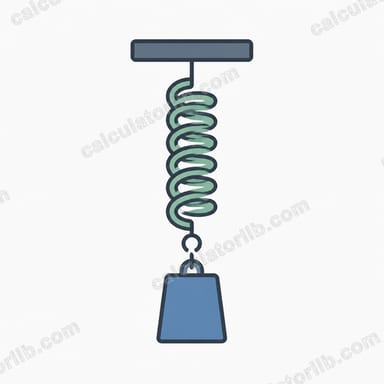
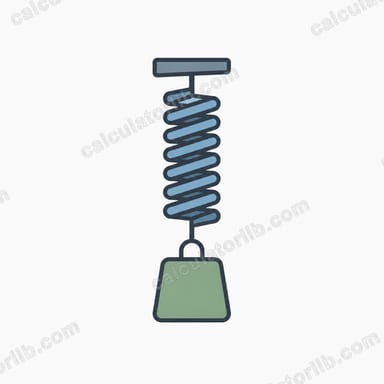
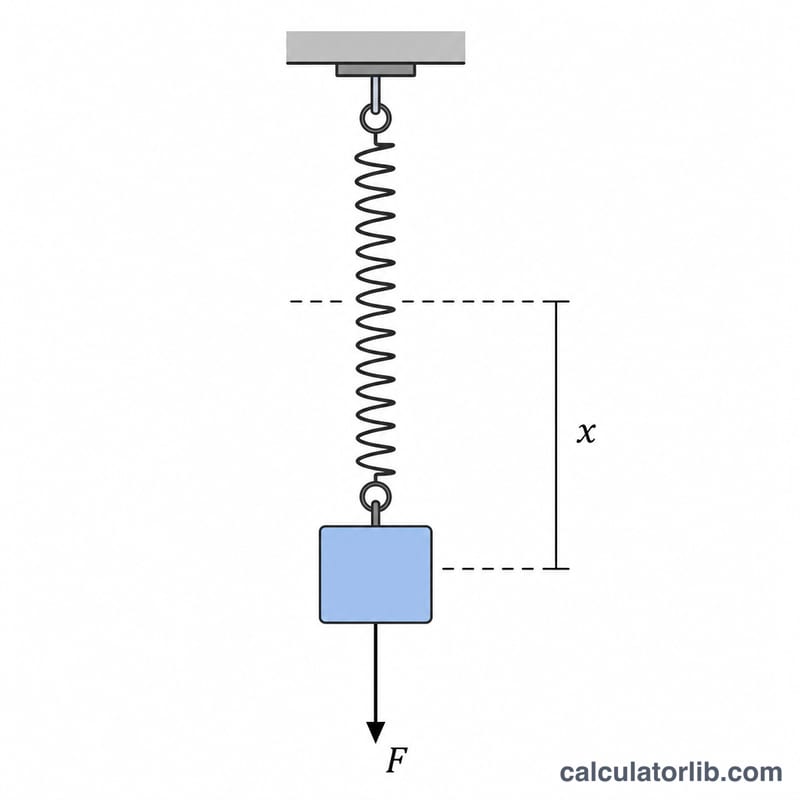
The spring constant, denoted k, measures how stiff a spring is — how much force is needed to stretch or compress it by a given distance. A high k means a stiff spring; a low k means a soft, easily-deformed spring. It is measured in newtons per meter (N/m). This calculator applies Hooke's Law, a universal physics relationship valid for any elastic spring within its elastic limit.
How to Use This Calculator
Enter the force applied to the spring in newtons (N) and the resulting displacement from its rest position in meters (m). The calculator instantly returns the spring constant \(k = F/x\), plus the elastic potential energy stored in the spring at that displacement.
The Formula Explained
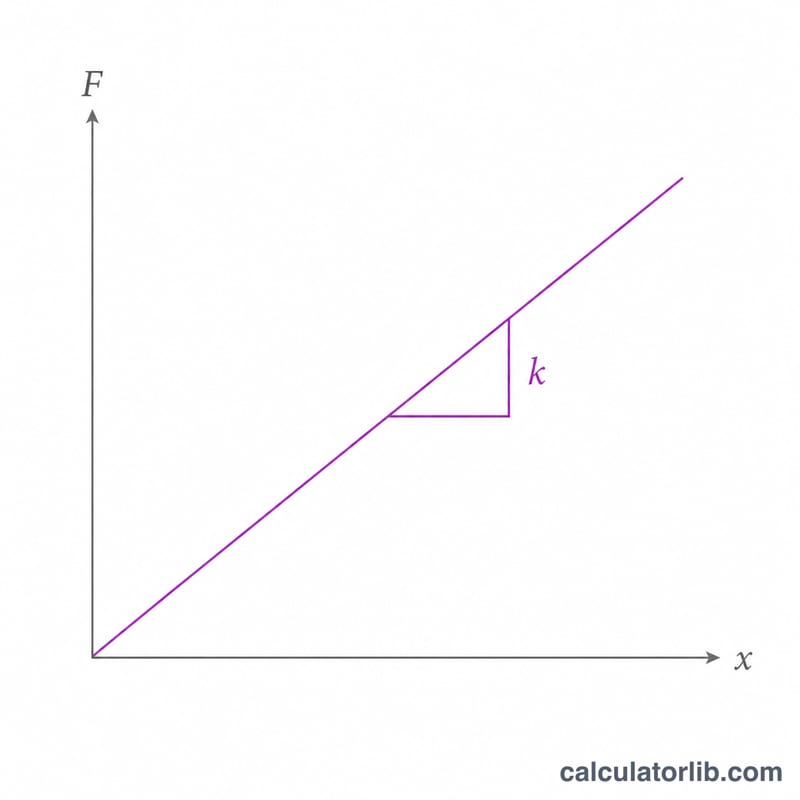
Hooke's Law states that the restoring force of a spring is proportional to its displacement: $$F = kx$$ Rearranging to solve for the stiffness gives $$k = \frac{F}{x}$$ The energy stored is the area under the force–displacement line, $$E = \tfrac{1}{2} k x^2$$
Worked Example
Suppose a 10 N force stretches a spring by 0.05 m. Then $$k = \frac{10}{0.05} = 200 \text{ N/m}$$ The stored elastic energy is $$E = \tfrac{1}{2} \times 200 \times 0.05^2 = \tfrac{1}{2} \times 200 \times 0.0025 = 0.25 \text{ J}$$
FAQ
What units should I use? Use newtons for force and meters for displacement to get k in N/m. If you measure in cm, convert to meters first (divide by 100).
Can the spring constant be negative? No. Force and displacement act in the same direction, so k is always positive. The minus sign in \(F = -kx\) refers to the restoring direction, not the stiffness value.
Does this work beyond the elastic limit? No. Hooke's Law only holds while the spring deforms elastically. Past the elastic limit the spring deforms permanently and k is no longer constant.