
What this calculator does
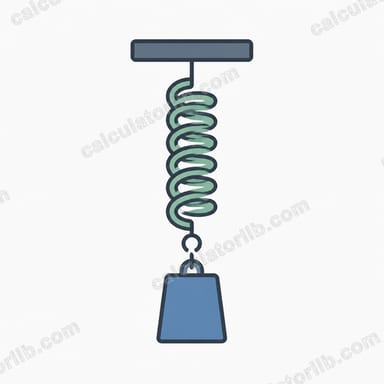
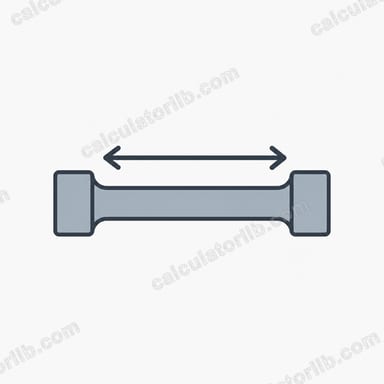
This Stress and Strain Calculator works out the three fundamental quantities of mechanics of materials: stress (\(\sigma\)), strain (\(\varepsilon\)), and Young's modulus (\(E\)). Given the axial force pulling on a member, its cross-sectional area, the amount it stretches, and its original length, the tool returns each value plus the elastic modulus that characterises the material's stiffness.
How to use it
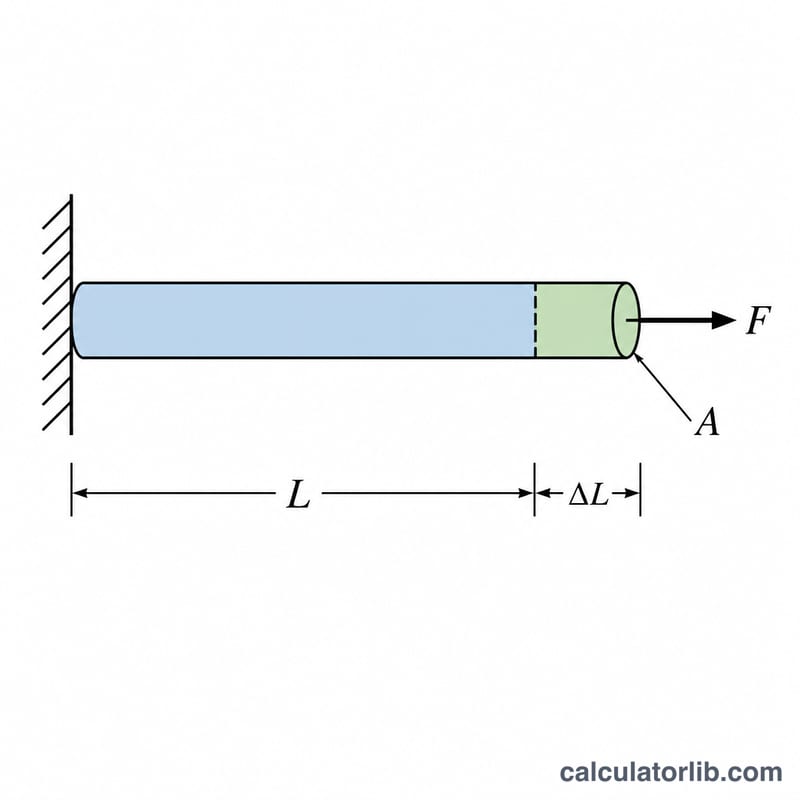
Enter the applied force F in newtons, the cross-section area A in square millimetres, the change in length ΔL and the original length L in millimetres. Because stress is reported as N/mm² it equals megapascals (MPa) directly, and Young's modulus is shown in both MPa and the more common GPa.
The formulas explained
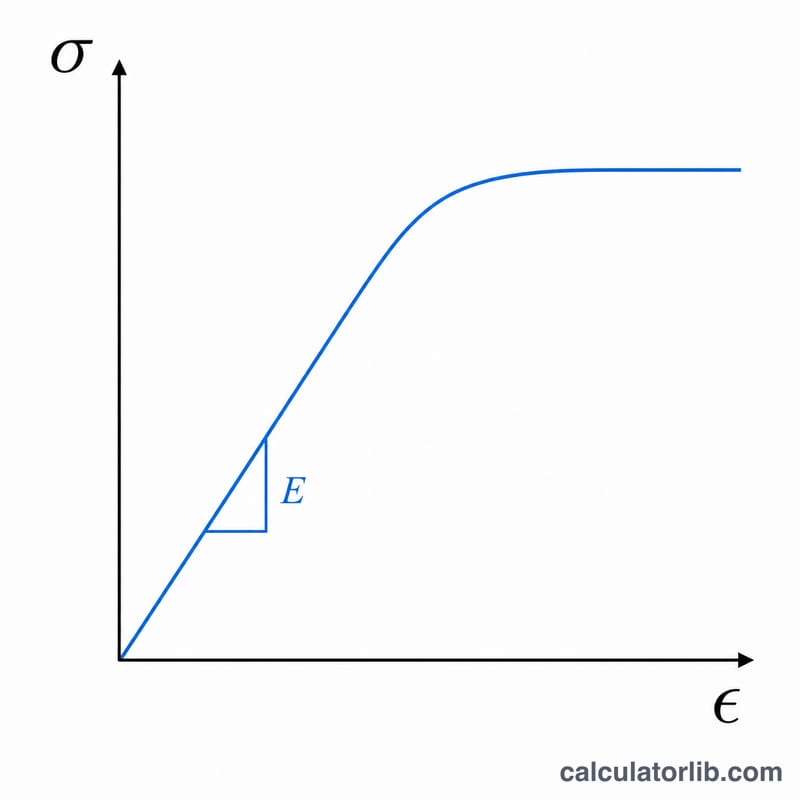
Stress is the internal force intensity, $$\sigma = \dfrac{F}{A}.$$ Strain is the relative deformation, $$\varepsilon = \dfrac{\Delta L}{L},$$ a dimensionless ratio. Within the elastic region Hooke's law gives a linear relationship, so the slope of stress versus strain is Young's modulus: $$E = \dfrac{\sigma}{\varepsilon}.$$ A higher \(E\) means a stiffer material that deforms less under the same load.
Worked example
A steel rod of area 100 mm² carries 10,000 N and stretches 0.5 mm over a 1,000 mm length. $$\sigma = \frac{10000}{100} = 100 \text{ MPa}.$$ $$\varepsilon = \frac{0.5}{1000} = 0.0005.$$ $$E = \frac{100}{0.0005} = 200{,}000 \text{ MPa} = 200 \text{ GPa}$$ — exactly the textbook value for structural steel.
FAQ
Why is stress in MPa? Because \(1 \text{ N/mm}^2\) equals \(1 \text{ MPa}\), entering force in newtons and area in mm² gives stress directly in megapascals.
Is strain unitless? Yes. It is a length divided by a length, so it has no units (sometimes expressed as a percentage).
Does this only work in the elastic range? Young's modulus is only meaningful below the proportional limit, where stress and strain are linear. Beyond yielding the simple \(E = \sigma/\varepsilon\) no longer applies.