
What Is Thermal Stress?
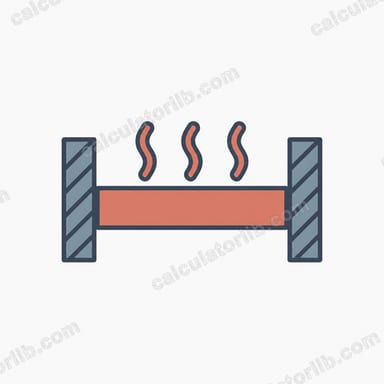
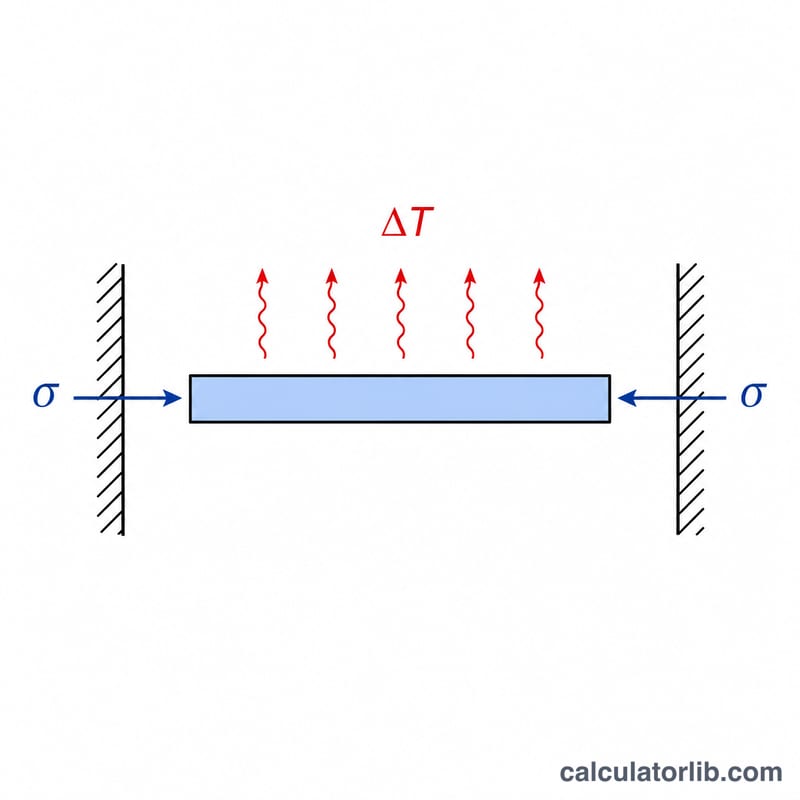
When a material is heated or cooled it naturally wants to expand or contract. If that movement is prevented — for example a steel beam rigidly fixed between two walls — internal stress builds up instead of free strain. This thermal stress can be large enough to buckle rails, crack concrete, or fail pipe joints. This calculator estimates the stress in a fully constrained member from three inputs.
How to Use It
Enter the material's Young's modulus (E) in gigapascals (GPa), the linear coefficient of thermal expansion (α) in units of \(\times 10^{-6}\) per °C, and the temperature change (ΔT) in °C. The tool returns the resulting stress in megapascals (MPa). A positive ΔT (heating) of a restrained member produces compressive stress; cooling produces tensile stress. The magnitude is the same regardless of sign.
The Formula Explained
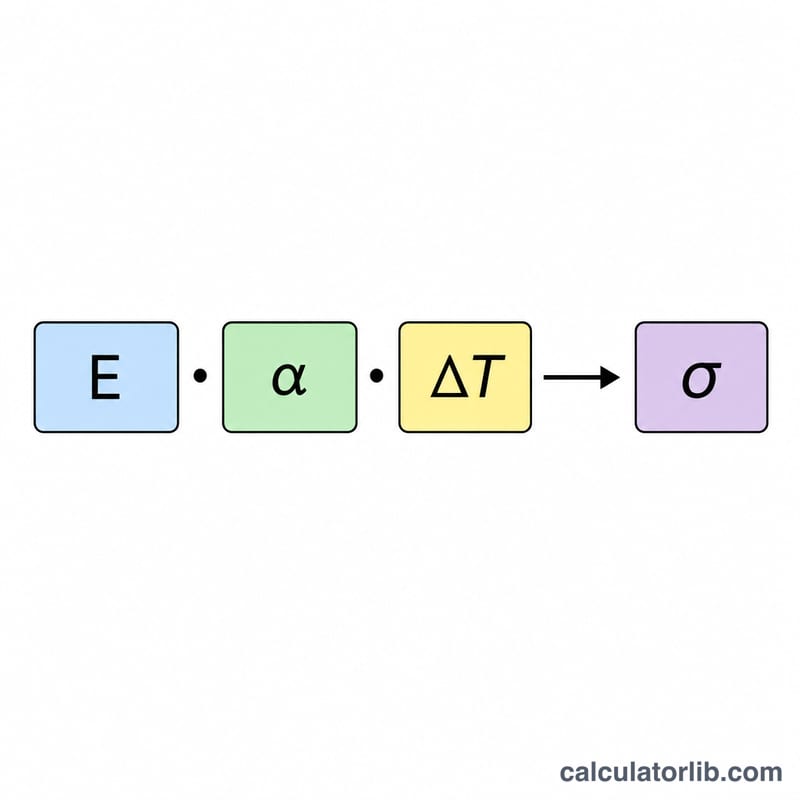
The governing equation is $$\sigma = E \cdot \alpha \cdot \Delta T.$$ The free thermal strain is \(\varepsilon = \alpha \cdot \Delta T\). When fully restrained, that strain is converted entirely into stress through Hooke's law \(\sigma = E \cdot \varepsilon\), giving \(\sigma = E \cdot \alpha \cdot \Delta T\). The calculator converts E from GPa to MPa (\(\times 1000\)) and α from \(\times 10^{-6}\) to base units before multiplying, so the answer lands in MPa.
Worked Example
For structural steel: E = 200 GPa, α = 12×10⁻⁶ /°C, ΔT = 50 °C. Then $$\sigma = 200{,}000 \text{ MPa} \times 0.000012 \times 50 = 120 \text{ MPa}.$$ A 50 °C temperature swing in a fully fixed steel bar produces about 120 MPa — a significant fraction of typical yield strength, which is why expansion joints exist.
FAQ
Does length matter? No. For a fully constrained member the stress depends only on E, α, and ΔT — length cancels out. Length affects the free expansion, not the constrained stress.
What if the member is only partially restrained? Then only the prevented portion of the strain becomes stress, so actual stress is lower than this maximum.
Is the result compression or tension? Heating a restrained member gives compression; cooling gives tension. This tool reports the magnitude.