
What Is Torsional Stiffness?
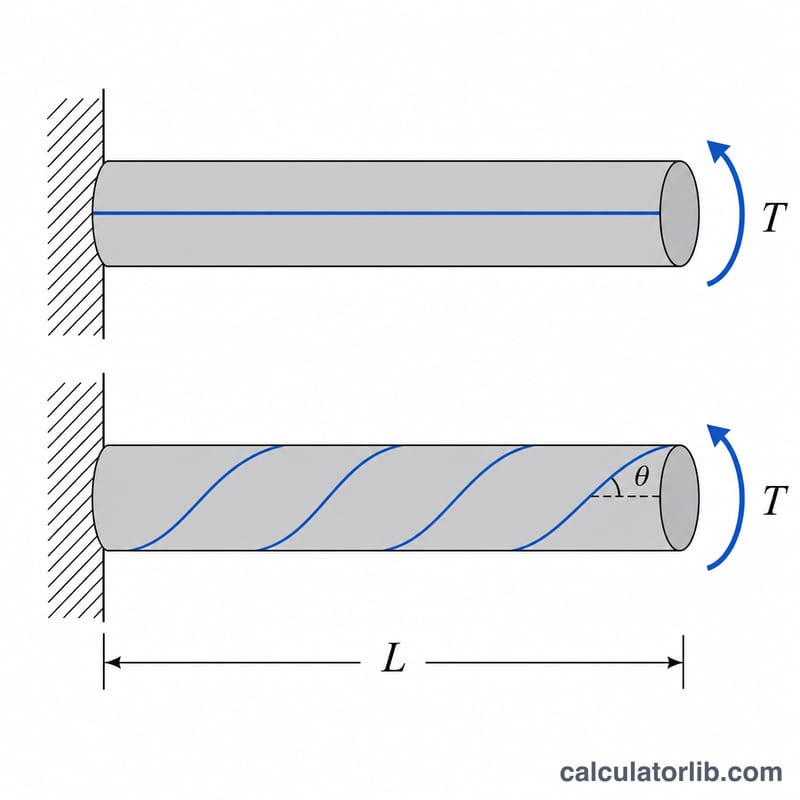
Torsional stiffness (\(k_t\)) measures how strongly a shaft or structural member resists twisting under an applied torque. A stiffer member rotates less for the same torque. It is a key property in drivetrains, chassis design, drill strings, and any rotating machinery where deflection and resonance matter. This calculator is universal — it works with any consistent material and geometry, using SI-derived units.
How to Use the Calculator
Enter three values: the shear modulus G of the material in GPa (steel ≈ 79 GPa, aluminium ≈ 26 GPa), the polar moment of inertia J of the cross-section in mm⁴, and the effective length L in mm. The calculator returns the torsional stiffness in N·mm/rad, N·m/rad, and N·m per degree of twist.
The Formula Explained
The governing equation is:
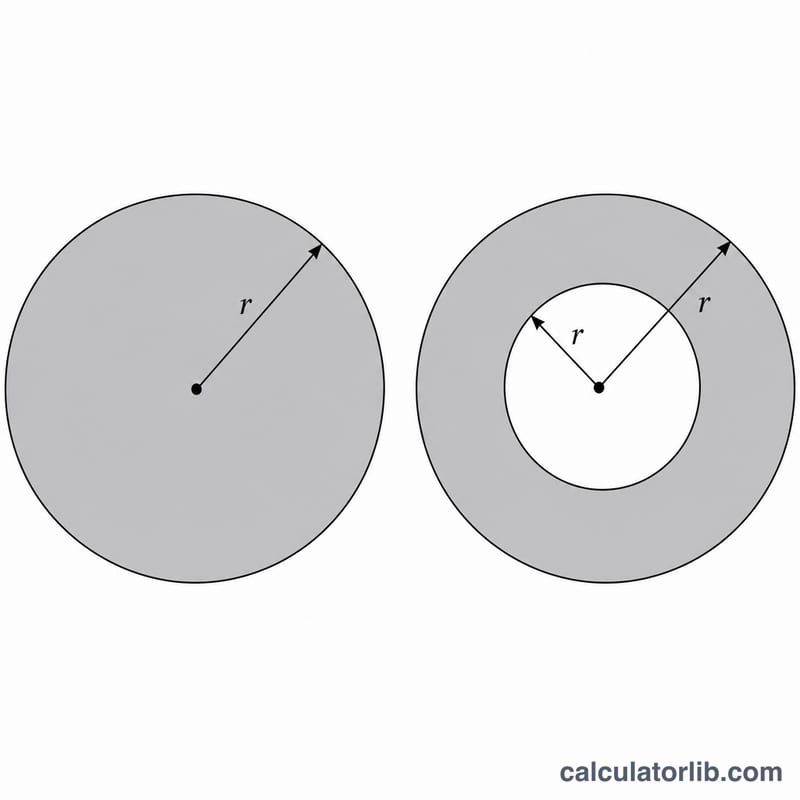
$$k_t = \frac{G \cdot J}{L} = \frac{T}{\theta}$$Here \(G \cdot J\) is the torsional rigidity of the section. Dividing by length \(L\) gives stiffness — torque per unit angle. Because \(k_t\) also equals \(T/\theta\), you can predict the angle of twist for any torque: \(\theta = T / k_t\). For a solid circular shaft, \(J = \pi d^4/32\); for a hollow shaft, \(J = \pi(D^4 - d^4)/32\).
Worked Example
A steel shaft (\(G = 79\ \text{GPa} = 79{,}000\ \text{N/mm}^2\)) has \(J = 100{,}000\ \text{mm}^4\) and length \(L = 500\ \text{mm}\). Then $$k_t = \frac{79{,}000 \times 100{,}000}{500} = 15{,}800{,}000\ \text{N}\cdot\text{mm/rad} = 15{,}800\ \text{N}\cdot\text{m/rad}.$$ Per degree, that is \(15{,}800 \times \pi/180 \approx 275.7\ \text{N}\cdot\text{m/deg}\).
FAQ
What units does this use? G in GPa, J in mm⁴, L in mm. Internally G is converted to N/mm², so results are in N·mm/rad and N·m/rad.
How do I find J? For a solid round shaft \(J = \pi d^4/32\). For other sections, use the appropriate polar moment of area formula.
How does stiffness relate to twist angle? \(\theta = T / k_t\). A higher \(k_t\) means a smaller twist angle for the same torque.