
What Is Rotational Stiffness?
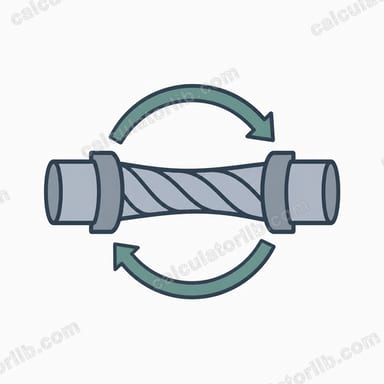
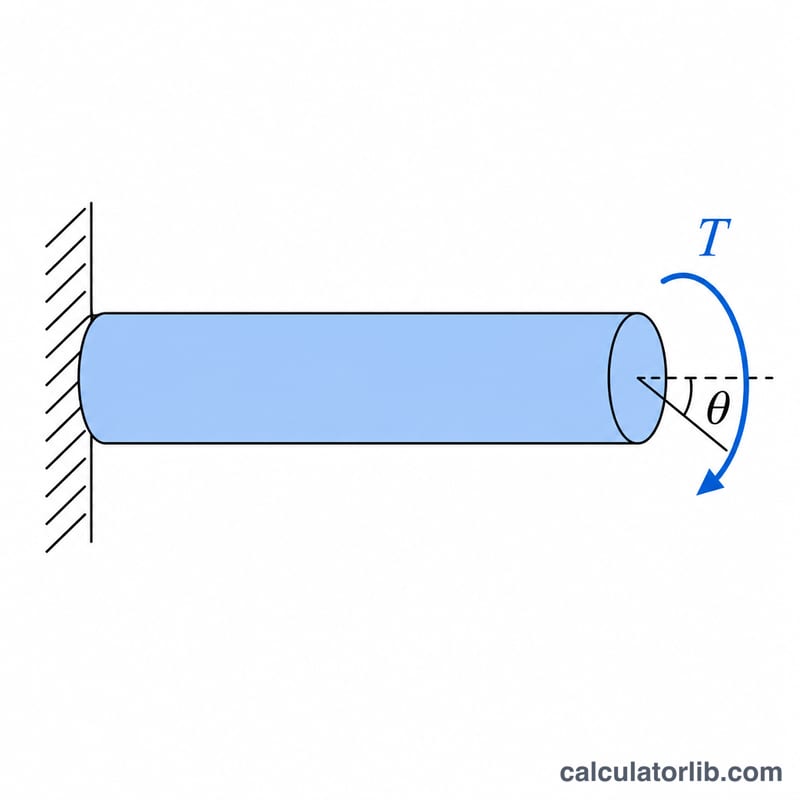
Rotational stiffness (also called torsional or angular stiffness) measures how strongly a structural element, shaft, joint, or spring resists being twisted. It is defined as the ratio of an applied moment (torque) to the angular rotation it produces. A high stiffness means the element rotates very little under a given torque; a low stiffness means it twists easily. The standard unit is newton-metres per radian (\(\text{N}\cdot\text{m}/\text{rad}\)).
How to Use This Calculator
Enter the applied torque T in newton-metres and the resulting angular deflection θ in radians. The calculator divides torque by deflection to return the rotational stiffness. If your angle is in degrees, convert it to radians first by multiplying by \(\pi/180\) (about \(0.01745\)).
The Formula Explained
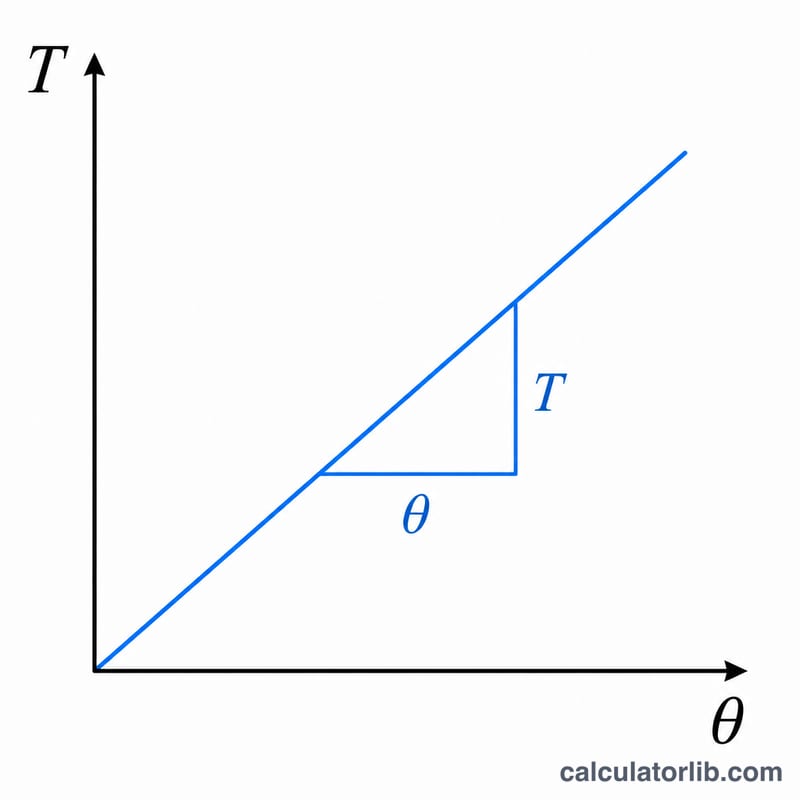
The governing equation is $$k = \frac{T}{\theta}$$ where:
• k = rotational stiffness (\(\text{N}\cdot\text{m}/\text{rad}\))
• T = applied torque or moment (\(\text{N}\cdot\text{m}\))
• θ = angular deflection (radians)
This is the rotational analogue of linear spring stiffness (\(k = F / x\)). Within the elastic range, torque and rotation are proportional, so stiffness is constant.
Worked Example
Suppose a shaft carries a torque of 100 N·m and twists by 0.05 radians. Then $$k = \frac{100}{0.05} = 2000 \ \text{N}\cdot\text{m}/\text{rad}$$ This shaft requires 2000 N·m of torque for every radian of rotation, indicating a fairly stiff member.
FAQ
What units should I use? Use newton-metres for torque and radians for the angle to get stiffness in \(\text{N}\cdot\text{m}/\text{rad}\).
My angle is in degrees — what do I do? Convert to radians: \(\text{radians} = \text{degrees} \times \pi / 180\). For example, \(2.86^\circ \approx 0.05 \ \text{rad}\).
Does this work for springs and beams? Yes. Any element exhibiting a linear moment–rotation relationship in its elastic range can be characterised by this stiffness.