
What Is Angular Resolution?
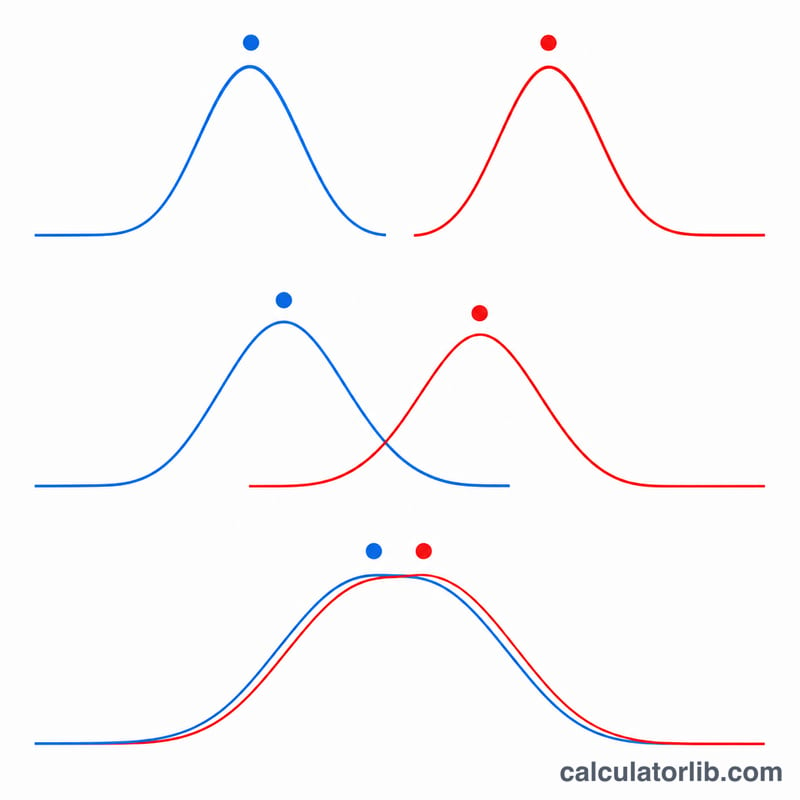
Angular resolution is the smallest angle between two distinct points that an optical instrument — a telescope, camera lens, microscope, or eye — can clearly separate. The fundamental limit is set by diffraction: light bending around the edge of a circular aperture. This calculator applies the Rayleigh criterion to find that diffraction-limited resolving power for any wavelength and aperture diameter.
How to Use the Calculator
Enter the wavelength of the light in nanometers (visible light is roughly 400–700 nm; 550 nm is a common green reference) and the diameter of the aperture in meters (for a telescope, this is the mirror or lens diameter). The calculator returns the minimum resolvable angle in radians and in arcseconds, where a smaller angle means finer detail can be distinguished.
The Formula Explained
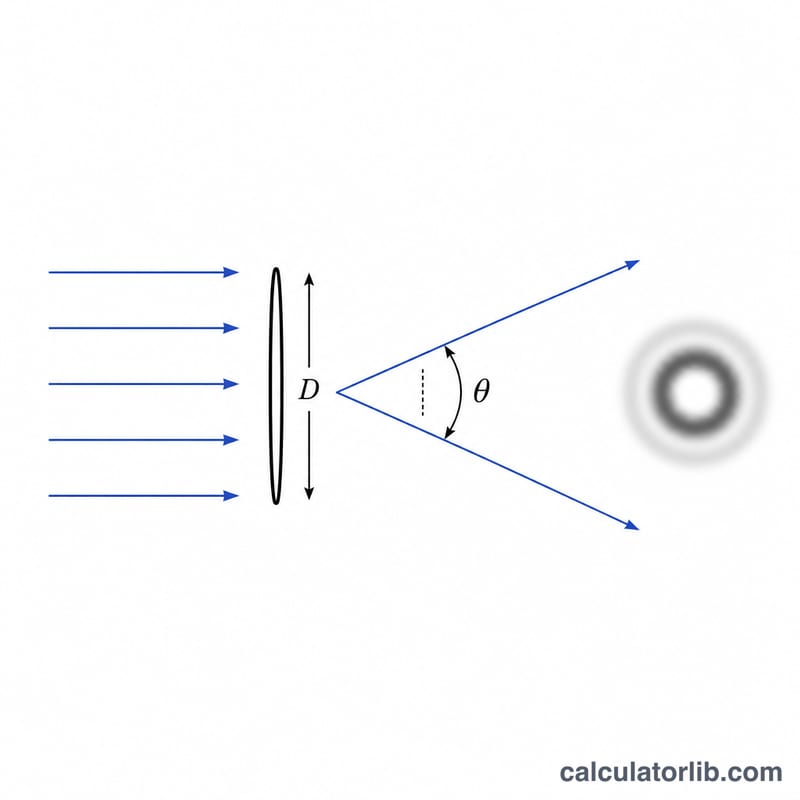
The Rayleigh criterion is $$\theta = 1.22 \times \frac{\text{Wavelength (nm)} \times 10^{-9}}{\text{Aperture Diameter (m)}}$$ where \(\theta\) is the angular resolution in radians, \(\lambda\) is the wavelength, \(D\) is the aperture diameter, and \(1.22\) is a constant derived from the first zero of the Airy diffraction pattern of a circular aperture. To convert radians to arcseconds, multiply by 206,265 (the number of arcseconds in one radian).
Worked Example
Consider a telescope with a 0.1 m aperture observing green light at \(\lambda = 550 \text{ nm} = 550 \times 10^{-9} \text{ m}\). Then $$\theta = 1.22 \times \frac{550 \times 10^{-9}}{0.1} = 6.71 \times 10^{-6} \text{ radians}$$ Converting: \(6.71 \times 10^{-6} \times 206265 \approx 1.38\) arcseconds. So this telescope can just separate two stars 1.38 arcseconds apart.
Constants & Reference Values
The Rayleigh criterion for a circular aperture is \(\theta = 1.22\,\lambda / D\), where \(\theta\) is the minimum resolvable angular separation (radians), \(\lambda\) is the wavelength of light, and \(D\) is the aperture diameter. The constants and reference values below are used in the calculation and in converting the result to practical units.
| Quantity | Value | Notes |
|---|---|---|
| Airy/Bessel diffraction factor | 1.22 | Dimensionless. Comes from the first zero of the Airy diffraction pattern (first zero of the Bessel function \(J_1\) at \(\approx 3.8317\), and \(3.8317/\pi \approx 1.2197\)). |
| Arcseconds per radian | 206265 | \(1\text{ rad} = \dfrac{180}{\pi}\times 3600 \approx 206265''\). Multiply a result in radians by this to get arcseconds. |
| Green reference wavelength | 550 nm | Common default for visible-light resolution near the peak sensitivity of the human eye (\(550\text{ nm} = 5.5\times10^{-7}\,\text{m}\)). |
| Visible band | 400–700 nm | Approximate range of human-visible wavelengths (violet to deep red). |
| Wavelength units (\(\lambda\)) | nm (input), m (formula) | Enter wavelength in nanometers; the calculator multiplies by \(10^{-9}\) to convert to meters before dividing. |
| Aperture units (\(D\)) | meters | Enter the clear aperture diameter in meters (e.g. a 200 mm telescope = 0.2 m). |
FAQ
Why 1.22? It comes from the first minimum of the Airy pattern (the 1.22 factor relates to the Bessel function zero) produced by a circular aperture.
Does a bigger aperture help? Yes. Resolution improves (the angle gets smaller) as aperture diameter increases, which is why large telescopes resolve finer detail.
Why does shorter wavelength resolve better? Because \(\theta\) is proportional to \(\lambda\), blue light (shorter wavelength) gives finer resolution than red light for the same aperture.