
What Is Angular Displacement?
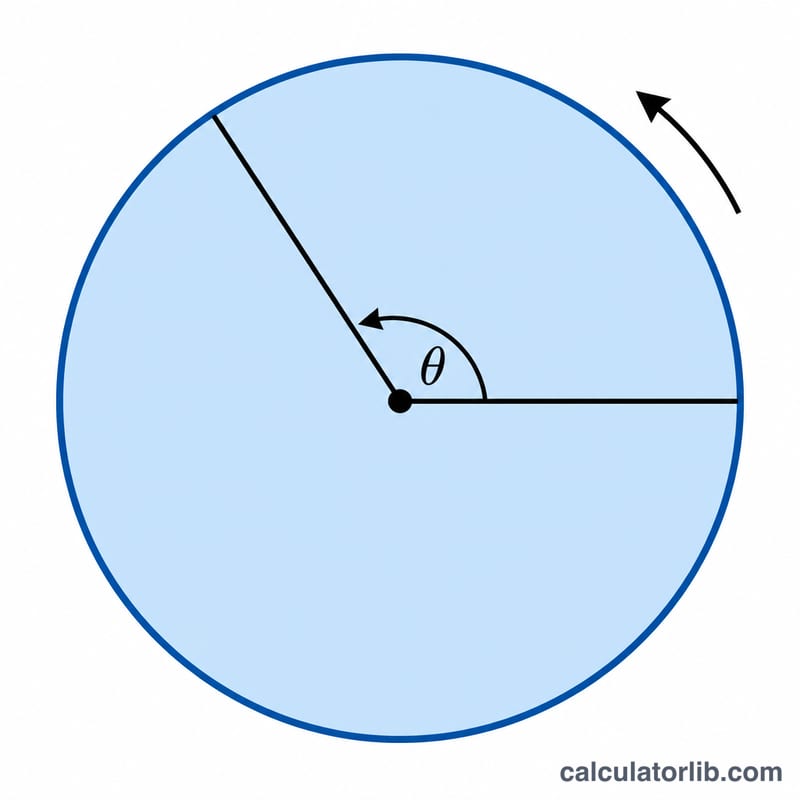
Angular displacement (\(\theta\)) is the angle through which a rotating object turns about an axis, measured in radians. This calculator uses the rotational kinematics equation $$\theta = \omega_i \, t + \frac{1}{2} \alpha \, t^{2}$$ to find that angle from an initial angular velocity, a constant angular acceleration, and the elapsed time. It is the rotational analogue of the linear equation \(s = u_i t + \frac{1}{2} a t^{2}\).
How to Use the Calculator
Enter the initial angular velocity \(\omega_i\) in radians per second, the constant angular acceleration \(\alpha\) in radians per second squared, and the time \(t\) in seconds. The tool returns the angular displacement in radians, and conveniently converts it to degrees (\(\times\, 180/\pi\)) and full revolutions (\(\div\, 2\pi\)). It also reports the final angular velocity \(\omega_f = \omega_i + \alpha t\).
The Formula Explained
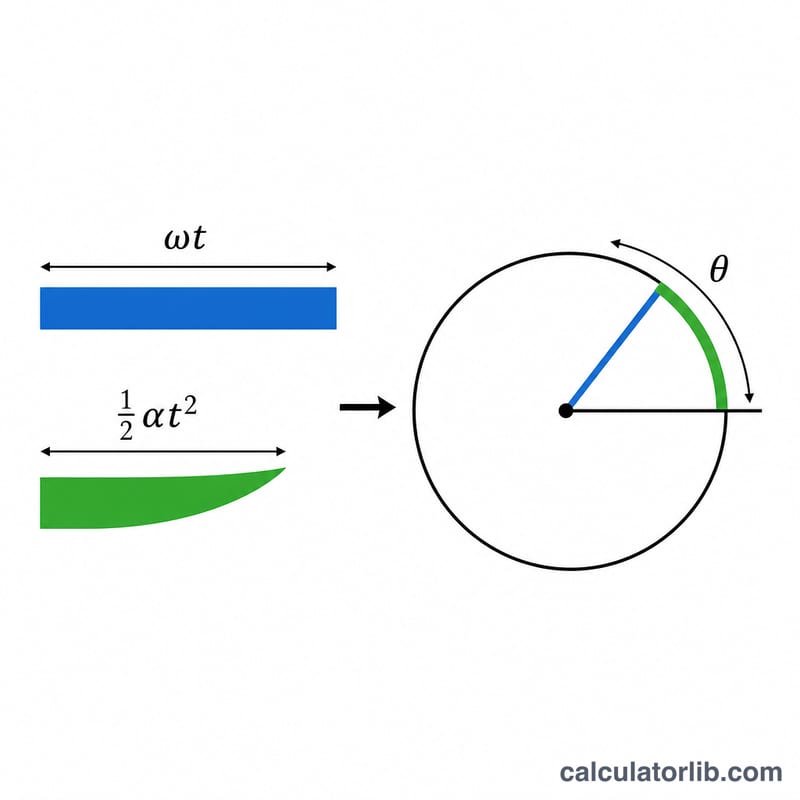
The first term, \(\omega_i t\), accounts for the angle covered if the object kept spinning at its starting speed. The second term, \(\frac{1}{2}\alpha t^{2}\), adds the extra angle produced by the acceleration over time. Together they give the total angle for motion under constant angular acceleration. If \(\alpha\) is zero, the object rotates uniformly and \(\theta = \omega_i t\).
Worked Example
A wheel starts at \(\omega_i = 2 \text{ rad/s}\) and accelerates at \(\alpha = 1.5 \text{ rad/s}^2\) for \(t = 4 \text{ s}\). Then $$\theta = 2 \times 4 + \frac{1}{2} \times 1.5 \times 4^{2} = 8 + 12 = 20 \text{ radians}.$$ That equals about \(1145.92^\circ\) or roughly \(3.18\) revolutions, and the wheel's final speed is \(\omega_f = 2 + 1.5 \times 4 = 8 \text{ rad/s}\).
Key Terms & Variables
The kinematic equation \(\theta = \omega_i t + \tfrac{1}{2}\alpha t^2\) relates the following rotational quantities. All SI units are based on the radian.
| Symbol | Quantity | SI Unit | Description |
|---|---|---|---|
| \(\theta\) | Angular displacement | rad | The angle through which the object rotates during time \(t\); the output of this calculator. |
| \(\omega_i\) | Initial angular velocity | rad/s | The rotational speed at the start of the time interval (\(t = 0\)). |
| \(\omega_f\) | Final angular velocity | rad/s | The rotational speed at the end of the interval, where \(\omega_f = \omega_i + \alpha t\). |
| \(\alpha\) | Angular acceleration | rad/s² | The rate of change of angular velocity. Positive values speed up rotation; negative values slow it down. |
| \(t\) | Time | s | The duration of the rotational motion over which displacement accumulates. |
These quantities are the rotational analogues of linear displacement, velocity, acceleration and time. If you know the start and end angular velocities and the time, you can find \(\alpha\) with the angular acceleration calculator instead.
FAQ
What units should I use? Use SI units: radians, rad/s and rad/s\(^2\). Results stay consistent in radians and are also shown in degrees and revolutions.
Does this assume constant acceleration? Yes. The equation \(\theta = \omega_i t + \frac{1}{2}\alpha t^{2}\) is valid only when angular acceleration \(\alpha\) is constant throughout the time interval.
How do I convert radians to degrees? Multiply radians by \(180/\pi \approx 57.2958\). To get revolutions, divide radians by \(2\pi\).