What Is Centripetal Force?
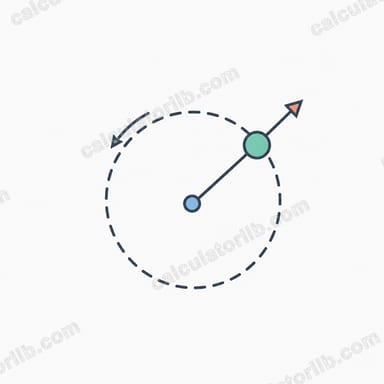
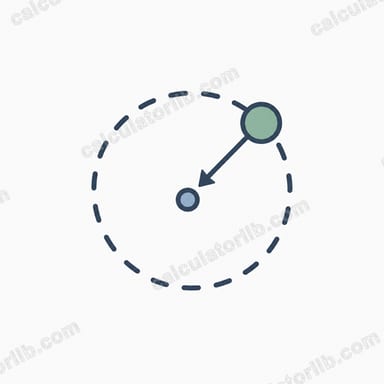
Centripetal force is the net inward force required to keep an object moving along a circular path. Without it, the object would fly off in a straight line according to Newton's first law. It always points toward the center of the circle and depends on the object's mass, its speed, and the radius of the curve. This calculator is a universal physics tool — it works with any consistent SI inputs.

How to Use This Calculator
Enter the object's mass in kilograms, its tangential velocity in meters per second, and the radius of the circular path in meters. The calculator returns the centripetal force in newtons (N) along with the centripetal acceleration in meters per second squared (m/s²).
The Formula Explained
The centripetal force is given by $$F = \frac{m \cdot v^{2}}{r}$$ where \(m\) is mass, \(v\) is speed, and \(r\) is the radius. Because velocity is squared, doubling the speed quadruples the force needed. A tighter curve (smaller \(r\)) also demands more force. The related centripetal acceleration is $$a = \frac{v^{2}}{r}$$ so \(F = m \cdot a\), consistent with Newton's second law.

Worked Example
A 2 kg ball is whirled in a circle of radius 4 m at 5 m/s. Then $$F = \frac{2 \times 5^{2}}{4} = \frac{2 \times 25}{4} = \frac{50}{4} = 12.5 \text{ N}.$$ The centripetal acceleration is $$a = \frac{25}{4} = 6.25 \text{ m/s}^{2}.$$
Unit Conversions for Speed, Mass and Radius
The formula \(F = \frac{mv^2}{r}\) gives force in newtons only when mass is in kilograms, speed in metres per second and radius in metres. Convert other units to SI first.
| Quantity | Unit | Equals (SI) |
|---|---|---|
| Speed | 1 km/h | 0.27778 m/s |
| Speed | 1 mph | 0.44704 m/s |
| Speed | 1 knot | 0.51444 m/s |
| Mass | 1 g | 0.001 kg |
| Mass | 1 lb | 0.45359 kg |
| Radius | 1 cm | 0.01 m |
| Radius | 1 km | 1000 m |
| Radius | 1 ft | 0.3048 m |
Output conversions
| From | To |
|---|---|
| 1 N | 0.22481 lbf |
| 1 kN | 1000 N |
| Acceleration in m/s² | Divide by 9.80665 to get acceleration in g |
Quick example
A speed of 72 km/h is 72 × 0.27778 ≈ 20 m/s (equivalently 72 ÷ 3.6 = 20). A 1000 kg car travelling at 20 m/s around a bend of radius 50 m needs:
$$F = \frac{1000 \cdot 20^2}{50} = \frac{400000}{50} = 8000\ \text{N}$$
So the force is 8000 N, which is 8 kN, or about 1798.5 lbf (8000 × 0.22481). The centripetal acceleration is \(a = v^2/r = 400/50 = 8\ \text{m/s}^2\), which is 8 ÷ 9.80665 ≈ 0.82 g.
Key Terms and Variables
- Centripetal force (F, newtons, N): the net force directed toward the centre of a circular path that keeps an object moving along the curve. It is not a separate kind of force; it is the name for the inward net force.
- Mass (m, kg): the amount of matter in the object, which sets its resistance to changes in motion (its inertia).
- Tangential speed (v, m/s): the object's speed along the circular path. Its direction is tangent to the circle.
- Radius of curvature (r, m): the distance from the centre of the circular path to the object. For a non-circular curve, it is the radius of the circle that best fits the curve at that point.
- Centripetal acceleration (a, m/s²): the inward acceleration, \(a = \frac{v^2}{r}\), so that \(F = ma\).
- Angular velocity (ω, rad/s): the rate of rotation, related to speed by \(v = \omega r\).
- Period (T, s): the time for one full revolution, with \(v = \frac{2\pi r}{T}\).
Equivalent forms
Substituting \(v = \omega r\) or \(v = 2\pi r/T\) into \(F = mv^2/r\) gives:
$$F = \frac{mv^2}{r} = m\omega^2 r = \frac{4\pi^2 m r}{T^2}$$
Net force vs. individual forces
Centripetal force is the net inward force, the vector sum of the real forces acting on the object. These real forces include tension (a ball on a string), friction (a car on a flat curve), gravity (a satellite in orbit), and the normal force (a banked road or a loop-the-loop track). Each situation uses a different force or combination of forces to supply the required \(mv^2/r\). Do not add centripetal force to a free-body diagram as an extra force.
FAQ
Is centripetal force a new kind of force? No. It is the name for whatever real force (tension, gravity, friction, normal force) acts inward to maintain circular motion.
What is the difference between centripetal and centrifugal force? Centripetal force is the real inward force. Centrifugal "force" is an apparent outward force felt only in a rotating reference frame.
What units should I use? Use kilograms, meters per second, and meters to get force in newtons (SI units).