
What Is the Damping Ratio?
The damping ratio (\(\zeta\), "zeta") is a dimensionless number that describes how oscillations in a mechanical or electrical system decay after a disturbance. For a single-degree-of-freedom mass-spring-damper system it compares the actual damping coefficient c to the critical damping coefficient. It is one of the most important parameters in vibration analysis, control systems, and structural engineering.
How to Use This Calculator
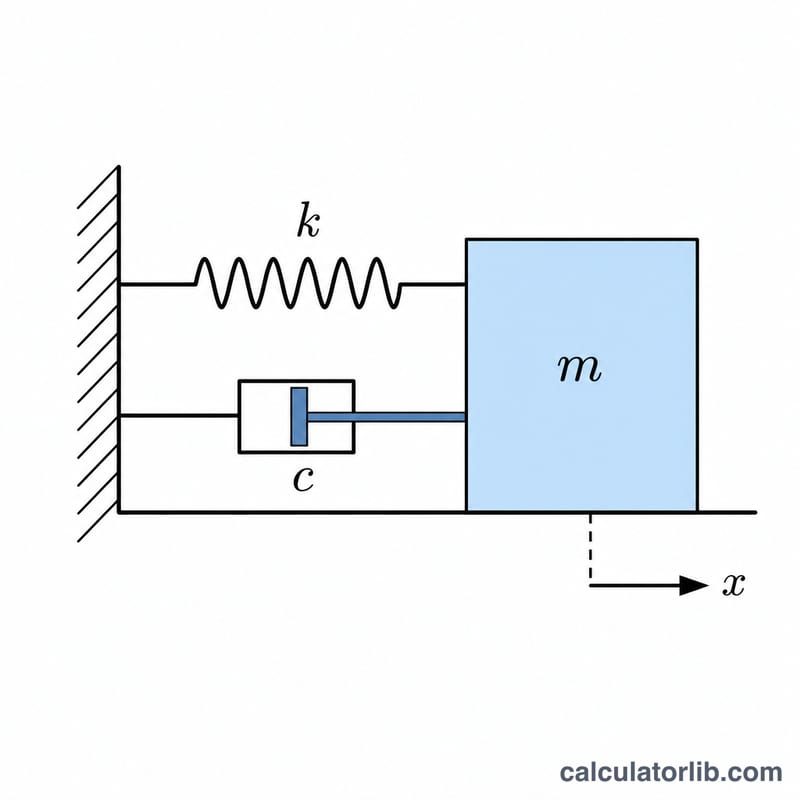
Enter the damping coefficient c (N·s/m), the spring stiffness k (N/m), and the mass m (kg). The calculator returns the damping ratio \(\zeta\), the critical damping coefficient, the undamped natural frequency, and tells you whether the system is underdamped, critically damped, or overdamped.
The Formula Explained
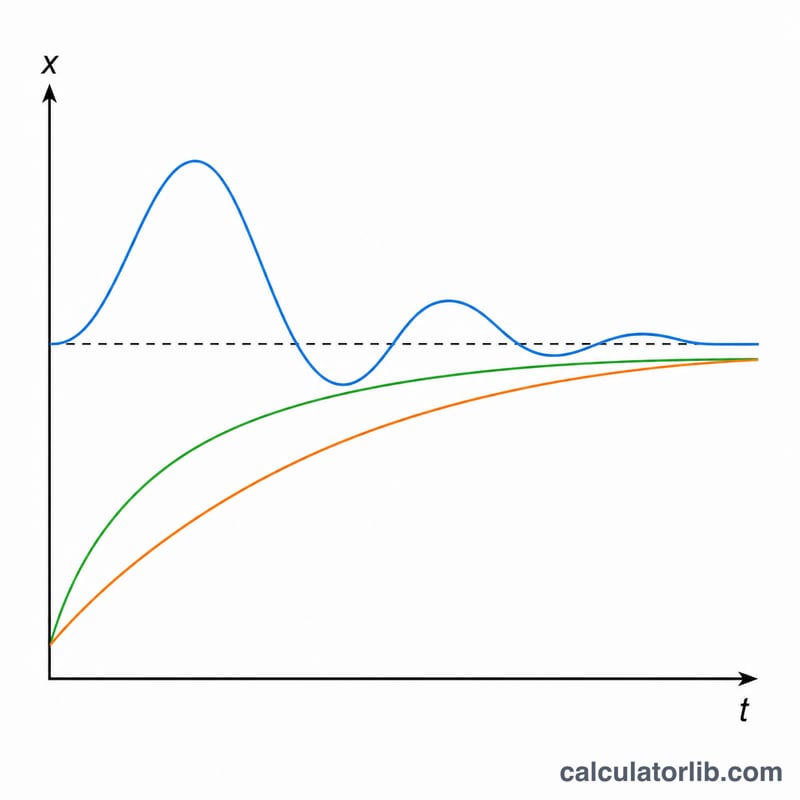
The damping ratio is calculated as $$\zeta = \frac{\text{Damping } c}{2\sqrt{\text{Stiffness } k \cdot \text{Mass } m}}$$ The denominator, \(2\sqrt{k \cdot m}\), is the critical damping coefficient cᶜ — the smallest amount of damping that prevents oscillation. When \(\zeta < 1\) the system oscillates while decaying (underdamped); when \(\zeta = 1\) it returns to equilibrium as fast as possible without oscillating (critically damped); and when \(\zeta > 1\) it returns slowly without oscillating (overdamped).
Worked Example
Suppose c = 20 N·s/m, k = 100 N/m, and m = 10 kg. First compute \(k \cdot m = 1000\), then \(\sqrt{1000} \approx 31.6228\), so the critical damping coefficient is \(2 \times 31.6228 \approx 63.2456 \text{ N}\cdot\text{s/m}\). The damping ratio is $$\zeta = \frac{20}{63.2456} \approx 0.3162$$ which is less than 1 — the system is underdamped and will oscillate as it settles.
FAQ
What does a damping ratio of 1 mean? It means the system is critically damped: it returns to rest in the shortest possible time without overshooting.
Is a higher damping ratio always better? Not necessarily. Very high damping (overdamped) makes a system sluggish. Many control systems target \(\zeta \approx 0.7\) for a fast response with minimal overshoot.
Can the damping ratio be negative? A negative \(\zeta\) indicates an unstable system where oscillations grow over time. This calculator assumes positive physical values.