
What Is a Physical Pendulum?
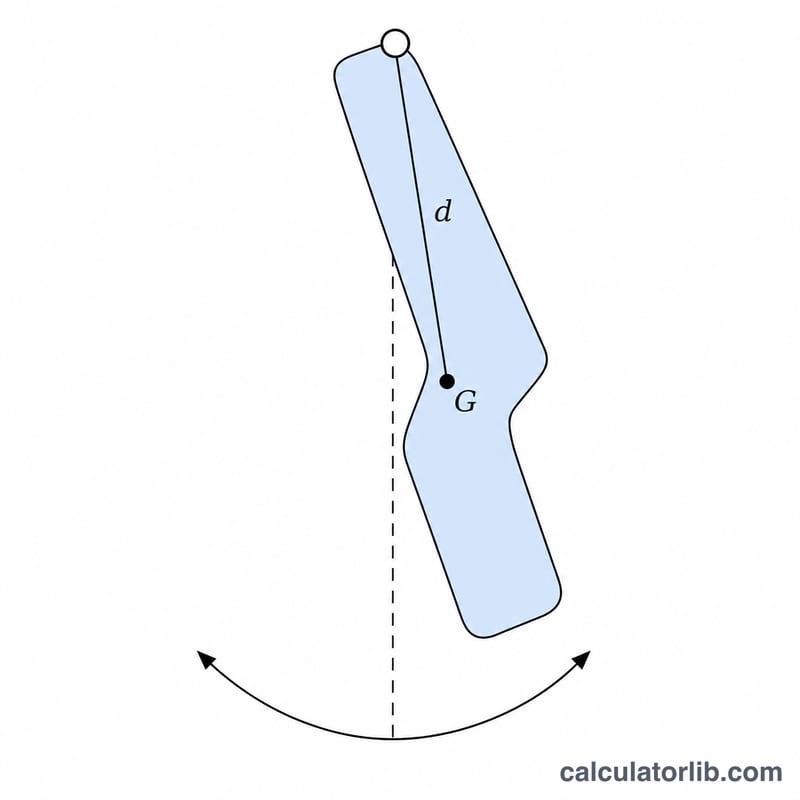
A physical pendulum is any rigid body that swings about a fixed horizontal axis under gravity — unlike a simple pendulum, its mass is distributed rather than concentrated at a single point. Examples include a swinging rod, a clock pendulum, or a hanging sign. The motion is governed by the body's moment of inertia about the pivot and the location of its center of mass.
The Formula
For small-angle oscillations the period is:
$$T = 2\pi \sqrt{\dfrac{\text{Inertia } I}{\text{Mass } m \cdot \text{Gravity } g \cdot \text{Distance } d}}$$
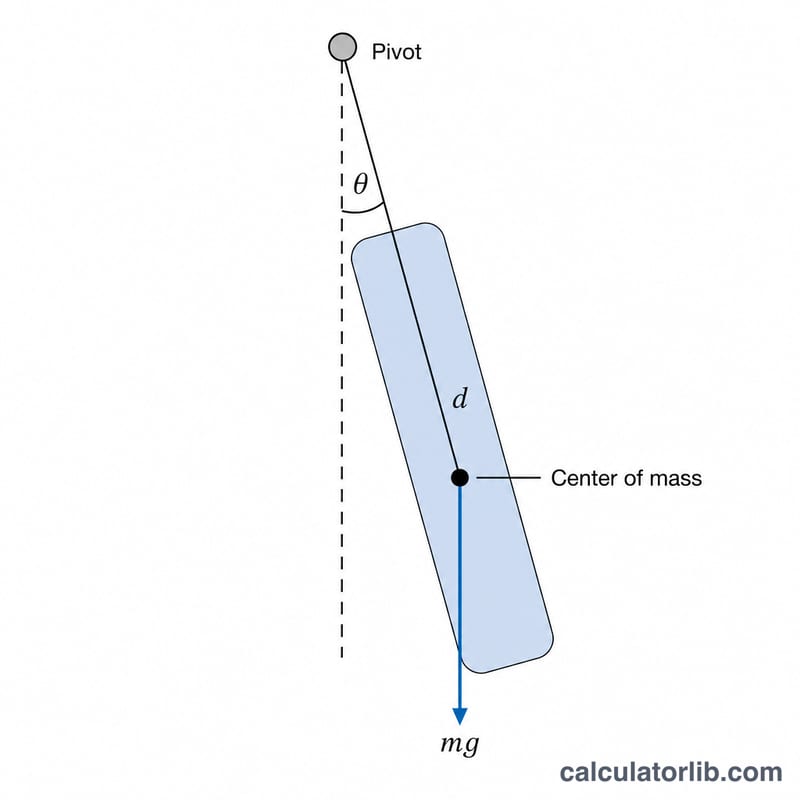
where I is the moment of inertia about the pivot axis (kg·m²), m is the total mass (kg), g is the gravitational acceleration (9.81 m/s² on Earth), and d is the distance from the pivot to the center of mass (m). The frequency is simply \(f = 1/T\).
How to Use the Calculator
Enter the moment of inertia about the pivot, the body's mass, the pivot-to-center-of-mass distance, and the local gravity. The calculator returns the period in seconds and the frequency in hertz. Make sure I is measured about the actual swing axis — use the parallel-axis theorem (\(I = I_{cm} + m \cdot d^2\)) if you only know the inertia about the center of mass.
Worked Example
Suppose I = 0.5 kg·m², m = 2 kg, d = 0.3 m, g = 9.81 m/s². Then \(m \cdot g \cdot d = 2 \times 9.81 \times 0.3 = 5.886\). So $$T = 2\pi \sqrt{\dfrac{0.5}{5.886}} = 2\pi \times \sqrt{0.084947} = 2\pi \times 0.29146 \approx 1.8313 \text{ seconds}$$ giving a frequency of about 0.546 Hz.
FAQ
Does this work for large swing angles? No — the formula assumes small oscillations (a few degrees). Larger amplitudes lengthen the true period.
What's the difference from a simple pendulum? A simple pendulum uses \(T = 2\pi \sqrt{\dfrac{L}{g}}\), valid only for a point mass on a massless string. The physical pendulum generalizes this to extended rigid bodies.
How do I get the moment of inertia about the pivot? Use the parallel-axis theorem: add \(m \cdot d^2\) to the inertia about the center of mass.