
What is the harmonic wave equation?
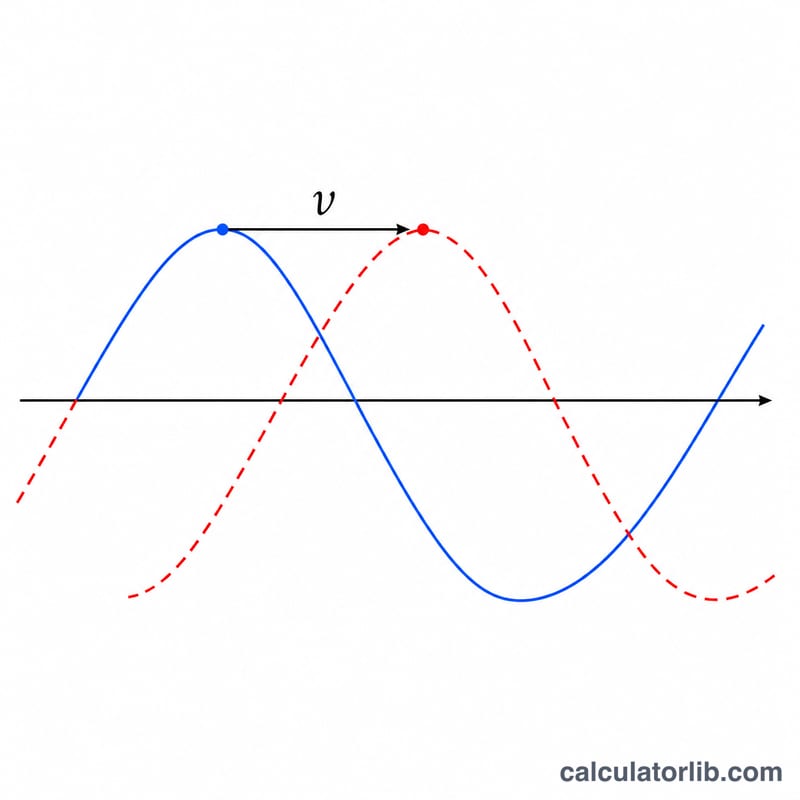
A harmonic (sinusoidal) traveling wave is described by \( y(x, t) = A \sin(kx - \omega t + \varphi) \). It models the transverse displacement y of any point on a one-dimensional medium — a string, a sound column, or an electromagnetic field component — as it varies with position x and time t. The minus sign in front of ωt produces a wave traveling in the positive x-direction.
$$ y(x, t) = A \sin\!\left( kx - \omega t + \varphi \right) $$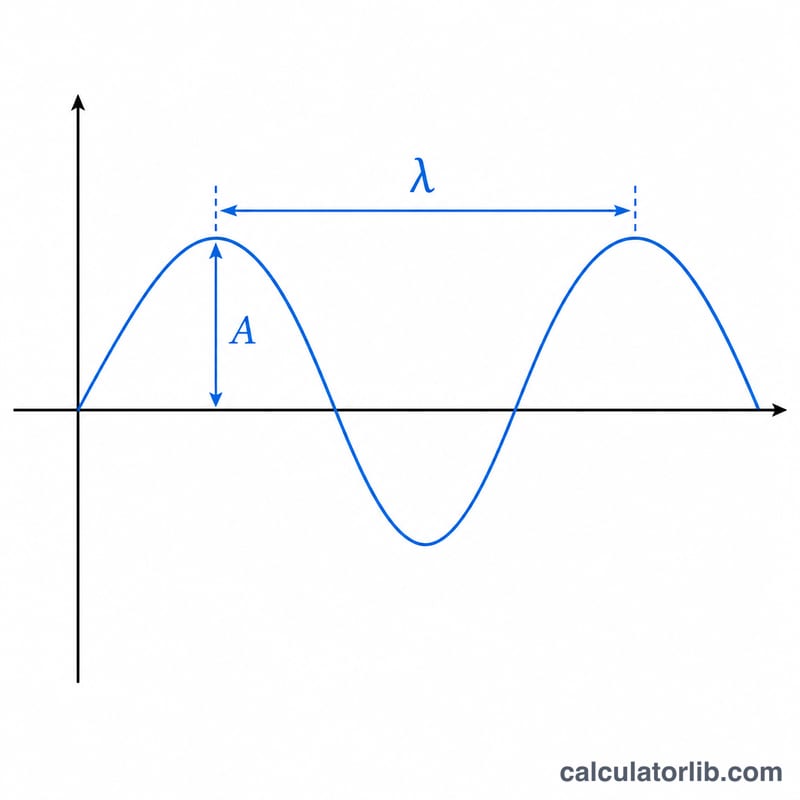
What the symbols mean
A is the amplitude (maximum displacement). k is the angular wave number in rad/m, related to wavelength by \( k = 2\pi/\lambda \). ω is the angular frequency in rad/s, related to frequency by \( \omega = 2\pi f \). φ is the phase constant in radians, which shifts the wave at \( t = 0 \) and \( x = 0 \).
How to use the calculator
Enter the amplitude, wave number k, angular frequency ω, phase constant φ, and the position x and time t you want to evaluate. The calculator returns the instantaneous displacement plus the wave's wavelength, frequency, period and phase speed. All angle quantities are in radians.
Worked example
Take \( A = 0.05 \ \text{m} \), \( k = 2 \ \text{rad/m} \), \( \omega = 3 \ \text{rad/s} \), \( \varphi = 0 \), at \( x = 1 \ \text{m} \) and \( t = 0 \ \text{s} \). The phase is $$ kx - \omega t + \varphi = 2(1) - 3(0) + 0 = 2 \ \text{rad}. $$ So $$ y = 0.05 \cdot \sin(2) = 0.05 \times 0.909297 \approx \mathbf{0.0454649 \ \text{m}}. $$ The wavelength is \( 2\pi/2 \approx 3.1416 \ \text{m} \), the frequency is \( 3/2\pi \approx 0.4775 \ \text{Hz} \), the period is \( 2\pi/3 \approx 2.0944 \ \text{s} \), and the wave speed is \( 3/2 = 1.5 \ \text{m/s} \).
FAQ
Do I use degrees or radians? Radians. The sine function operates on the phase expressed in radians, and k, ω and φ are all in radian-based units.
What if I want a wave moving in the −x direction? Use a plus sign: \( y = A \sin(kx + \omega t + \varphi) \). You can mimic this by entering a negative ω.
Why is wave speed \( v = \omega/k \)? A point of constant phase satisfies \( kx - \omega t = \text{const} \), so \( dx/dt = \omega/k \). This phase velocity equals \( \lambda \cdot f \).