
What Is the Aperture Area Calculator?
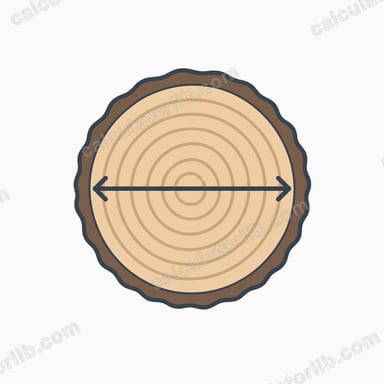
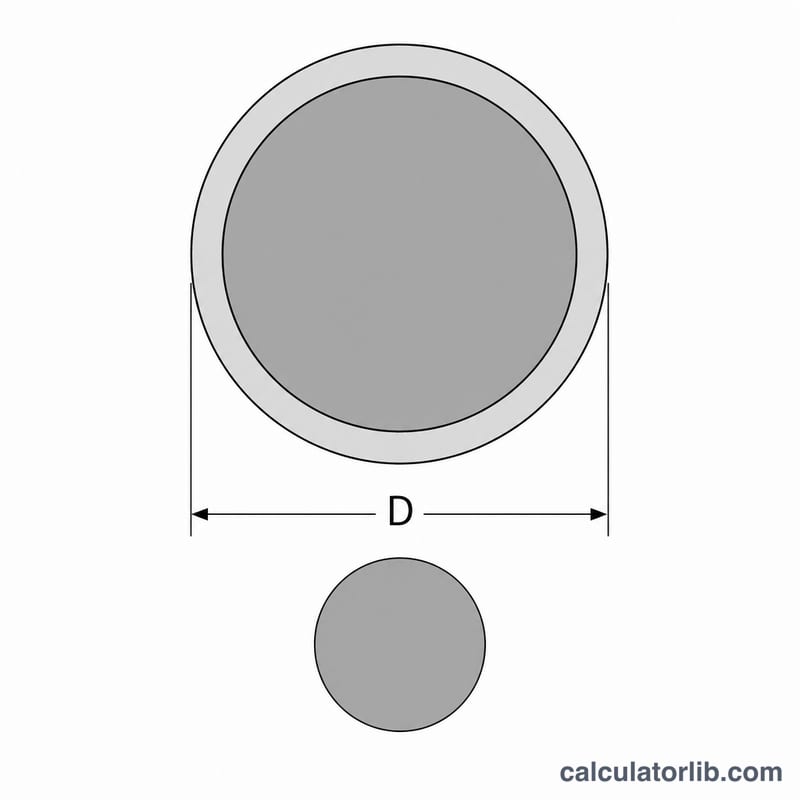
An aperture is any circular opening — a camera lens diaphragm, a pipe bore, a nozzle, a porthole, or a hole in a plate. The aperture area is the surface area of that circular opening. This calculator converts a diameter into its exact area, which is essential for working out light gathering, flow rates, pressure drops, and material requirements.
How to Use It
Enter the aperture diameter in millimetres and press calculate. The tool returns the area in square millimetres (mm²) and square centimetres (cm²), plus the radius. Because the relationship is purely geometric, the result applies to any circular opening regardless of context.
The Formula Explained
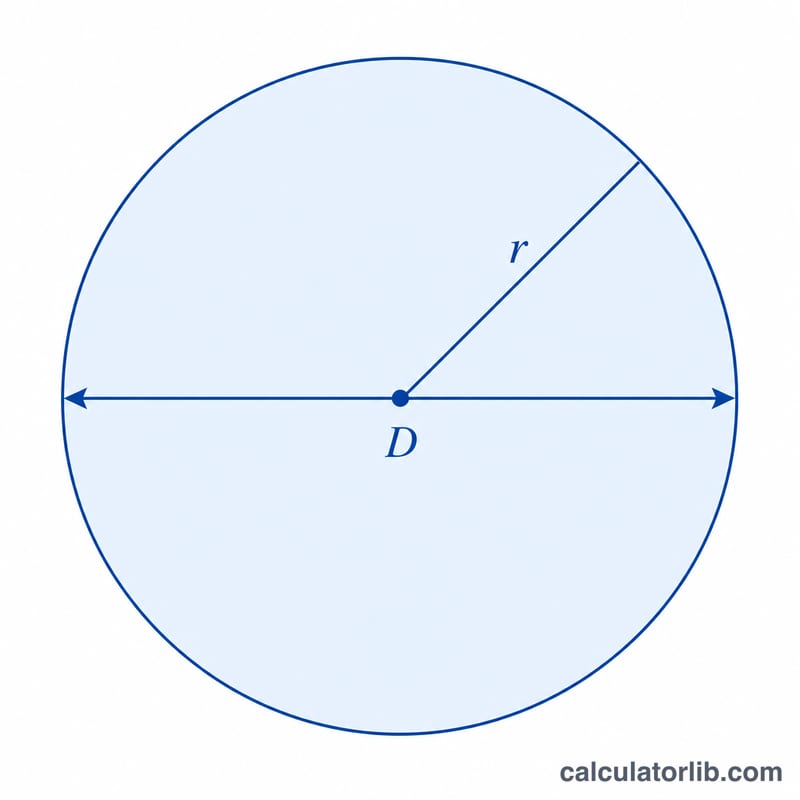
A circle's area equals pi times the radius squared. Since the radius is half the diameter, the formula becomes $$A = \pi\left(\frac{D}{2}\right)^2$$. Squaring the radius means the area grows with the square of the diameter — doubling the diameter quadruples the area. This is why a slightly wider aperture lets in dramatically more light or fluid.
Worked Example
Suppose an aperture has a diameter of 50 mm. The radius is \(50 \div 2 = 25\) mm. The area is $$\pi \times 25^2 = \pi \times 625 \approx 1{,}963.50 \text{ mm}^2,$$ which equals about 19.63 cm². A 100 mm aperture, by contrast, would be roughly 7,854 mm² — four times larger.
Area Unit Conversions
Aperture area is most naturally expressed in square millimeters (mm²) when working from a diameter in millimeters, but many applications report area in square centimeters (cm²), square meters (m²), or square inches (in²). Because area scales with the square of a length, each unit conversion factor is the square of the corresponding linear factor — for example, since \(1\,\text{cm} = 10\,\text{mm}\), it follows that \(1\,\text{cm}^2 = 10^2 = 100\,\text{mm}^2\).
| From | To mm² | To cm² | To m² | To in² |
|---|---|---|---|---|
| 1 mm² | 1 | 0.01 | 0.000001 | 0.00155 |
| 1 cm² | 100 | 1 | 0.0001 | 0.155 |
| 1 m² | 1,000,000 | 10,000 | 1 | 1,550 |
| 1 in² | 645.16 | 6.4516 | 0.00064516 | 1 |
Key conversion factors
- \(1\,\text{cm}^2 = 100\,\text{mm}^2\)
- \(1\,\text{m}^2 = 1{,}000{,}000\,\text{mm}^2 = 10{,}000\,\text{cm}^2\)
- \(1\,\text{in}^2 = 645.16\,\text{mm}^2 = 6.4516\,\text{cm}^2\) (based on exactly \(1\,\text{in} = 25.4\,\text{mm}\))
Worked example
Consider a circular aperture with a diameter of 50 mm. Its area is \(A = \pi (50/2)^2 = \pi \times 625 \approx \) 1963.5 mm². To express this in other units, apply the factors above:
- In cm²: \(1963.5 \div 100 = 19.635\,\text{cm}^2\)
- In m²: \(1963.5 \div 1{,}000{,}000 = 0.0019635\,\text{m}^2\)
- In in²: \(1963.5 \div 645.16 \approx 3.044\,\text{in}^2\)
The same area can be checked directly with the Area of a Circle Calculator using the radius (half the diameter, 25 mm), which gives \(A = \pi (25)^2 \approx\) 1963.5 mm².
FAQ
Can I use other units? Yes — the math is unit-agnostic. If you enter the diameter in inches, the area comes out in square inches; just ignore the mm/cm labels.
Does aperture area relate to f-number? In photography the entrance pupil diameter equals focal length divided by f-number, and this area then determines relative light gathering.
Why use diameter instead of radius? Diameters are usually the directly measured dimension (e.g. a drill bit or pipe spec), so starting from diameter avoids an extra division step for you.