
What Is Torque?
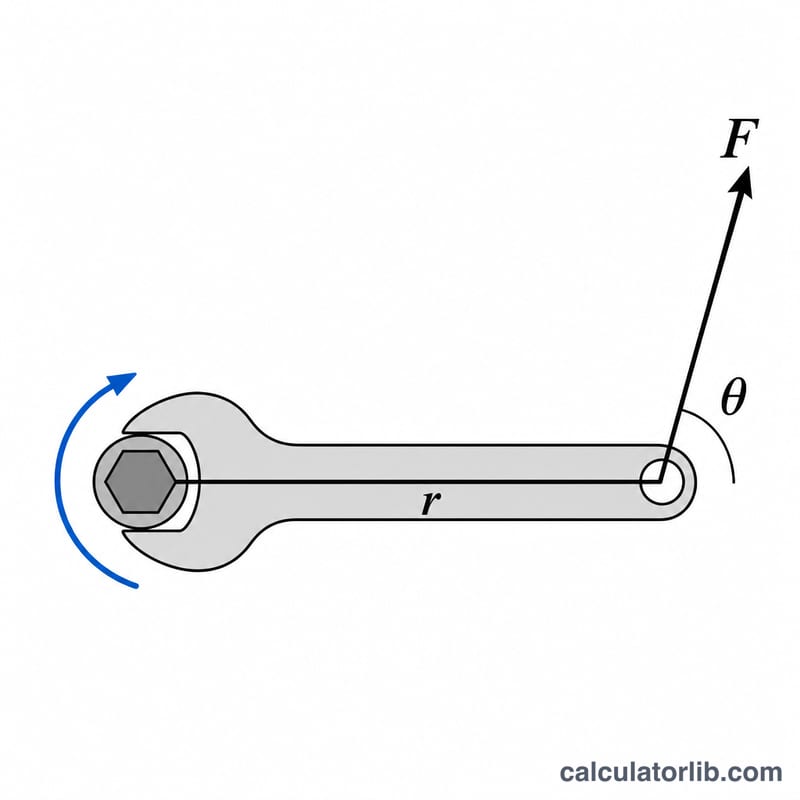
Torque (also called the moment of force) measures how strongly a force tends to rotate an object about a pivot or axis. It depends not just on the size of the force, but on where and at what angle the force is applied. A longer lever arm or a force applied perpendicular to the arm produces more torque. The SI unit is the newton-metre (\(\text{N}\cdot\text{m}\)).
The Formula Explained
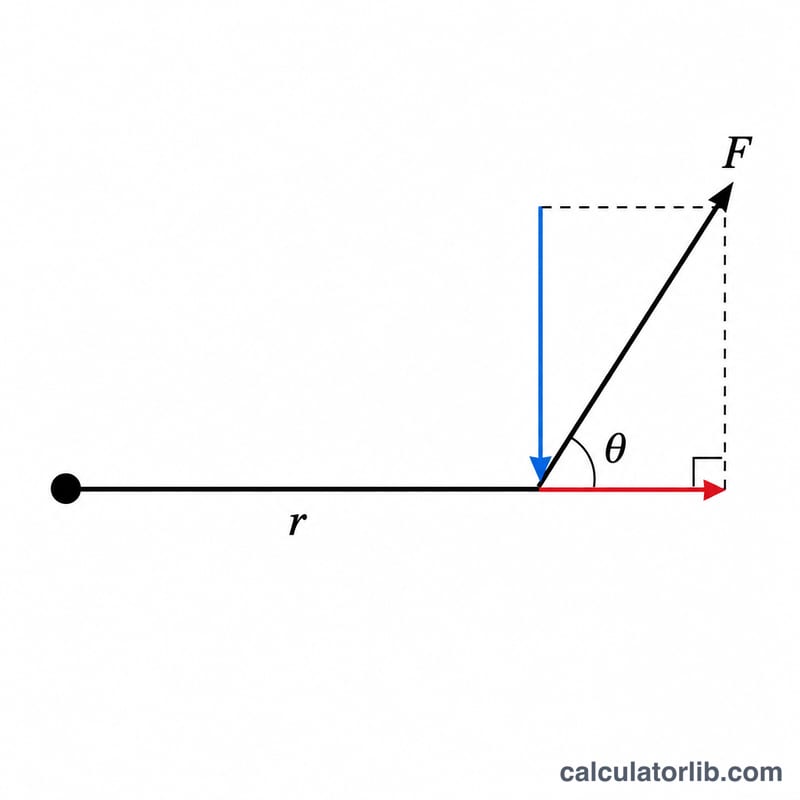
This calculator uses $$\tau = r \cdot F \cdot \sin(\theta)$$, where \(\tau\) is the torque in \(\text{N}\cdot\text{m}\), \(r\) is the distance from the pivot to the point where the force is applied (the lever arm length, in metres), \(F\) is the magnitude of the applied force in newtons, and \(\theta\) is the angle between the force vector and the lever arm in degrees. When the force is perpendicular (\(\theta = 90°\)), \(\sin(\theta) = 1\) and torque is maximised. When the force points straight along the arm (\(\theta = 0°\) or \(180°\)), it produces no rotation at all.
How to Use It
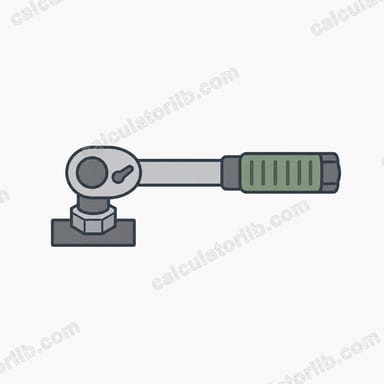
Enter the applied force, the lever arm length, and the angle between them, then read off the torque in newton-metres. To find the torque a 100 N force creates on a 0.5 m wrench held at 90°, the answer is simply $$0.5 \times 100 \times \sin(90°) = 50\ \text{N}\cdot\text{m}.$$
Worked Example
Suppose you push with 200 N on a door handle 0.8 m from the hinges, at an angle of 60° to the door. $$\text{Torque} = 0.8 \times 200 \times \sin(60°) = 160 \times 0.8660 \approx 138.56\ \text{N}\cdot\text{m}.$$ Pushing perpendicular (90°) would instead give the full \(160\ \text{N}\cdot\text{m}\).
FAQ
What units does this use? Force in newtons, length in metres, and angle in degrees, giving torque in newton-metres (\(\text{N}\cdot\text{m}\)).
Why does angle matter? Only the component of force perpendicular to the lever arm produces rotation. The \(\sin(\theta)\) term extracts that perpendicular component.
What if my angle is 90°? Then \(\sin(90°) = 1\), and torque is simply \(r \times F\) — the maximum possible for that force and lever arm.