
What is the Motor Torque Calculator?
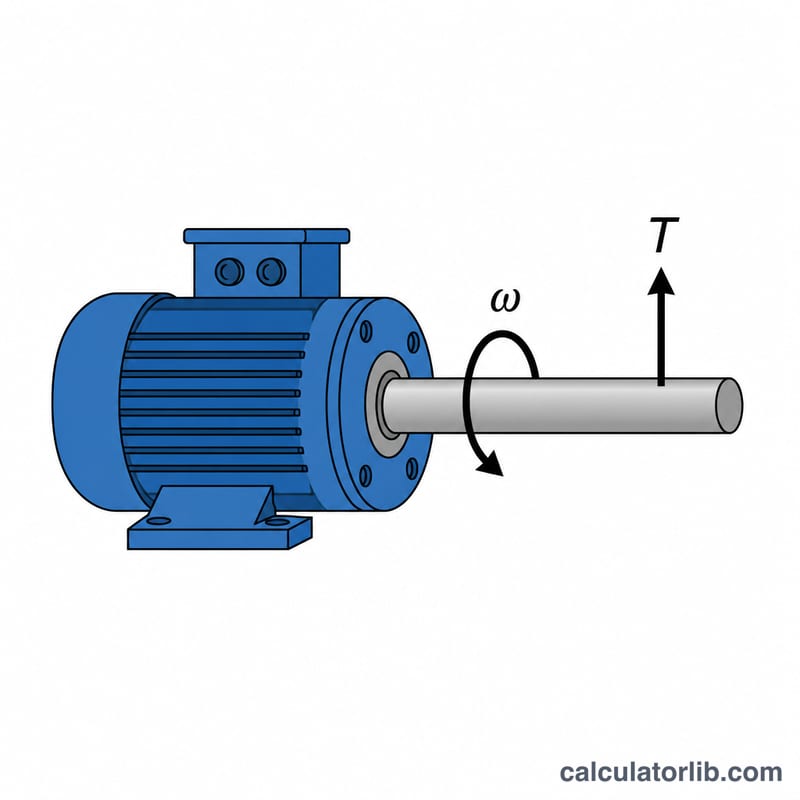
This tool computes the torque produced by a rotating motor from its mechanical output power and rotational speed. Torque is the twisting force a motor delivers to a shaft, measured in newton-metres (\(\text{N}\cdot\text{m}\)). The relationship between power, torque, and speed is universal for any rotating machine — electric motors, engines, turbines, and gearboxes alike.
How to use it
Enter the motor's power in watts (W) and its rotational speed in revolutions per minute (RPM). The calculator first converts RPM to angular velocity \(\omega\) in radians per second, then divides power by \(\omega\) to give torque. To convert kilowatts to watts, multiply by 1,000; to convert horsepower to watts, multiply by about 745.7.
The formula explained
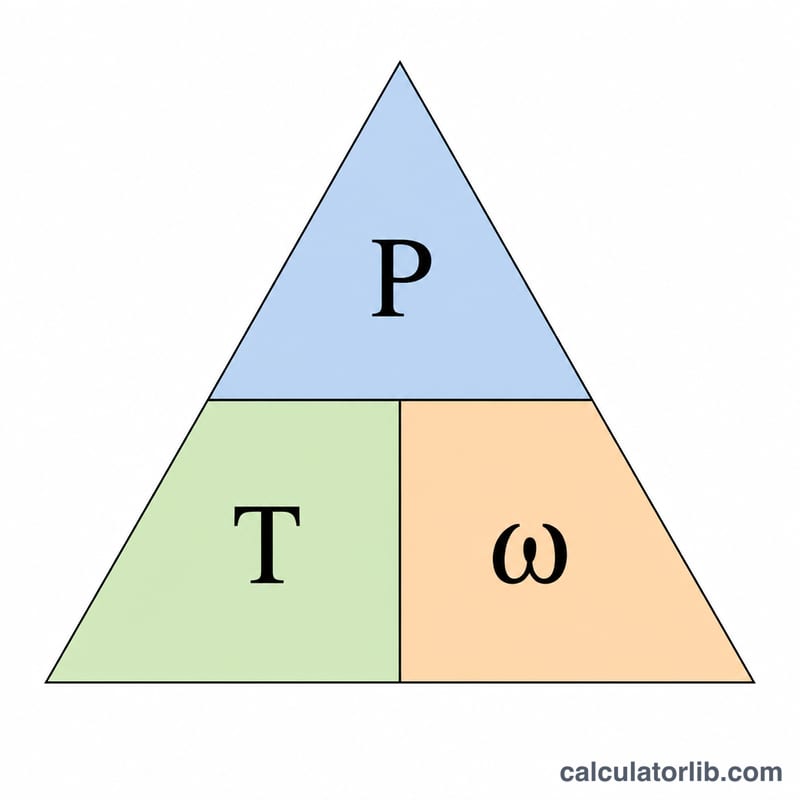
Power equals torque times angular velocity: \(P = T\cdot\omega\). Rearranging gives \(T = P / \omega\). Since speed is usually given in RPM, we convert it: \(\omega = 2\pi\cdot\text{RPM}/60\). Combining these yields $$T = \frac{P}{\dfrac{2\pi\cdot\text{RPM}}{60}}$$ The factor \(2\pi\) converts revolutions to radians, and dividing by 60 converts minutes to seconds.
Worked example
A 1,000 W motor running at 1,500 RPM: \(\omega = 2\pi \times 1500 / 60 = 157.08\ \text{rad/s}\). Torque $$T = \frac{1000}{157.08} = 6.366\ \text{N}\cdot\text{m}$$ So this motor delivers roughly \(6.37\ \text{N}\cdot\text{m}\) of torque at its rated speed.
FAQ
Why does torque drop as speed rises? For a fixed power, faster rotation means each revolution carries less twisting force, so torque is inversely proportional to speed.
Should I use input or output power? Use mechanical output (shaft) power for shaft torque. If you only know electrical input power, multiply by the motor efficiency first.
How do I convert N·m to lb-ft? Multiply newton-metres by 0.7376 to get pound-feet.