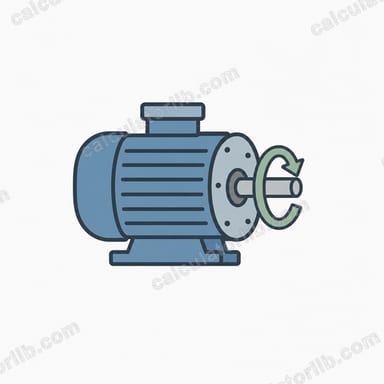

What is the Electric Motor Torque Calculator?
This tool computes the shaft torque produced by an electric motor from its rated mechanical power and rotational speed. Torque is the rotational force a motor delivers and is essential for sizing drives, gearboxes, couplings, and the load itself. The calculator is universal — it works for any motor (AC, DC, induction, servo) as long as you provide power and speed.
How to use it
Enter the motor's mechanical (output) power in kilowatts and its operating speed in revolutions per minute (RPM). The calculator returns torque in newton-metres (N\(\cdot\)m) and also pound-feet (lb\(\cdot\)ft) for imperial work. Use the actual running speed for accurate results — for induction motors this is the loaded speed (e.g. 1450 RPM), not the synchronous speed (1500 RPM).
The formula explained
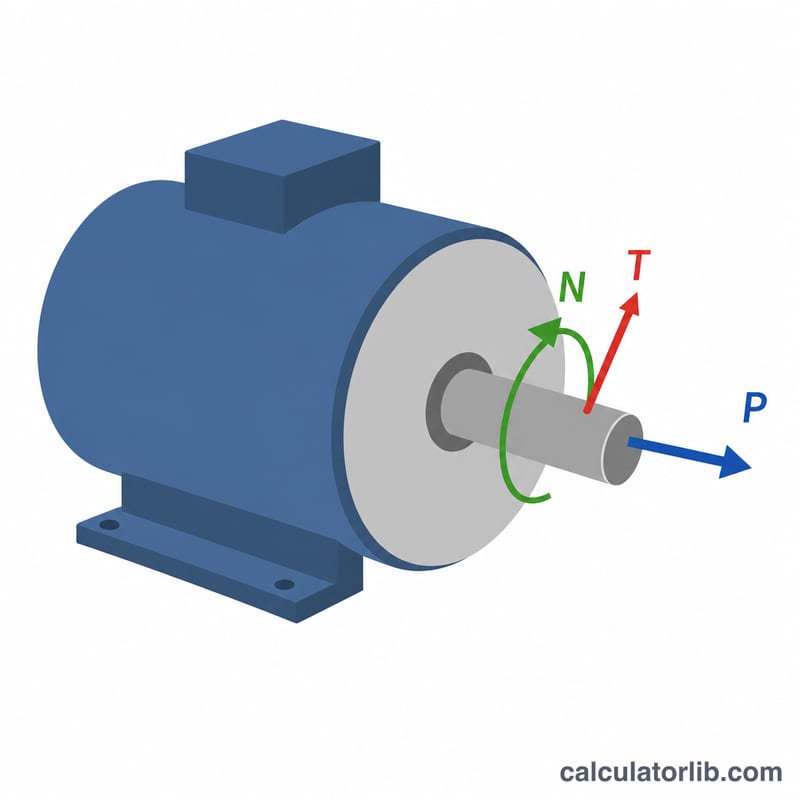
Mechanical power equals torque times angular velocity: \(P = T \times \omega\). Angular velocity \(\omega\) in radians per second is \(2\pi N/60\), where \(N\) is RPM. Rearranging gives \(T = P / (2\pi N/60)\). Power must be in watts (kW \(\times\) 1000) so the result is in N\(\cdot\)m. A handy shortcut is $$T \,(\text{N}\cdot\text{m}) \approx \frac{9550 \times P(\text{kW})}{N(\text{RPM})}$$

Worked example
A 7.5 kW motor runs at 1450 RPM. Convert power: \(7.5 \times 1000 = 7500\) W. Angular velocity: $$\frac{2\pi \times 1450}{60} = 151.844 \ \text{rad/s}$$ Torque: $$\frac{7500}{151.844} = \mathbf{49.39 \ \text{N}\cdot\text{m}}$$ or about 36.4 lb\(\cdot\)ft.
FAQ
Should I use synchronous or actual speed? Use the actual loaded speed for the torque the motor really delivers at the shaft.
Is this electrical or mechanical power? Use mechanical (output) power. If you only have input electrical power, multiply by efficiency first.
What about the 9550 constant? \(9550 \approx 60 \times 1000 / (2\pi)\), which converts kW and RPM directly to N\(\cdot\)m — the same equation simplified.