
What Is the Energy Density of Fields?
Electric and magnetic fields store energy in the space around them. The energy density (\(u\)) measures how much energy is stored per unit volume, expressed in joules per cubic meter (J/m³). This is a universal physics concept that applies anywhere in the universe — there is no country-specific scope. It underpins how we understand light, electromagnetic waves, capacitors, inductors, and field theory.
The Formula Explained
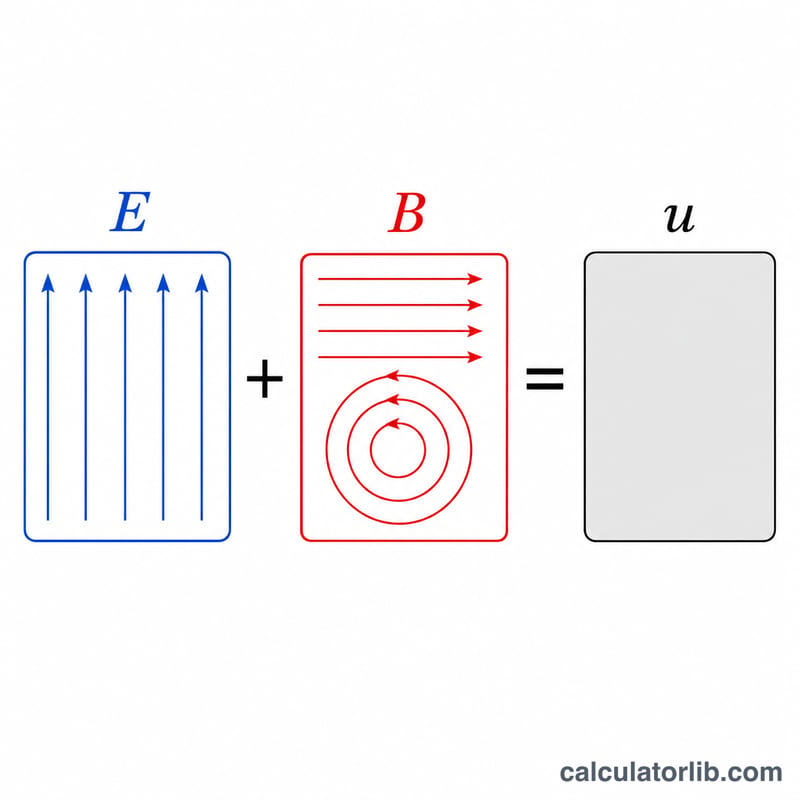
The total energy density combines two contributions:
$$u = \frac{1}{2}\,\varepsilon\,E^{2} + \frac{B^{2}}{2\,\mu}$$
Here E is the electric field strength (V/m), B is the magnetic flux density (T), ε (epsilon) is the permittivity of the medium (F/m), and μ (mu) is the permeability (H/m). In vacuum, \(\varepsilon \approx 8.854\times10^{-12}\) F/m and \(\mu \approx 1.2566\times10^{-6}\) H/m. The first term is the electric energy density; the second is the magnetic energy density.
How to Use the Calculator
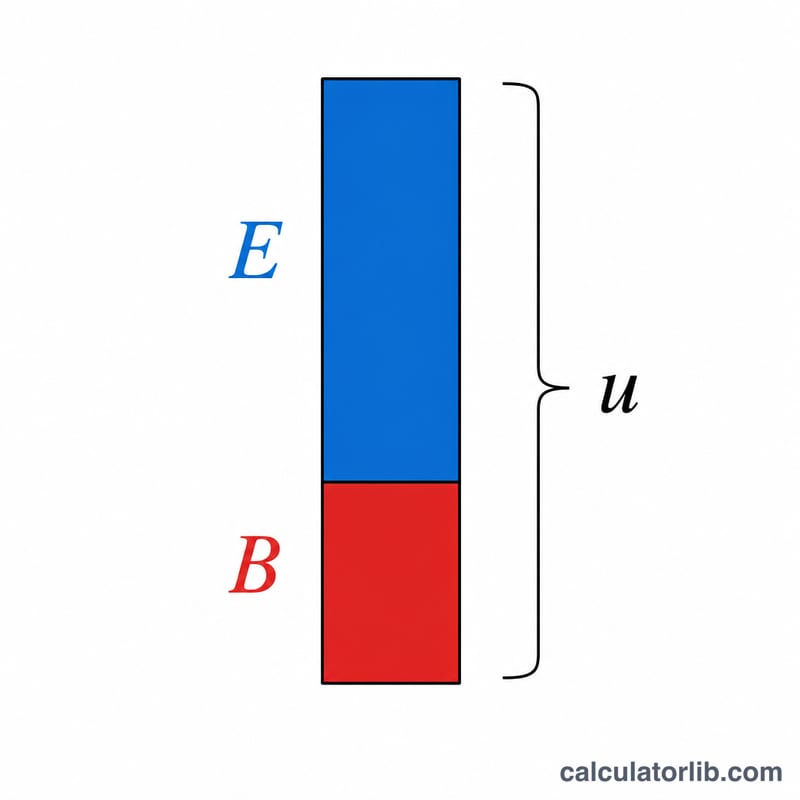
Enter the electric field E, the magnetic field B, and the medium's permittivity and permeability (the defaults are vacuum values). The calculator returns the total energy density along with the separate electric and magnetic components so you can see which dominates.
Worked Example
Suppose \(E = 1000\) V/m and \(B = 0.001\) T in vacuum (\(\varepsilon = 8.854\times10^{-12}\), \(\mu = 1.2566\times10^{-6}\)). The electric term is $$\frac{1}{2} \times 8.854\times10^{-12} \times 1000^{2} = 4.427\times10^{-6}\ \text{J/m}^3.$$ The magnetic term is $$\frac{(0.001)^{2}}{2 \times 1.2566\times10^{-6}} = \frac{1\times10^{-6}}{2.5133\times10^{-6}} \approx 0.3979\ \text{J/m}^3.$$ The total is about 0.3979 J/m³ — the magnetic field overwhelmingly dominates here.
FAQ
Why is the magnetic term often larger? Because magnetic energy density scales with \(1/\mu\), which is large, while the electric term is scaled by the tiny \(\varepsilon\). For an electromagnetic wave in vacuum the two contributions are actually equal.
What units should I use? SI units: E in V/m, B in tesla, ε in F/m, μ in H/m. The result is then J/m³.
Does this work in materials? Yes — substitute the material's permittivity (\(\varepsilon = \varepsilon_0\varepsilon_r\)) and permeability (\(\mu = \mu_0\mu_r\)).