
What this calculator does
This tool solves the classical kinetic energy equation, \(KE = \frac{1}{2} m v^{2}\), for any one of its three quantities — kinetic energy, mass, or velocity — when you know the other two. Each field comes with a unit dropdown, so you can mix and match units like kilojoules, kilowatt-hours, pounds, or kilometers per hour. Internally every value is converted to SI base units (joules, kilograms, meters per second), the formula is applied, and the answer is converted back to the unit you selected.
How to use it
First choose what to calculate from the "Choose a Calculation" dropdown. If you select Calculate KE, enter mass and velocity. For Calculate Mass, enter kinetic energy and velocity. For Calculate Velocity, enter kinetic energy and mass. Pick the unit beside each value, optionally fix the number of significant figures (or leave it on "auto" for about 6 digits), and read the result.
The formula explained
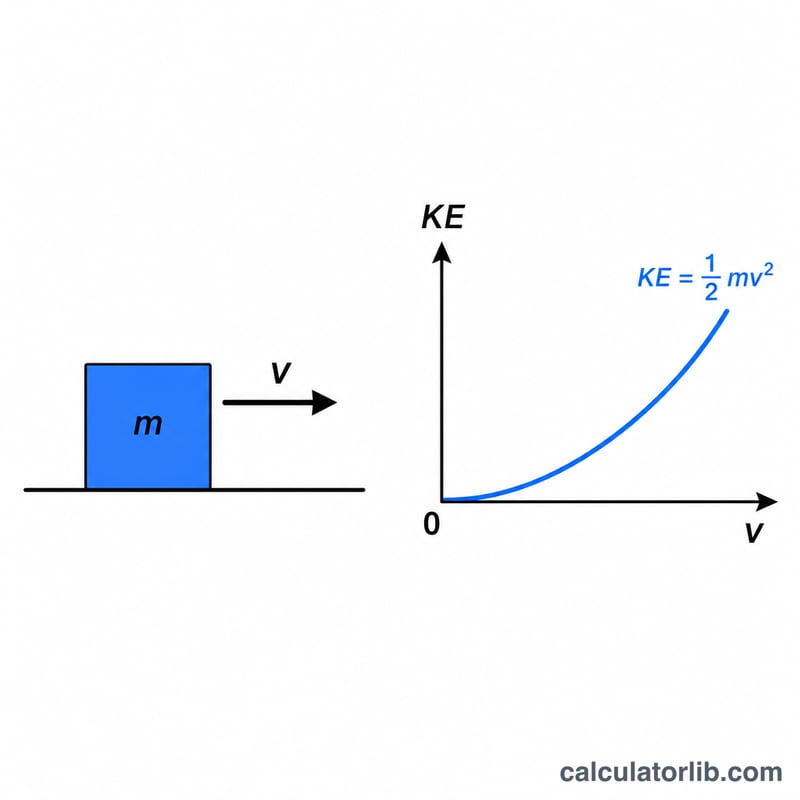
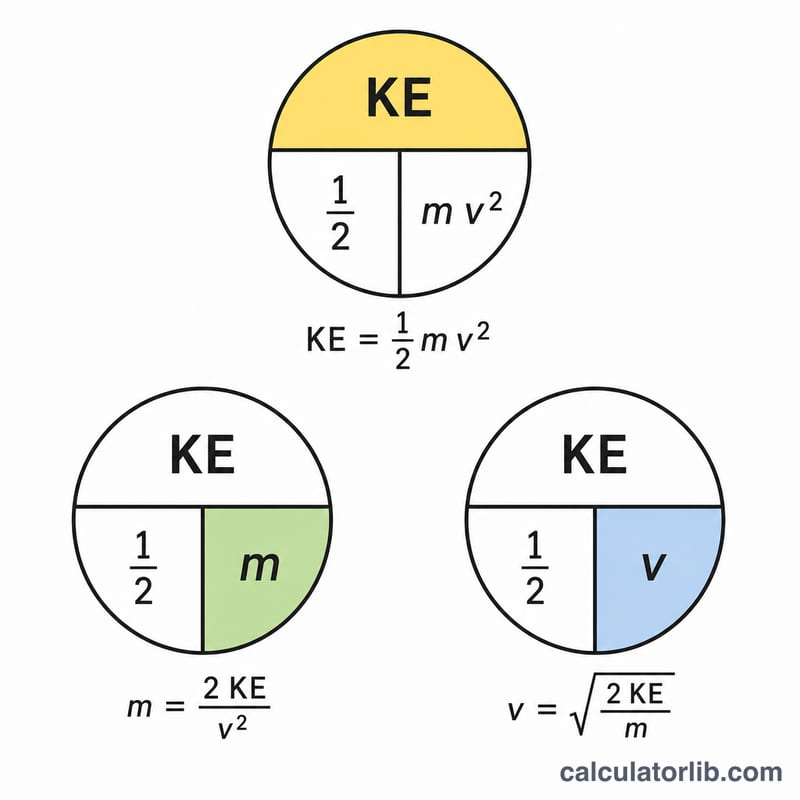
Kinetic energy is the energy an object possesses due to its motion. The base relationship is $$KE = \frac{1}{2} m v^{2}.$$ Rearranging gives \(m = \frac{2KE}{v^{2}}\) (requires \(v \ne 0\)) and \(v = \sqrt{\frac{2KE}{m}}\) (requires \(m > 0\)). Because velocity is squared, its sign does not affect the energy; when solving for velocity the calculator reports the non-negative magnitude.
Worked example
A 10 kg object moving at 5 m/s has $$KE = \frac{1}{2} \times 10 \times 5^{2} = \frac{1}{2} \times 10 \times 25 = \mathbf{125\ \text{J}}.$$ Reversing it: with KE = 125 J and m = 10 kg, \(v = \sqrt{\frac{2 \times 125}{10}} = \sqrt{25} = 5\ \text{m/s}\), which is 18 km/h. With KE = 125 J and v = 5 m/s, \(m = \frac{2 \times 125}{25} = 10\ \text{kg}\).
FAQ
Why must velocity be non-zero when solving for mass? The mass formula divides by \(v^{2}\); a zero velocity means zero energy carries no information about mass, so the result is undefined.
Can kinetic energy be negative? No. KE is always zero or positive, so solving for velocity with a negative energy is unphysical and is rejected.
Which BTU and calorie are used? The mean BTU (1055.87 J) and mean calorie (4.19002 J) are used for unit conversion.