
What this calculator does
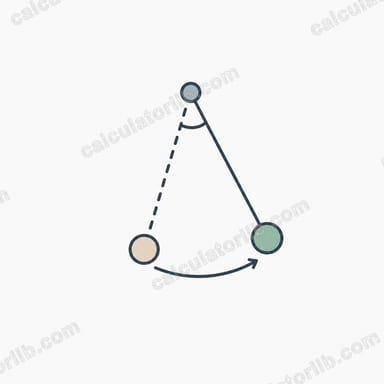
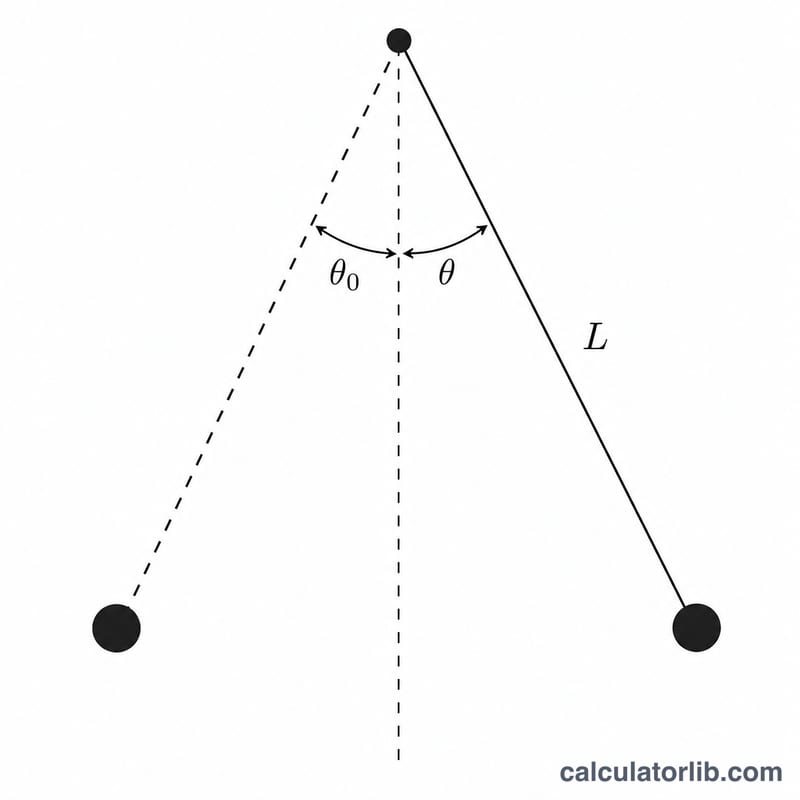
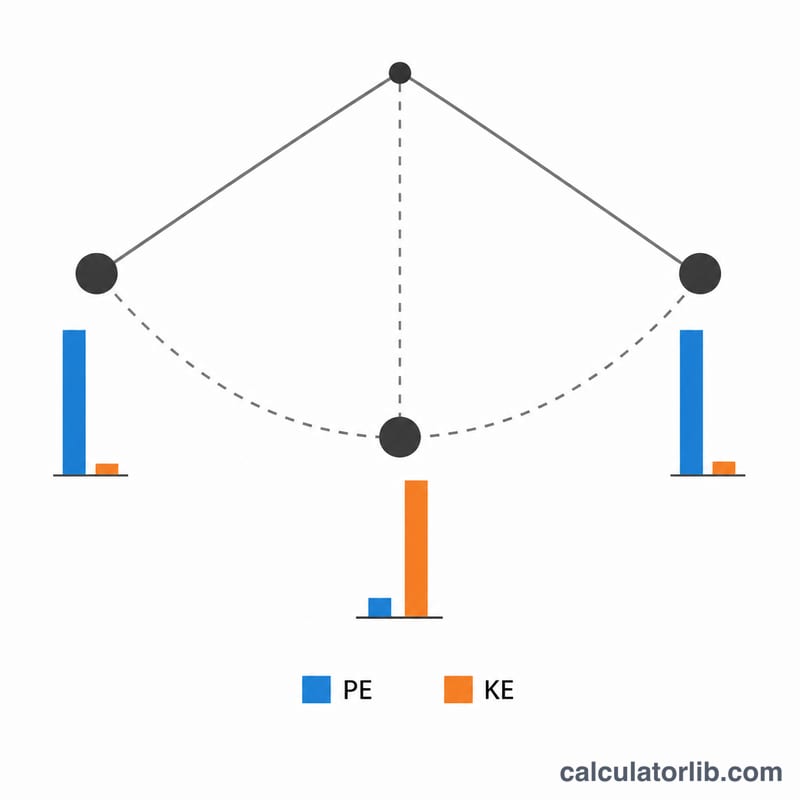
This tool computes the kinetic energy of a simple pendulum as it swings. A pendulum released from rest at an angle θ₀ trades gravitational potential energy for kinetic energy as it falls toward the bottom of its arc. At any intermediate angle θ, the kinetic energy equals the potential energy lost since release.
The formula explained
The bob's height above its release point changes by \(L \cdot (\cos\theta - \cos\theta_0)\), where L is the pendulum length measured from pivot to bob. Multiplying by mass m and gravity g gives the energy released:
$$KE = m \cdot g \cdot L \left( \cos\theta - \cos\theta_0 \right)$$
At the release angle (\(\theta = \theta_0\)) the kinetic energy is zero. It reaches a maximum at the lowest point (\(\theta = 0\)). The calculator also returns the bob's speed via \(v = \sqrt{2 \cdot KE/m}\) and the vertical height dropped from the release position.
How to use it
Enter the bob's mass in kilograms, the pendulum length in metres, the release angle θ₀ and the current angle θ in degrees, and gravity (default 9.81 m/s²). Make sure θ is smaller than θ₀ — the bob cannot rise above where it started without extra energy.
Worked example
A 0.5 kg bob on a 1 m string is released from 30° and reaches the bottom (\(\theta = 0\)). The kinetic energy is $$0.5 \times 9.81 \times 1 \times (\cos 0° - \cos 30°) = 0.5 \times 9.81 \times (1 - 0.8660) = 0.6573 \text{ J}.$$ Its speed is \(\sqrt{2 \times 0.6573 / 0.5} \approx 1.62 \text{ m/s}\).
FAQ
Why does θ have to be less than θ₀? Because the pendulum starts from rest at θ₀; it can only swing toward smaller angles, gaining kinetic energy. If \(\theta > \theta_0\) the formula gives a negative value, which we clamp to zero.
Is this only for small swings? No. This energy formula is exact for any swing amplitude because it comes from conservation of energy, not the small-angle approximation.
What units are used? SI units: kilograms, metres, m/s², giving energy in joules and speed in metres per second.