
What is the present value factor?
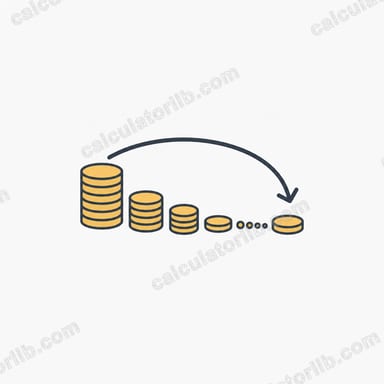
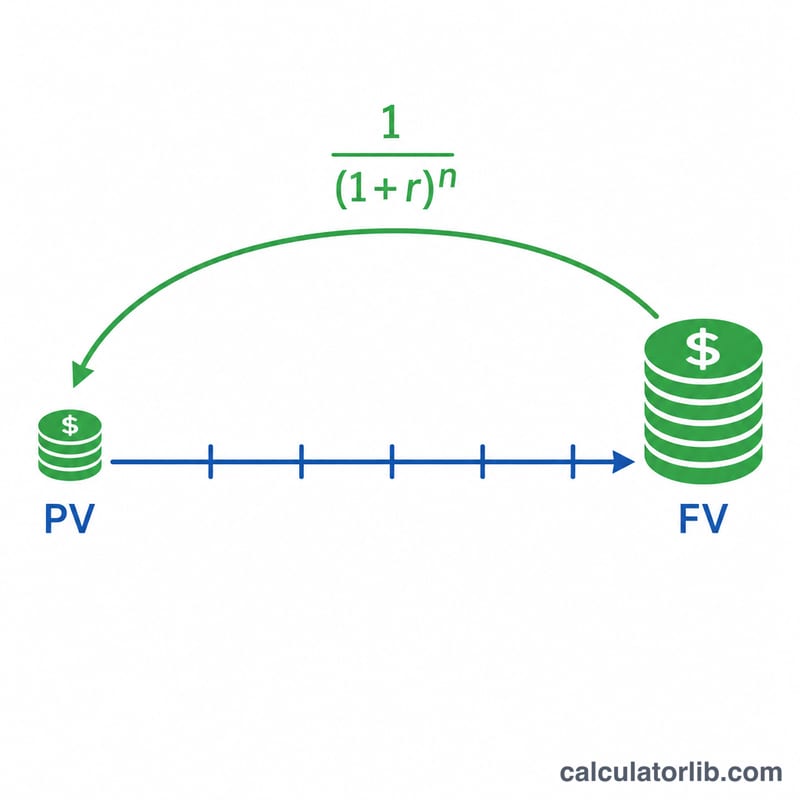
The present value factor (also called the discount factor) tells you how much one unit of money received \(n\) years in the future is worth today, given an annual interest rate \(r\). It is the inverse of the compound future value factor \((1 + r)^n\). Multiplying a future amount by the discount factor converts it into a present value — the lump sum you would need to invest today to grow into that future amount. This is universal time-value-of-money math and works with any currency.
How to use this calculator
Enter the future amount you want to reach (FV), the annual interest rate as a percent, and the number of years (\(n\)). Choose how many decimal places to round the factor to and a rounding mode (truncate, round half-up, or ceiling). The tool returns the present value factor, the present value (required principal today), and a year-by-year table of discount factors from year 1 to year \(n\).
The formula explained
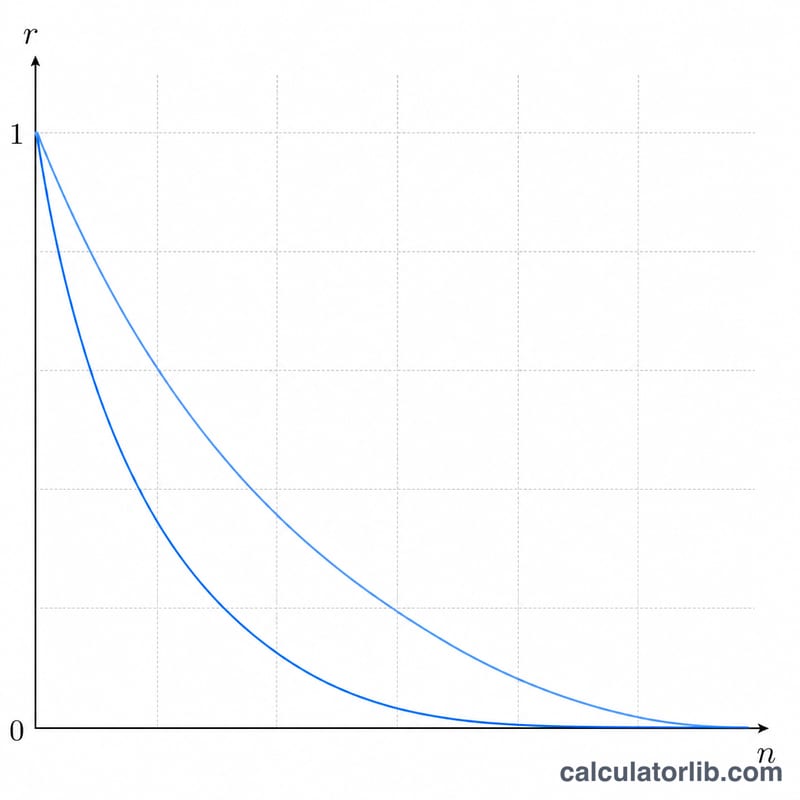
First convert the rate to a decimal: \(r = \text{rate\%} / 100\). Then $$\text{PVF} = \frac{1}{(1 + r)^n}.$$ The present value is $$\text{PV} = \text{FV} \times \text{PVF}.$$ If \(r = 0\) there is no discounting, so \(\text{PVF} = 1\) and \(\text{PV} = \text{FV}\). The rate must be greater than \(-100\%\) so that \((1 + r)\) stays positive.
Worked example
Suppose FV = 1 unit (e.g. one unit of 10,000 currency), rate = 3%, years = 20, 3 decimals, round half-up. Then \(r = 0.03\) and \(1.03^{20} = 1.806111\). $$\text{PVF} = \frac{1}{1.806111} = 0.553676,$$ rounded to \(0.554\). $$\text{PV} = 1 \times 0.554 = 0.554$$ — meaning about \(0.554\) units today grows to 1 unit in 20 years at 3%.
FAQ
Is this currency-specific? No. The factor is unitless and the present value uses whatever money unit you enter, so it applies to any currency.
How does rounding affect the result? The factor is rounded to your chosen decimals using the selected mode, and the present value is computed from that rounded factor. Financial institutions may round differently, so treat results as informational.
What happens at a 0% rate? No discounting occurs: the factor is 1 and the present value equals the future amount.