
What is the Energy to Wavelength Calculator?
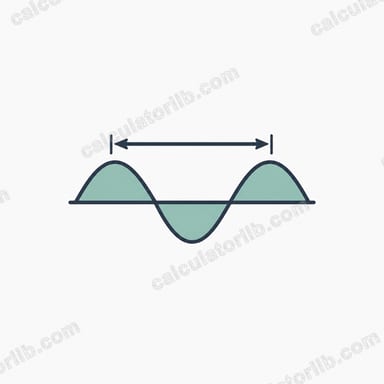
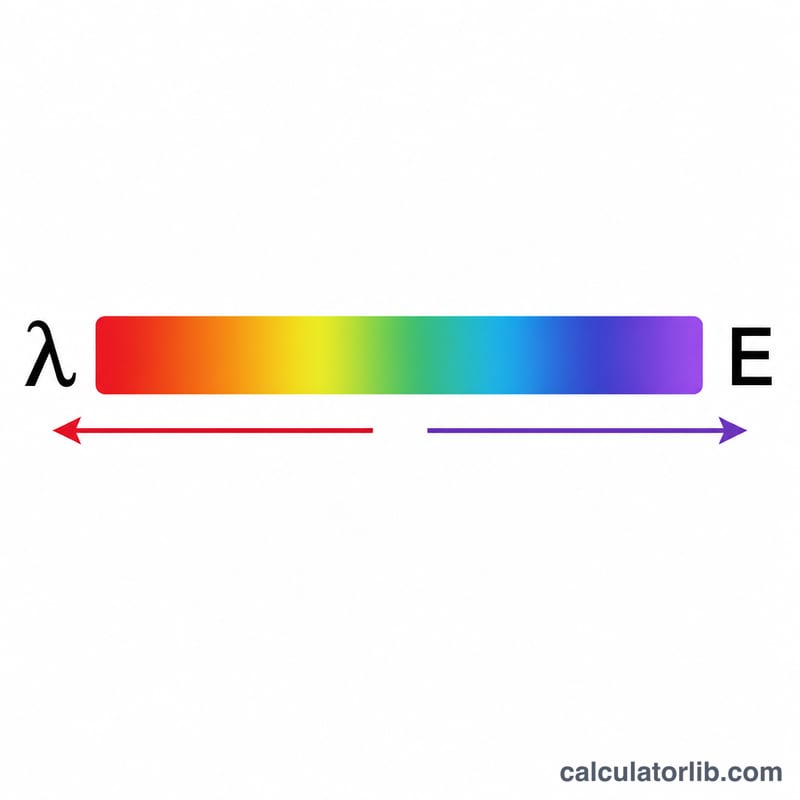
This tool converts the energy of a photon into its corresponding wavelength using the Planck–Einstein relation. Because energy and wavelength are inversely related, high-energy photons (like X-rays) have very short wavelengths, while low-energy photons (like radio waves) have long wavelengths. Enter an energy value in electronvolts (eV) or joules (J) and instantly get the wavelength in nanometers and meters, along with the photon frequency.
How to use it
Type the photon energy into the input box, choose the unit (eV or J), and the calculator returns the wavelength. Electronvolts are convenient for atomic, optical and particle physics; joules are the SI unit. The result in nanometers is handy for checking where a photon falls in the electromagnetic spectrum — visible light spans roughly 380–750 nm.
The formula explained
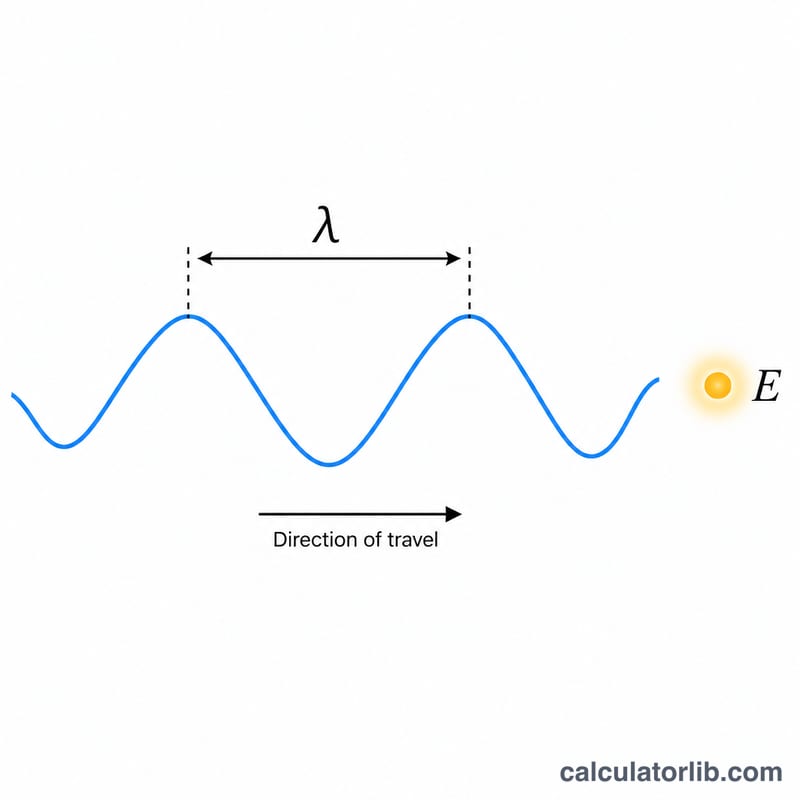
The wavelength is given by $$\lambda = \frac{h\,c}{E}$$, where \(h = 6.62607015\times10^{-34}\ \text{J}\cdot\text{s}\) is the Planck constant and \(c = 2.99792458\times10^{8}\ \text{m/s}\) is the speed of light. If the energy is entered in eV it is first converted to joules by multiplying by \(1.602176634\times10^{-19}\ \text{J/eV}\). The frequency is found from \(\nu = \frac{E}{h}\).
Worked example
Suppose a photon has an energy of 2.0 eV. Converting to joules: \(2.0 \times 1.602176634\times10^{-19} = 3.204\times10^{-19}\ \text{J}\). Then $$\lambda = \frac{6.62607015\times10^{-34} \times 2.99792458\times10^{8}}{3.204\times10^{-19}} \approx 6.199\times10^{-7}\ \text{m} = \text{about } 620\ \text{nm}$$ — orange-red visible light.
FAQ
Why is wavelength inversely proportional to energy? Because the product hc is constant, increasing energy must shorten the wavelength.
What is the quick shortcut for eV? A handy approximation is \(\lambda(\text{nm}) \approx \frac{1239.84}{E(\text{eV})}\).
Does this work for any photon? Yes — gamma rays, X-rays, UV, visible, infrared, microwaves and radio waves all follow the same relation.