
What Is the Coefficient of Friction?
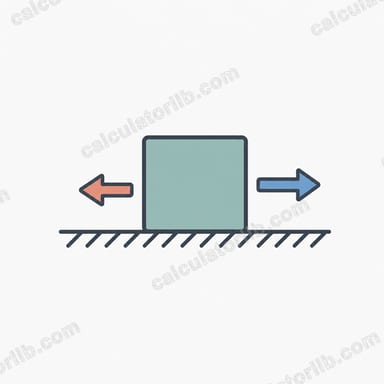
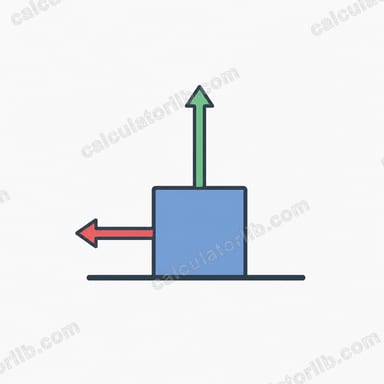
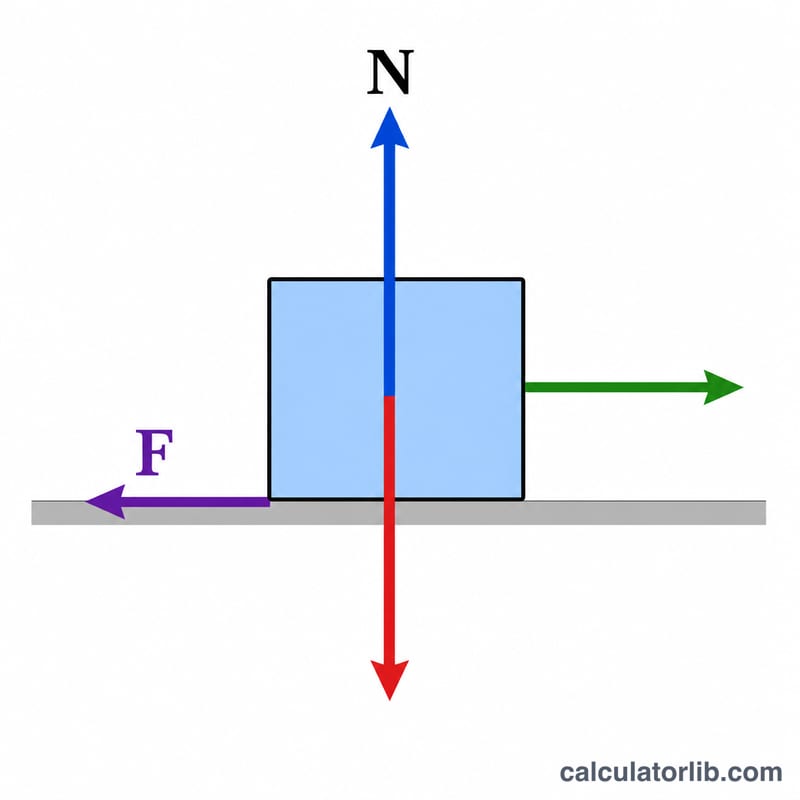
The coefficient of friction (\(\mu\)) is a dimensionless number that describes how strongly two surfaces resist sliding against each other. It is defined as the ratio of the friction force (\(F\)) acting parallel to the surface to the normal force (\(N\)) pressing the surfaces together. A higher \(\mu\) means more resistance to motion — rubber on dry asphalt has a high \(\mu\), while ice on ice has a very low one.
How to Use This Calculator
Enter the friction force \(F\) (in newtons) and the normal force \(N\) (in newtons), then read off the coefficient \(\mu\). If you measured the force needed to just start an object moving, you get the static coefficient; if you measured the force to keep it sliding at constant speed, you get the kinetic coefficient. Both use the same formula.
The Formula Explained
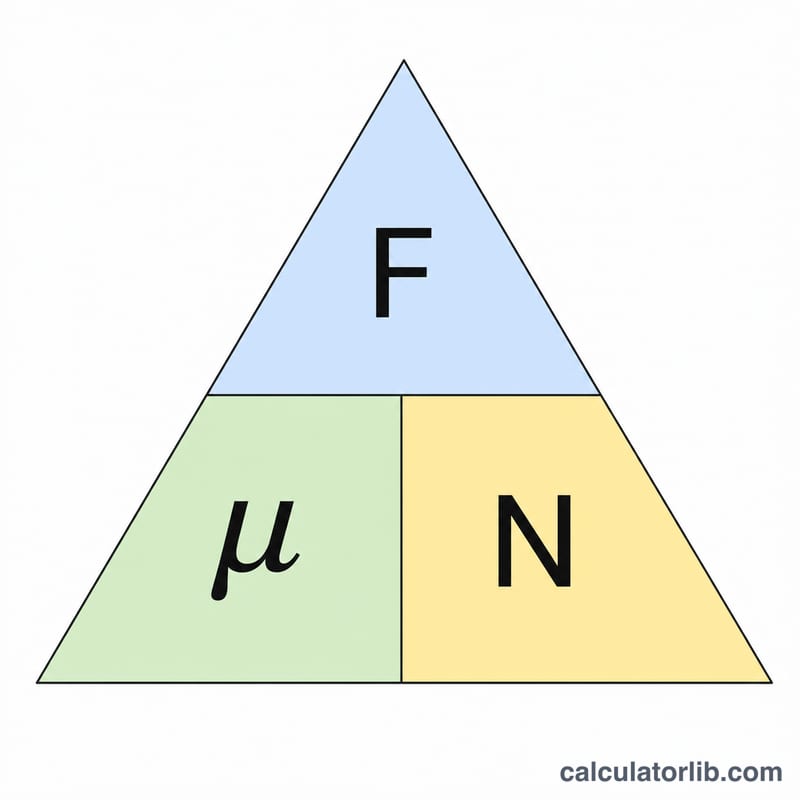
The relationship is simply $$\mu = \frac{\text{Friction Force, F (N)}}{\text{Normal Force, N (N)}}$$ Because both forces are measured in the same units (newtons), the result is unitless. On a flat surface the normal force often equals the object's weight, \(N = m \cdot g\), so you can derive it from mass if needed.
Worked Example
Suppose a box requires a horizontal pull of 50 N to slide steadily, and the box presses down on the floor with a normal force of 100 N. Then $$\mu = \frac{50}{100} = 0.5$$ This is a typical kinetic friction coefficient for many everyday material pairs.
FAQ
Can \(\mu\) be greater than 1? Yes. While most common surfaces have \(\mu\) between 0 and 1, rough or sticky materials (e.g., rubber on rubber) can exceed 1.
What if my normal force is zero? The formula is undefined when \(N = 0\), since there is no contact force; the calculator returns 0 in that case.
Is the coefficient the same for static and kinetic friction? No. Static friction (before motion starts) is usually slightly higher than kinetic friction (during sliding), so measure the relevant force for the case you need.