
What is the Swamee-Jain Friction Factor Calculator?
The Swamee-Jain equation is an explicit formula that estimates the Darcy friction factor (f) for fully turbulent flow in a pipe. It was developed as a direct approximation of the implicit Colebrook-White equation, avoiding the need for iterative solving. Engineers use the friction factor to compute head loss and pressure drop in pipelines via the Darcy-Weisbach equation.
How to use it
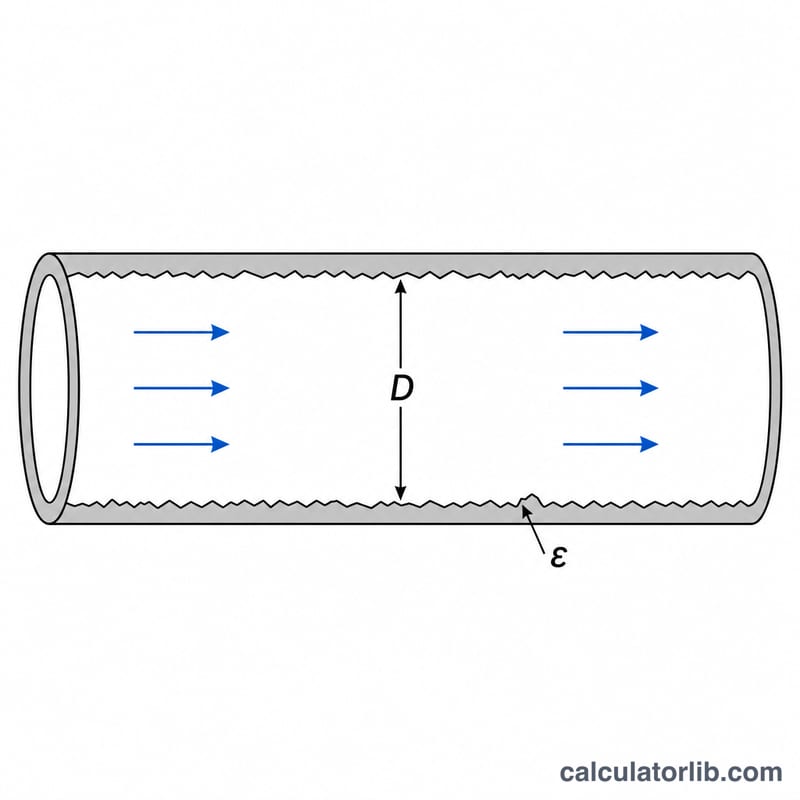
Enter three values: the absolute pipe roughness \(\varepsilon\) (in metres), the internal pipe diameter \(D\) (in metres), and the Reynolds number \(\text{Re}\) of the flow. The calculator computes the relative roughness \(\varepsilon/D\) and returns the dimensionless Darcy friction factor. The equation is valid for \(5000 \le \text{Re} \le 10^8\) and \(10^{-6} \le \varepsilon/D \le 10^{-2}\).
The formula explained
The friction factor is given by:
$$f = \dfrac{0.25}{\left[\log_{10}\!\left(\dfrac{\text{Roughness }\varepsilon\,/\,\text{Diameter }D}{3.7} + \dfrac{5.74}{\text{Re}^{0.9}}\right)\right]^{2}}$$
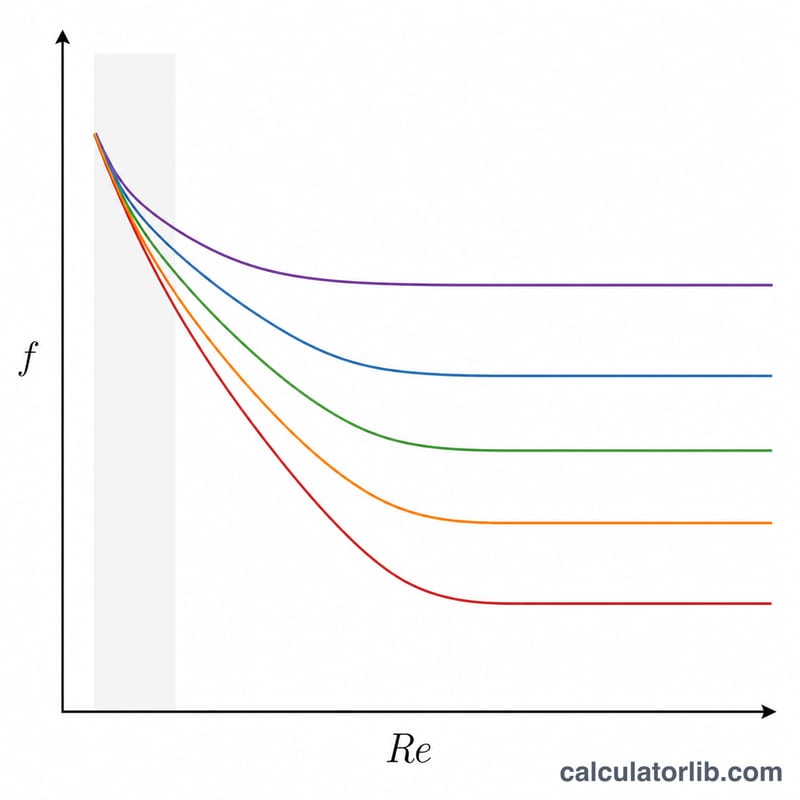
The two terms inside the logarithm capture the relative-roughness (pipe wall) effect and the viscous (Reynolds number) effect. As the flow becomes fully rough, the second term vanishes and \(f\) approaches a constant value set by \(\varepsilon/D\).
Worked example
Take \(\varepsilon = 0.00015\ \text{m}\), \(D = 0.1\ \text{m}\), \(\text{Re} = 100{,}000\). Then \(\varepsilon/D = 0.0015\), so \((\varepsilon/D)/3.7 = 0.000405405\). \(\text{Re}^{0.9} = 100000^{0.9} \approx 31622.78\), so \(5.74/\text{Re}^{0.9} \approx 0.00018152\). The sum is \(0.00058693\); \(\log_{10}\) of that \(\approx -3.23139\); squared \(\approx 10.4419\). Thus $$f = \dfrac{0.25}{10.4419} \approx 0.02394.$$
FAQ
Is this the Darcy or Fanning friction factor? It returns the Darcy (Darcy-Weisbach) friction factor. Divide by 4 to get the Fanning factor.
Does it work for laminar flow? No. For \(\text{Re}\) below about 2300 use \(f = 64/\text{Re}\) instead.
How accurate is it? Within roughly 1-2% of the Colebrook equation across its valid range, which is excellent for engineering design.