
What Is the K-Factor?
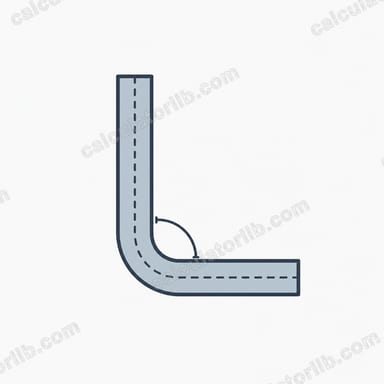
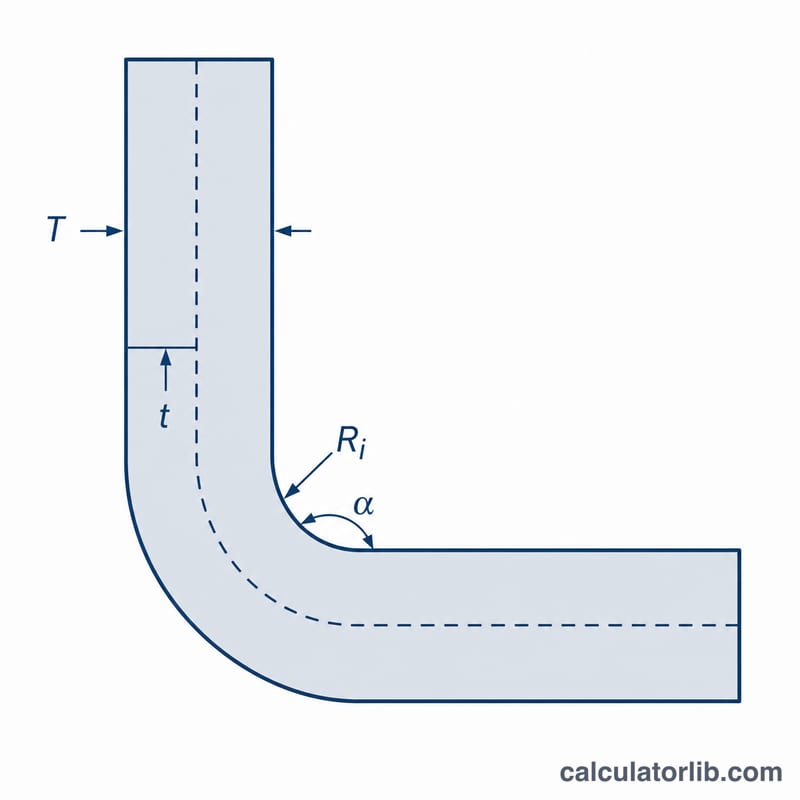
The K-factor is a fundamental constant in sheet metal fabrication. It describes where the neutral axis — the layer of material that neither stretches nor compresses during bending — sits within the thickness of the sheet. It is expressed as a ratio between 0 and 0.5, where K equals the distance from the inside surface to the neutral axis divided by the material thickness. Knowing the K-factor lets you predict bend allowance, bend deduction and flat-pattern lengths accurately.
How to Use This Calculator
Enter the measured bend allowance (the arc length of the neutral axis through the bend), the bend angle in degrees, the inside bend radius, and the material thickness. Use consistent length units (all mm or all inches). The calculator returns the K-factor and the resulting neutral-axis position.
The Formula Explained
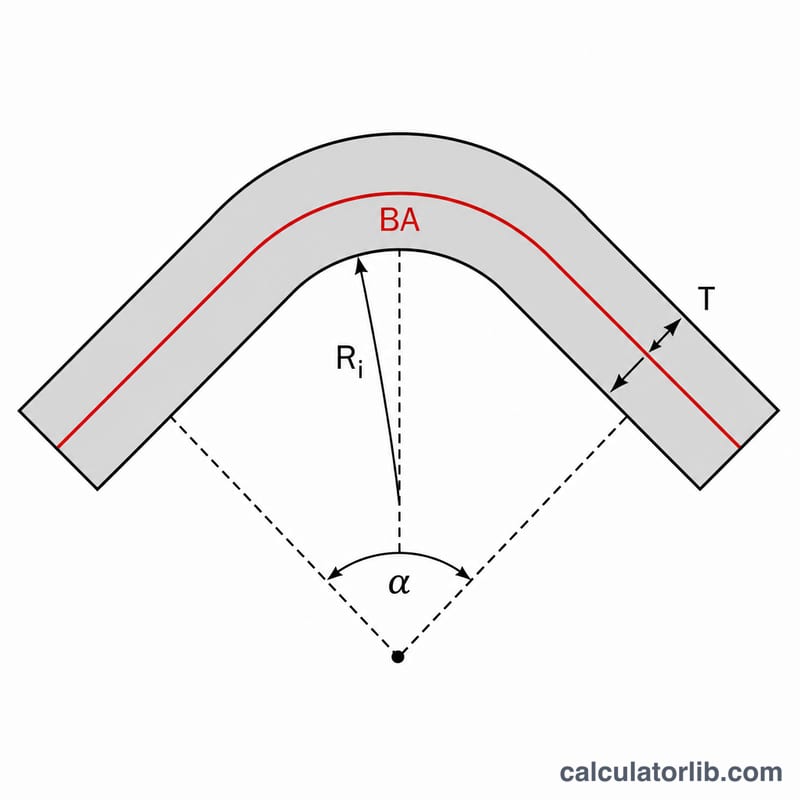
Bend allowance equals the arc length of the neutral axis: \( \text{BA} = \frac{\pi}{180} \cdot \alpha \cdot (\text{R}_i + K \cdot \text{T}) \). Rearranging to solve for K gives
$$K = \frac{\text{BA} - \frac{\pi}{180} \cdot \alpha \cdot \text{R}_i}{\frac{\pi}{180} \cdot \alpha \cdot \text{T}}$$The \( \frac{\pi}{180} \cdot \alpha \) term simply converts the bend angle from degrees to radians.
Worked Example
Suppose \( \text{BA} = 6.81 \), angle = 90°, \( \text{R}_i = 3 \) and \( \text{T} = 3 \). The angle in radians is
$$90 \cdot \frac{\pi}{180} = 1.5708$$The denominator is
$$1.5708 \cdot 3 = 4.7124$$The numerator is
$$6.81 - 1.5708 \cdot 3 = 6.81 - 4.7124 = 2.0976$$So
$$K = \frac{2.0976}{4.7124} \approx 0.445,$$and the neutral axis sits at \( 0.445 \cdot 3 \approx 1.336 \) from the inner face.
FAQ
What is a typical K-factor value? For most steels and aluminium it ranges from about 0.3 to 0.5, commonly around 0.42–0.45.
Does the K-factor change with radius? Yes — tighter inside radii relative to thickness generally shift the neutral axis inward, lowering K.
What units should I use? Any consistent unit works because K is dimensionless; just keep BA, \( \text{R}_i \) and T in the same units.