
What Is the Tonnage Calculator?
The Tonnage Calculator estimates the weight, in US short tons, of a quantity of bulk material such as gravel, sand, crushed stone, topsoil or concrete. By entering the length, width and depth of the area to be filled along with the material's density, you instantly get the total tonnage you need to order. It is a handy planning tool for landscaping, paving, construction and excavation projects.
How to Use It
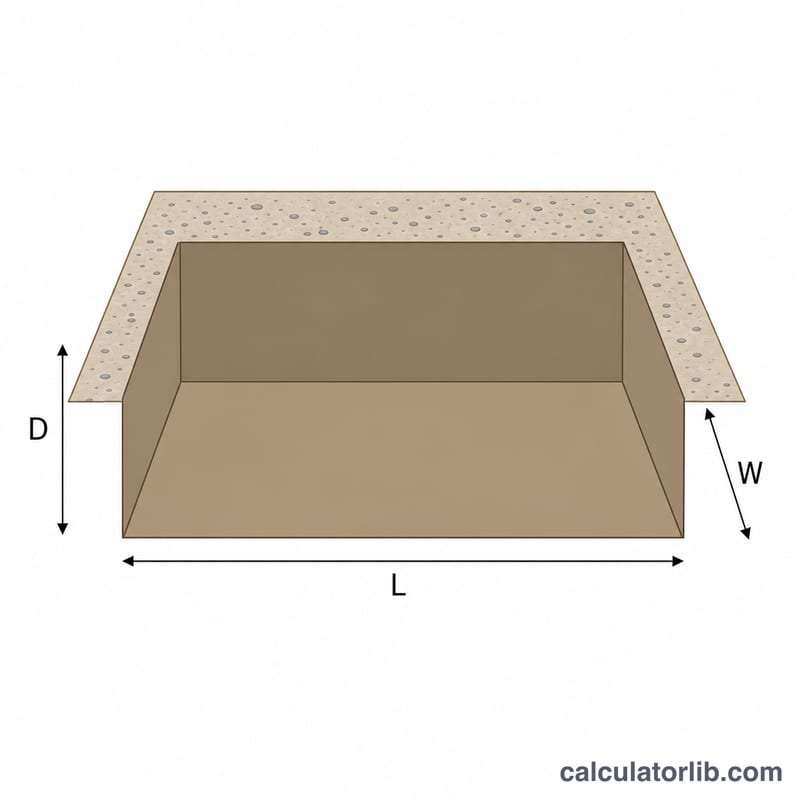
Enter the three dimensions of your space in feet (length, width and depth). Then provide the density of your material in pounds per cubic foot. Common approximate densities are: gravel and sand \(\approx 100 \text{ lb/ft}^3\), crushed stone \(\approx 100 \text{ lb/ft}^3\), topsoil \(\approx 75 \text{ lb/ft}^3\), and concrete \(\approx 150 \text{ lb/ft}^3\). The calculator multiplies these to find total weight and converts it to tons.
The Formula Explained
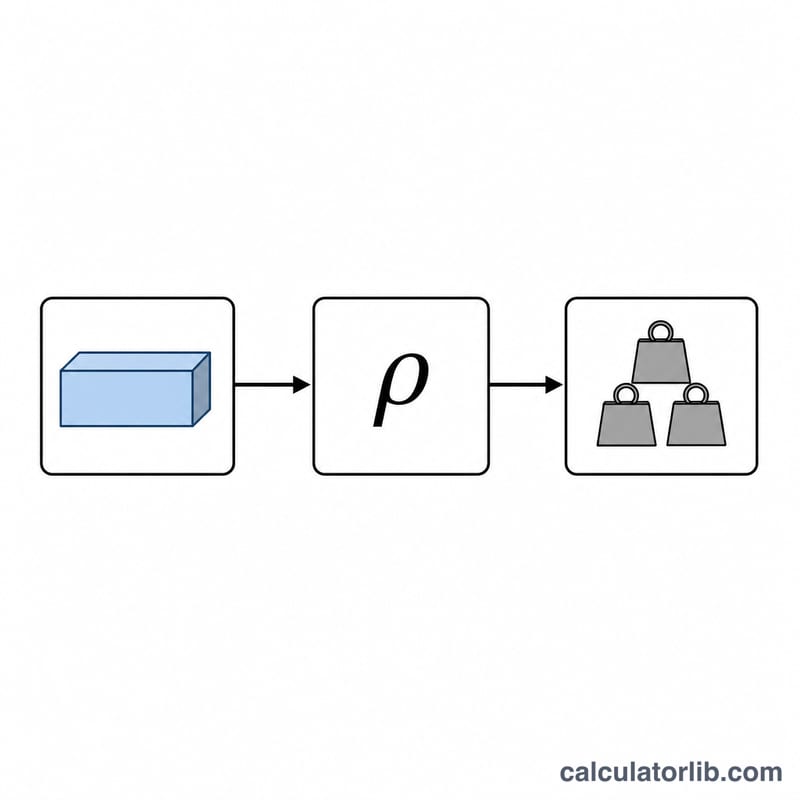
First the volume is found: \(V = L \times W \times D\) (cubic feet). Multiplying volume by density gives the mass in pounds. Dividing that by 2000 (the number of pounds in one US short ton) gives the tonnage:
$$\text{Tons} = \frac{L \times W \times D \times \rho}{2000}$$
Worked Example
Suppose you are spreading gravel over an area 10 ft long, 10 ft wide, 1 ft deep, with a density of 100 lb/ft³. Volume = \(10 \times 10 \times 1 = 100 \text{ ft}^3\). Weight = \(100 \times 100 = 10{,}000 \text{ lb}\). Tonnage = \(10{,}000 \div 2000 =\) 5 tons.
FAQ
Which "ton" does this use? It uses the US short ton (2,000 lb). A metric tonne is 1,000 kg (\(\approx 2{,}204.6 \text{ lb}\)) and a long ton is 2,240 lb.
Why does density matter so much? Two materials of equal volume can weigh very differently — concrete is roughly twice as heavy as topsoil — so an accurate density is essential.
Should I order extra? Yes. Materials compact and settle, so ordering 5–10% extra is a common practice.