
What is the Asphalt Tonnage Calculator?
This calculator estimates how many tons of hot-mix asphalt you need to pave a rectangular area. Asphalt is sold and delivered by weight (tons), but jobs are measured by area and thickness, so you must convert volume to weight using the material's density. This tool does that conversion instantly.
How to use it
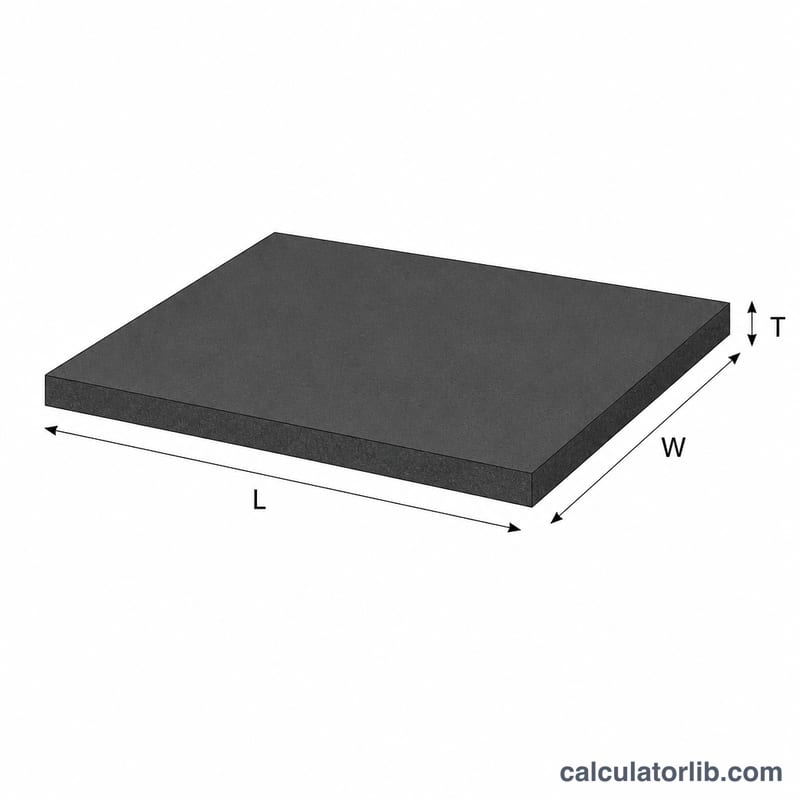
Enter the length and width of the area in feet, the compacted thickness in inches, and the asphalt density in pounds per cubic foot. Standard dense-graded hot-mix asphalt weighs roughly 145 lb/ft³, which is the default. Click calculate to get the required tonnage, plus volume and total weight.
The formula explained
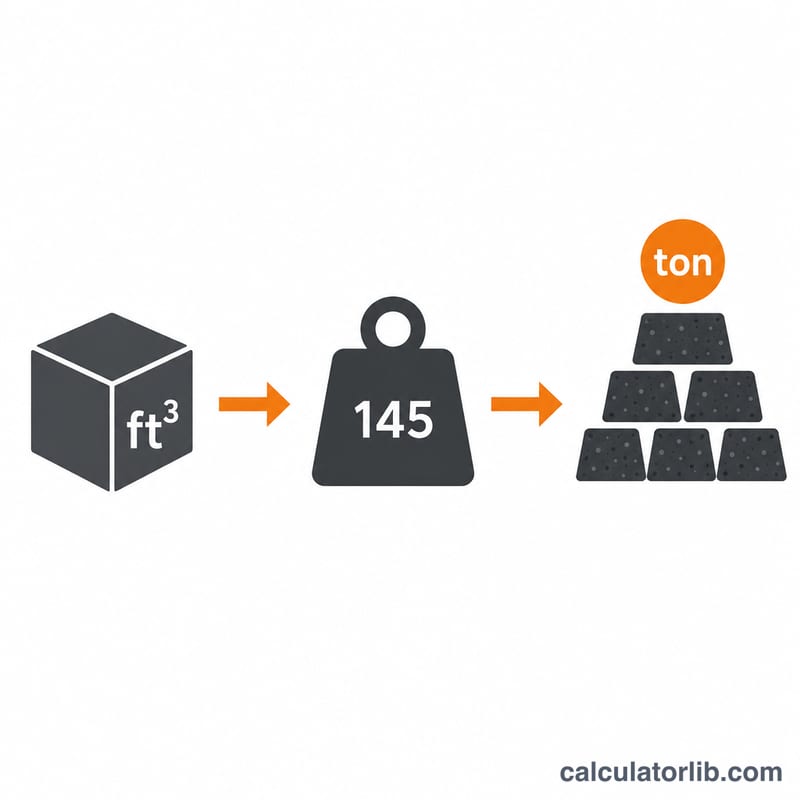
First, thickness is converted from inches to feet by dividing by 12. The volume in cubic feet is Length × Width × Thickness(ft). That volume is multiplied by the density (lb/ft³) to get total weight in pounds, then divided by 2000 (pounds per US short ton) to get tons.
$$\text{Tons} = \frac{\text{Length (ft)} \times \text{Width (ft)} \times \dfrac{\text{Thickness (in)}}{12} \times \text{Density (lb/ft}^3\text{)}}{2000}$$
Worked example
For a driveway 100 ft long, 20 ft wide, paved 3 inches thick at 145 lb/ft³: thickness = \(3 \div 12 = 0.25\) ft. Volume = \(100 \times 20 \times 0.25 = 500\) ft³. Weight = \(500 \times 145 = 72{,}500\) lb. Tons = \(72{,}500 \div 2000 =\) 36.25 tons.
Recommended Asphalt Thickness by Application
Asphalt thickness is specified as the compacted depth (after rolling), which is what your tonnage calculation should be based on. Loose-laid mix compacts down roughly 20–25%, so a paver crew lays it thicker than the final number. The ranges below are typical for residential and light-commercial work; always defer to a geotechnical engineer or local DOT spec for public roads.
| Application | Compacted thickness | Course type | Notes |
|---|---|---|---|
| Residential driveway | 2–3 in | Surface (or single lift) | 2 in over a solid aggregate base; 3 in if vehicles are heavy or base is marginal. |
| Parking lot (passenger cars) | 3–4 in | Base + surface | Typically 2–3 in base course plus 1–1.5 in surface course. |
| Roads / heavy traffic | 4–6+ in | Base + binder + surface | Multiple lifts; thickness driven by traffic loading and subgrade strength. |
| Base course (any job) | 2–4 in per lift | Base | Coarser, larger aggregate; provides structural support. |
| Surface (wearing) course | 1–2 in | Surface | Finer mix for smoothness, skid resistance and weatherproofing. |
When a section is built in multiple lifts, calculate tonnage for each lift separately (each at its own thickness) and add them together.
Asphalt Density by Mix Type
The calculator defaults to 145 lb/ft³, the standard figure for compacted dense-graded hot-mix asphalt (HMA). Different mix designs have meaningfully different densities, so changing the density field to match your actual mix improves accuracy. Compacted in-place densities generally fall between about 110 and 150 lb/ft³.
| Mix type | Approx. density (lb/ft³) | When to use it |
|---|---|---|
| Dense-graded HMA | ~145 | Most driveways, lots and roads; the all-purpose default. |
| Base course HMA | ~140–148 | Structural lower lifts under the surface course. |
| Stone Matrix Asphalt (SMA) | ~145–150 | High-traffic, rut-resistant surfaces; gap-graded with stone-on-stone contact. |
| Open-graded friction course | ~110–125 | Surface drainage and reduced splash on highways; high void content. |
| Porous / permeable asphalt | ~100–120 | Stormwater infiltration in lots and walkways; very high voids. |
| Recycled / RAP mixes | ~140–148 | Cost-saving mixes using reclaimed asphalt pavement; close to dense-graded. |
Open-graded and porous mixes weigh less for the same volume because of their intentional air voids, so using 145 lb/ft³ for them will over-estimate tonnage. Always confirm the design density with your supplier's mix sheet.
Tonnage for Common Paving Jobs
The examples below all use the default density of 145 lb/ft³. Volume is computed as length × width × (thickness ÷ 12) in cubic feet, then weight is volume × 145, divided by 2000 to get U.S. short tons. None of these include a waste allowance — see the ordering guidance below.
| Job | Dimensions (L × W × T) | Volume (ft³) | Tons @ 145 lb/ft³ |
|---|---|---|---|
| Single driveway | 100 ft × 20 ft × 3 in | 500 | 36.25 |
| Short driveway / apron | 40 ft × 12 ft × 2 in | 80 | 5.8 |
| Small parking lot | 120 ft × 80 ft × 3 in | 2,400 | 174 |
| Road segment | 500 ft × 24 ft × 4 in | 4,000 | 290 |
Worked example for the single driveway: \( \text{Tons} = \dfrac{100 \times 20 \times \frac{3}{12} \times 145}{2000} = \dfrac{500 \times 145}{2000} = \dfrac{72{,}500}{2000} = 36.25 \) tons. Once you have a tonnage, you can extend it into a budget with an asphalt driveway cost calculator using the same length, width, thickness and density plus a per-ton price and labor figure.
How Much Asphalt to Order
The calculated tonnage is the theoretical amount of compacted material in your slab. Real jobs need a little more, so use the calculated figure as a starting point and adjust before placing the order.
- Add 5–10% for waste and compaction. Allow for spillage, edge spread, uneven subgrade and material left in the truck. For a clean rectangular driveway 5% is usually enough; for irregular shapes or hand-work, lean toward 10%. Example: 36.25 tons × 1.10 ≈ 40 tons to order.
- Round up to delivery increments. Asphalt is sold and trucked in bulk; many suppliers deliver in full truckloads (often ~20–25 tons) or charge minimums for partial loads. Round up to the nearest practical increment rather than ordering an exact fractional figure.
- Confirm the density with your supplier. The 145 lb/ft³ default is a good estimate for dense-graded HMA, but your actual mix may differ. Ask for the design density on the mix sheet and re-run the calculation with that value, especially for open-graded or porous mixes.
- Watch short tons vs. metric tonnes. This calculator returns U.S. short tons (2,000 lb). A metric tonne is 1,000 kg ≈ 2,205 lb, so one short ton ≈ 0.907 metric tonnes. If your supplier quotes in metric tonnes, convert before comparing prices and order quantities.
This is general planning information, not engineering advice. For structural pavement design, traffic loading and base requirements, consult a qualified paving contractor or engineer.
FAQ
What density should I use? Most hot-mix asphalt is 142–148 lb/ft³; 145 is a safe average. Your supplier may quote a specific value.
Should I order extra? Yes — add about 5–10% for waste, compaction variation, and uneven subgrade.
What is a "ton" here? A US short ton of 2,000 pounds. If your supplier uses metric tonnes, divide pounds by 2,204.62 instead.