
What This Calculator Does
The Asphalt Driveway Cost Calculator estimates how much it will cost to pave a driveway with hot-mix asphalt. By entering your driveway dimensions, the desired asphalt thickness, material density, the price per ton of asphalt, and a figure for labor and other costs, you get a fast, realistic budget — including how many tons of asphalt you'll actually need.
How to Use It
Measure your driveway length and width in feet. Choose a thickness — most residential driveways use 2–3 inches of asphalt over a compacted base. The default density of 145 lb/ft³ is typical for compacted hot-mix asphalt. Enter the price your supplier quotes per ton and add your estimated labor, equipment, and prep costs. Prices vary by region and currency, so use quotes from your local contractor.
The Formula Explained
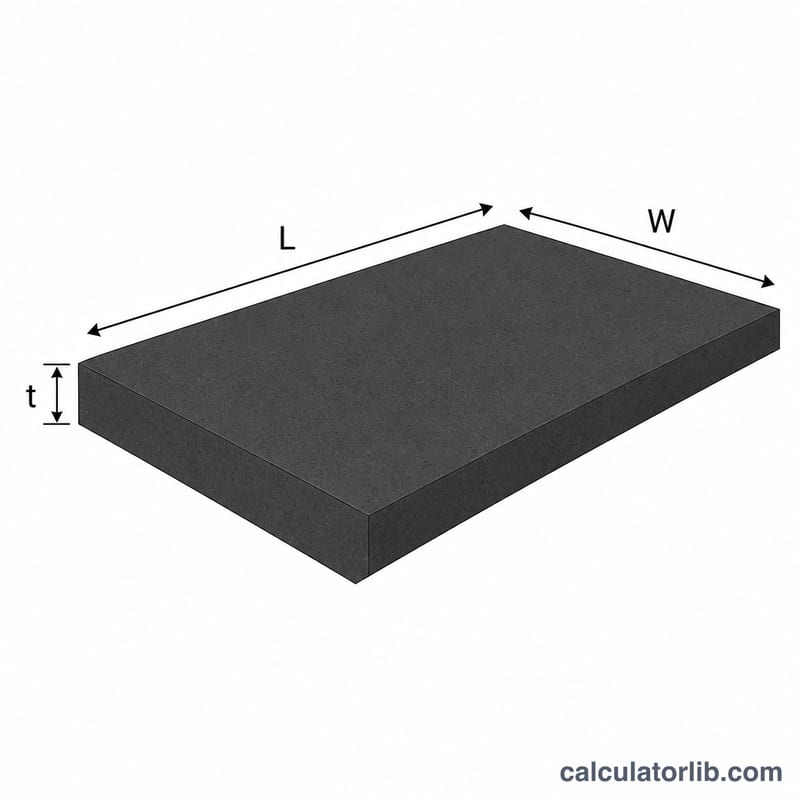
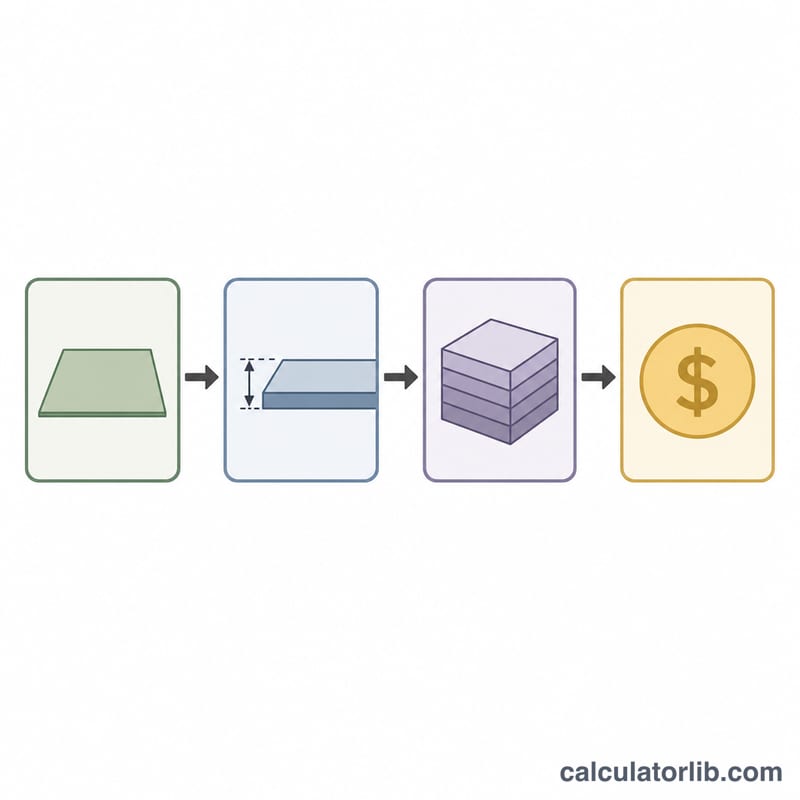
First the surface area is found: \(\text{area} = \text{length} \times \text{width}\). The thickness is converted from inches to feet (÷12) and multiplied by the area to get volume in cubic feet. Multiplying volume by density gives the weight in pounds, and dividing by 2000 converts pounds to US tons. Finally, tons × price per ton gives material cost, and labor is added for the total.
$$\begin{gathered} \text{Total Cost} = \frac{L \cdot W \cdot \frac{T}{12} \cdot D}{2000} \times \text{Price/Ton} + \text{Labor} \\[1.5em] \text{where}\quad \left\{ \begin{aligned} L &= \text{Length (ft)} \\ W &= \text{Width (ft)} \\ T &= \text{Thickness (in)} \\ D &= \text{Density (lb/ft}^3\text{)} \end{aligned} \right. \end{gathered}$$
Worked Example
A 40 ft × 12 ft driveway = 480 ft². At 3 inches (0.25 ft) thick, volume:
$$480 \times 0.25 = 120 \text{ ft}^3$$
With density 145 lb/ft³, weight:
$$120 \times 145 = 17{,}400 \text{ lb} = 8.7 \text{ tons}$$
At $120/ton, material = $1,044. Add $1,500 labor:
$$8.7 \times 120 + 1500 = \$2{,}544 \text{ total}$$
Practical Paving Tips
- Order 5–10% extra. Add a waste/compaction allowance so you don't run short mid-job. Hot mix compacts as it's rolled and edges/irregular shapes always consume more than the bare math suggests.
- Round up to what suppliers sell. Asphalt plants typically sell by the whole or half ton, so round your computed tonnage up rather than down.
- Confirm base prep and old-surface removal are in the quote. A proper compacted aggregate sub-base is critical to driveway life. Make sure tear-out and disposal of any existing surface are listed line items, not surprises.
- Pave in warm, dry weather. Hot-mix asphalt places and compacts best in mild-to-warm temperatures on a dry base; avoid paving in cold or wet conditions.
- Get multiple local quotes. Price per ton and labor rates vary significantly by region and season, so compare at least two or three contractors before committing.
This is general guidance only, not a substitute for an on-site assessment by a licensed paving contractor. Always verify dimensions, base requirements and local pricing before purchasing.
Typical Asphalt Thickness & Density Values
Use these standard values as starting points. Your local code, soil conditions and expected traffic load determine the right spec — when in doubt, follow the contractor's or engineer's recommendation.
| Item | Typical value | Notes / use case |
|---|---|---|
| Residential driveway (compacted asphalt) | 2"–3" | Cars and light vehicles; 3" gives a longer-lasting surface. |
| Heavy / commercial use | 3"–4" | Trucks, RVs, frequent or heavy loads. |
| Compacted hot-mix density | ≈140–150 lb/ft³ (default 145) | Used to convert volume to tons; dense-graded HMA falls in this range. |
| Aggregate base / sub-base depth | 4"–8" | Compacted crushed stone under the asphalt; thicker for poor or soft soils. |
Note that the thickness entered in the calculator is the finished, compacted asphalt layer — the aggregate base depth is separate and is usually priced as gravel. The density figure only affects how many tons your volume converts to; raising it from 145 to 150 lb/ft³ increases tonnage (and material cost) by roughly 3.4%.
FAQ
How thick should an asphalt driveway be? For passenger cars, 2–3 inches of compacted asphalt over a solid base is standard; heavier loads may need more.
Why divide by 2000? One US ton equals 2000 pounds, so dividing total pounds by 2000 converts the material weight into the tons that suppliers price by.
Is the estimate exact? No — it's a planning estimate. Actual costs depend on site prep, removal of old surface, grading, drainage, and local labor rates. Always get a contractor quote.