What Is the Rebar Weight Calculator?
This tool estimates the weight of steel reinforcement bars (rebar) used in concrete construction. Enter the bar diameter, the length of each bar, and how many bars you have, and it returns the unit weight (kg per metre), the weight of one bar, the total weight in kilograms and tonnes, plus total length. It is useful for ordering steel, estimating material cost, and checking delivery quantities.
How to Use It
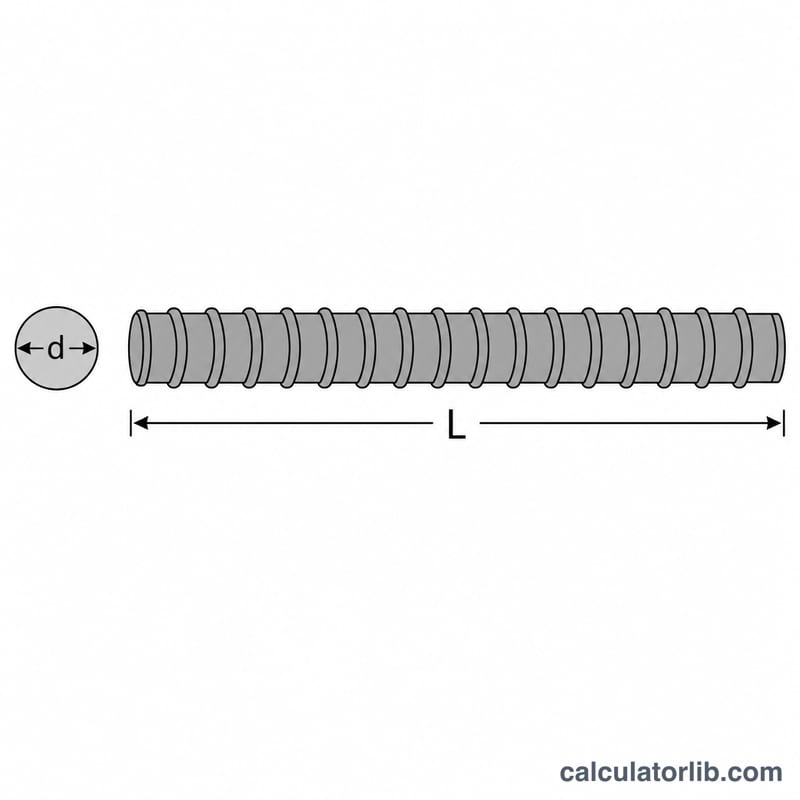
1. Enter the bar diameter in millimetres (common sizes: 8, 10, 12, 16, 20, 25, 32 mm). 2. Enter the length of a single bar in metres (standard stock is often 12 m). 3. Enter the number of bars. The calculator instantly shows the weight breakdown.
The Formula Explained
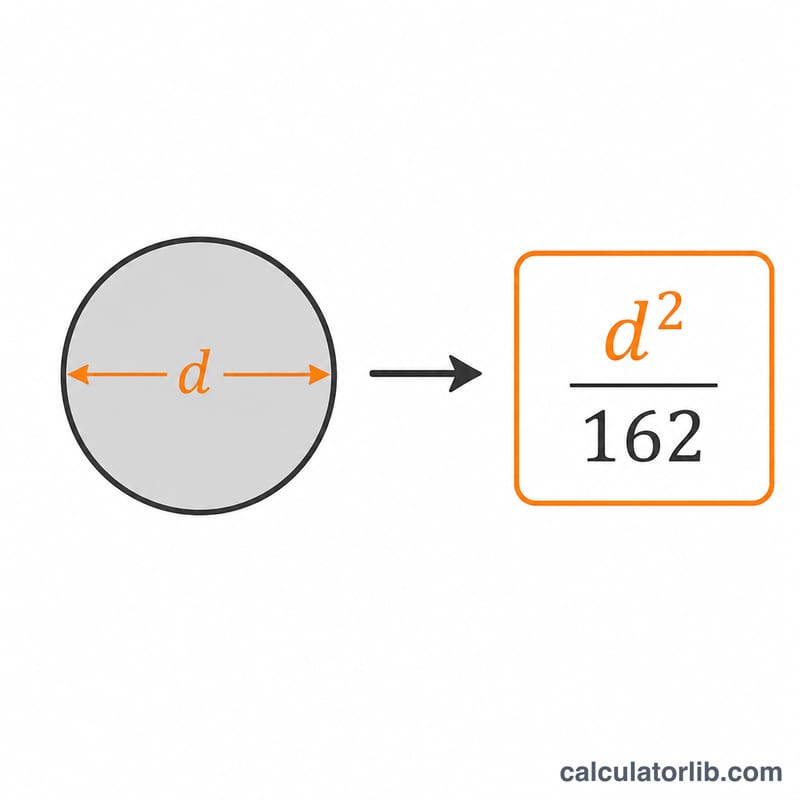
The widely used shortcut for the weight of a round steel bar is \(W = d^{2} / 162\), giving kilograms per metre when the diameter d is in millimetres. This is derived from the density of steel (about 7850 kg/m³) combined with the cross-sectional area \(\pi d^{2}/4\), which simplifies to \(d^{2}/162.2 \approx d^{2}/162\). The full formula is:
$$W = \frac{\text{Diameter (mm)}^{2}}{162} \times \text{Length (m)} \times \text{No. of Bars}$$Multiply the unit weight by the bar length and the number of bars to get the total weight.
Worked Example
For a 16 mm bar that is 12 m long, with 10 bars: unit weight =
$$16^{2} / 162 = 256 / 162 = 1.5802 \text{ kg/m}$$Weight per bar =
$$1.5802 \times 12 = 18.963 \text{ kg}$$Total weight =
$$18.963 \times 10 = 189.63 \text{ kg} \approx 0.19 \text{ tonnes}$$Total length =
$$12 \times 10 = 120 \text{ m}$$Standard Rebar Sizes and Unit Weights
The unit weight (mass per metre) of a plain round steel bar follows directly from its nominal diameter. The widely used shortcut is
$$W_{\text{unit}} = \frac{d^2}{162}\ \text{kg/m}$$where \(d\) is the nominal diameter in millimetres. The constant comes from the cross-sectional area times the density of steel, taken as 7850 kg/m³:
$$\frac{\pi}{4} \times d^2 \times 7850 \times 10^{-6} = \frac{d^2}{162.28}$$Rounding 162.28 down to 162 is the convention used in Indian Standard practice (IS 1786 / IS 2502 bar-bending schedules) and in many other metric markets; it overstates weight by about 0.17%, which is harmless for ordering. Published nominal masses in other standards (EN 10080 / BS 4449, ASTM A615) are derived the same way but rounded differently, so a supplier's table may differ from the values below in the last decimal place.
| Nominal diameter (mm) | Cross-sectional area (mm²) | Unit weight, \(d^2/162\) (kg/m) | Weight of one 12 m bar (kg) |
|---|---|---|---|
| 6 | 28.3 | 0.222 | 2.67 |
| 8 | 50.3 | 0.395 | 4.74 |
| 10 | 78.5 | 0.617 | 7.41 |
| 12 | 113.1 | 0.888 | 10.67 |
| 16 | 201.1 | 1.580 | 18.96 |
| 20 | 314.2 | 2.469 | 29.63 |
| 25 | 490.9 | 3.858 | 46.30 |
| 28 | 615.8 | 4.839 | 58.07 |
| 32 | 804.2 | 6.321 | 75.85 |
| 36 | 1017.9 | 8.000 | 96.00 |
| 40 | 1256.6 | 9.877 | 118.52 |
Two practical notes. First, the area column is the nominal area used for design (steel area \(A_s\)); the weight column is what you pay for. Second, ribs and deformations are already accounted for — nominal diameter and nominal mass are defined so that a deformed bar weighs the same as a plain round bar of that diameter, within the mass tolerance of the governing standard (commonly ±4.5% to ±7% per bar depending on size and code).
Metric vs Imperial Bar Sizes and Weight Units
In the United States and some markets that follow US practice, rebar is specified by a bar number under ASTM A615/A706 rather than by a diameter in millimetres. The bar number is the nominal diameter in eighths of an inch: #4 is 4/8 in = 0.500 in, #8 is 8/8 in = 1.000 in. The table maps the common designations to metric diameters and unit weights computed with \(d^2/162\), then converted to pounds per foot.
| US bar size | Nominal diameter (in) | Nominal diameter (mm) | Unit weight (kg/m) | Unit weight (lb/ft) |
|---|---|---|---|---|
| #3 | 0.375 | 9.5 | 0.557 | 0.374 |
| #4 | 0.500 | 12.7 | 0.996 | 0.669 |
| #5 | 0.625 | 15.9 | 1.561 | 1.049 |
| #6 | 0.750 | 19.1 | 2.252 | 1.513 |
| #7 | 0.875 | 22.2 | 3.042 | 2.044 |
| #8 | 1.000 | 25.4 | 3.982 | 2.676 |
| #10 | 1.270 | 32.3 | 6.440 | 4.328 |
| #11 | 1.410 | 35.8 | 7.911 | 5.316 |
These are close but not identical to the official ASTM nominal weights (for example ASTM lists #8 as 2.670 lb/ft against 2.676 lb/ft here), because \(d^2/162\) uses a rounded constant and a rounded millimetre diameter. For ordering and estimating the difference is under 0.5%; for contractual weight certification, use the nominal mass printed in the governing standard.
Weight and length unit conversions:
| From | To | Multiply by |
|---|---|---|
| 1 tonne (metric ton) | kilograms | 1000 |
| 1 tonne (metric ton) | pounds | 2204.62 |
| 1 kg/m | lb/ft | 0.672 |
| 1 lb/ft | kg/m | 1.488 |
| 1 kg | pounds | 2.20462 |
| 1 metre | feet | 3.28084 |
Watch the ton. One US short ton = 2000 lb = 907.18 kg, which is about 9.3% lighter than a metric tonne; the UK long ton = 2240 lb = 1016.05 kg. A quote "per ton" from a US supplier and a quote "per tonne" from a metric supplier are not the same unit, so convert both to kilograms before comparing. This calculator reports kilograms and metric tonnes.
Ordering and Site Planning Tips
The calculator gives the theoretical weight of the bars you describe. Turning that into a purchase order takes a few extra steps.
- Use cutting lengths, not member lengths. Before entering a length, add the hook, bend and anchorage allowances from the bar-bending schedule, and remember that bends shorten a bar relative to its outside dimensions. Stirrups, ties, links, chairs, spacers and starter bars are real steel and are often forgotten — total them as separate size-and-length groups and run each group through the calculator.
- Add laps and wastage on top. A common estimating allowance is 3–5% for simple, long, straight runs and up to 7–10% where there are many laps, bends, small cut-offs or congested detailing. Where lap splices are explicitly scheduled (typically 40–50 bar diameters, per the project's design code), count them in the cutting lengths and keep the percentage allowance only for offcut wastage so you do not double-count.
- Work in whole stock bars and round up. Mills supply fixed lengths — 12 m is the most common metric stock length, with 6 m and 18 m also available in many markets, while US suppliers typically stock 20 ft, 40 ft and 60 ft. You cannot buy 7.3 bars, so divide your total cutting length by the stock length, round the bar count up, and plan cuts so the remainder of each bar is reused elsewhere.
- Convert units before comparing quotes. Suppliers price by kilogram, by metric tonne, by short ton or sometimes per bar. Reduce every quote to a price per kilogram for the same grade and diameter, and check whether the price is for theoretical (nominal) weight or actual weighbridge weight — they differ by the mass tolerance of the standard.
- Check deliveries by weight and by count. Theoretical weight is a nominal figure; a delivered bundle may legitimately vary by a few percent per bar under the governing standard. Verify bar count, diameter with a calliper or gauge, and mill markings for grade, in addition to the weighbridge ticket.
Worked example
A slab needs 120 bars of 16 mm diameter, each cut to 12 m (cutting length already includes hooks):
$$W = \frac{16^2}{162} \times 12 \times 120 = \frac{256}{162} \times 1440 = 1.580 \times 1440 = 2275.56\ \text{kg}$$So the theoretical requirement is 2275.56 kg, or about 2.276 tonnes. Adding a 5% offcut and wastage allowance gives 2275.56 × 1.05 = 2389.34 kg, which is 2.39 tonnes to order. Because each bar is exactly one 12 m stock length, the order is 120 bars plus 6 spare bars (5% of 120 = 6), i.e. 126 bars.
These allowances and stock lengths are general industry practice and vary by country, mill and project specification. The structural drawings, bar-bending schedule and governing design code always take precedence over any rule of thumb here.
FAQ
Why d²/162 and not d²/162.2? 162 is the rounded site-standard divisor; the precise value is 162.28. The small difference is negligible for ordering.
Does it work for any bar size? Yes — the formula applies to any round steel bar diameter you enter.
How do I convert to tonnes? Divide the total kilograms by 1000, which this calculator does for you.