What is the Lumber Weight Calculator?
The Lumber Weight Calculator estimates how much a piece — or a stack — of wood weighs based on its dimensions and the density of the species. This is handy for planning shipping costs, sizing vehicle loads, checking structural limits, or simply knowing whether you can lift a board yourself. Wood weight depends heavily on species and moisture content, so the result is an estimate based on the density you supply.
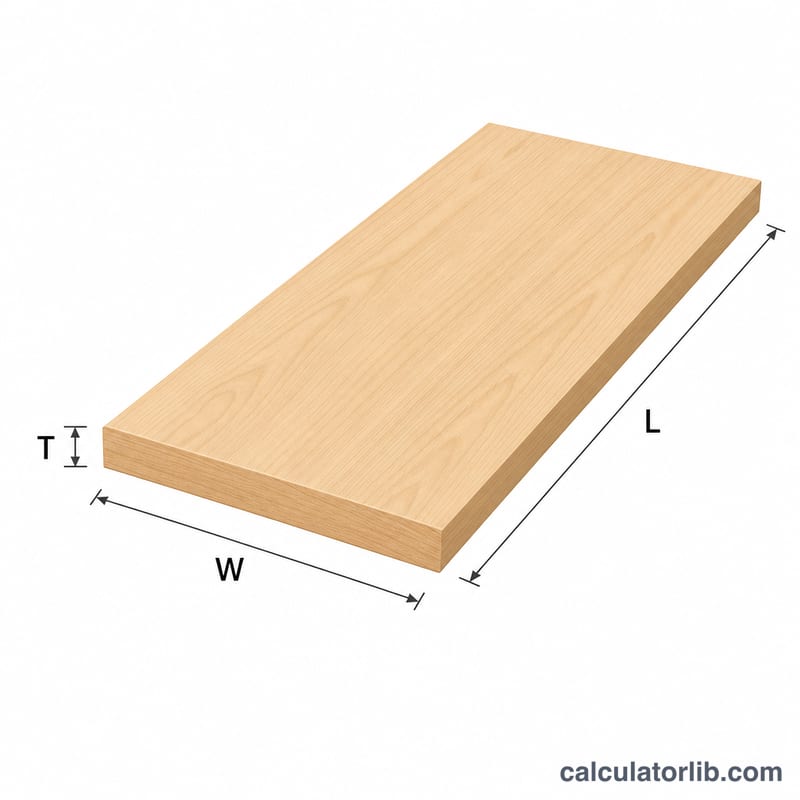
How to use it
Enter the board's thickness, width, and length — all in inches. Add the number of pieces and the wood density in pounds per cubic foot (lb/ft³). Typical dry densities range from about 25 lb/ft³ for softwoods like pine to 45+ lb/ft³ for dense hardwoods such as oak. The calculator returns the weight per piece and the total weight, plus the computed volume.
The formula explained
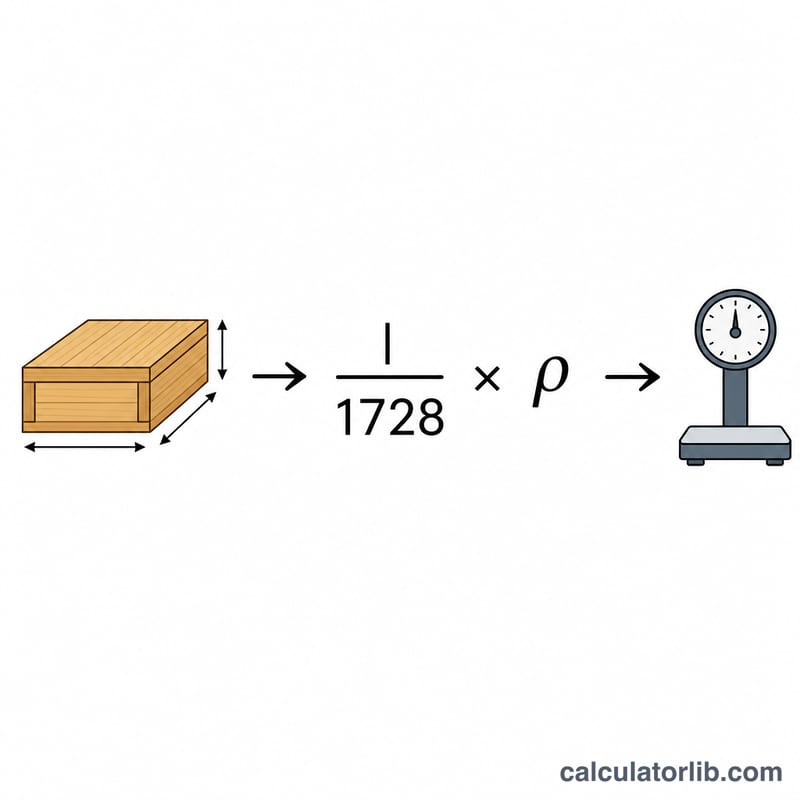
First the volume is found in cubic feet: multiply thickness × width × length (all in inches) and divide by 1728, since there are 1,728 cubic inches in a cubic foot. Then multiply that volume by the wood density to get weight. For multiple identical pieces, the totals are simply scaled by the piece count.
$$\text{Weight} = \frac{\text{Thickness} \times \text{Width} \times \text{Length}}{1728} \times \text{Pieces} \times \text{Density}$$
Worked example
A 2 × 4 board that is 96 inches long (a standard 8-foot stud) with a density of 35 lb/ft³: volume = $$\frac{2 \times 4 \times 96}{1728} = \frac{768}{1728} = 0.4444 \text{ ft}^3.$$ Weight = \(0.4444 \times 35 \approx 15.56\) lb per piece. For 10 such boards the total weight is about 155.6 lb.
Wood Density by Species (lb/ft³)
The calculator needs a density figure, and density is the single biggest source of error in a lumber weight estimate — oak is roughly twice as heavy as white pine for the same board size. The values below are typical kiln-dried densities at about 12% moisture content, which is the normal service condition for interior and covered construction lumber. They are consistent with the species data published in the Wood Handbook — Wood as an Engineering Material (USDA Forest Service, Forest Products Laboratory), a US reference; species names such as "SPF" (spruce-pine-fir) and "Douglas fir-larch" are North American commercial grade groupings rather than single botanical species.
| Material / species | Density (lb/ft³) | Density (kg/m³) |
|---|---|---|
| Western red cedar | 23 | ≈ 368 |
| Eastern white pine | 25 | ≈ 400 |
| SPF (spruce-pine-fir) | 27 | ≈ 433 |
| Redwood | 28 | ≈ 449 |
| Poplar (yellow-poplar) | 29 | ≈ 465 |
| Douglas fir-larch | 34 | ≈ 545 |
| Southern yellow pine | 37 | ≈ 593 |
| Black walnut | 38 | ≈ 609 |
| Birch | 43 | ≈ 689 |
| Hard (sugar) maple | 44 | ≈ 705 |
| Red oak | 45 | ≈ 721 |
| White oak | 47 | ≈ 753 |
| Hickory | 51 | ≈ 817 |
| Softwood plywood | 34–36 | ≈ 545–577 |
| OSB (oriented strand board) | 40 | ≈ 641 |
| MDF (medium-density fiberboard) | 45–50 | ≈ 721–801 |
Two cautions. First, individual boards vary: within one species, density commonly ranges ±10% around the table value, and slow-grown or dense-grained pieces can exceed it. Second, moisture matters enormously. Freshly sawn (green) lumber may hold 40–100%+ moisture by dry weight, so a green board can weigh 30–80% more than the kiln-dried figure above — softwoods sold "green" or "S-GRN" and lumber stacked outdoors in the rain both fall into this range. Pressure-treated lumber leaves the plant saturated with waterborne preservative solution and is also much heavier than the table suggests until it air-dries.
To convert any of these figures yourself: \(1\ \text{lb/ft}^3 = 16.0185\ \text{kg/m}^3\).
FAQ
Should I use nominal or actual dimensions? Use the actual measured dimensions for accuracy. A nominal "2×4" actually measures about 1.5 × 3.5 inches when dressed.
What density should I enter? Use the density for your species at the relevant moisture content. Green (wet) lumber can weigh substantially more than kiln-dried wood.
Does this work in metric? This version expects inches and lb/ft³. Convert your metric figures first, or use a metric tool.