
What the Lumber Shrinkage Calculator Does
Wood loses moisture as it dries, and as that moisture leaves the cells the board physically gets smaller. This Lumber Shrinkage Calculator estimates how much a piece of lumber will shrink across all three dimensions and how its total volume changes. It is a practical planning tool for woodworkers, carpenters, sawyers and construction professionals who need to account for dimensional loss before cutting, milling or ordering material.
The Inputs You Provide
- Initial Width (inches) – the board's starting width.
- Initial Thickness (inches) – the board's starting thickness.
- Initial Length (feet) – the board's starting length.
- Shrinkage Percentage (%) – the expected shrinkage for the wood species and moisture change, applied equally to each dimension.
Note that width and thickness are entered in inches while length is in feet, so the volume figure is a mixed unit (inch × inch × foot) used here purely for comparing before-and-after sizes consistently.
The Formula
The calculator first builds a shrinkage factor:
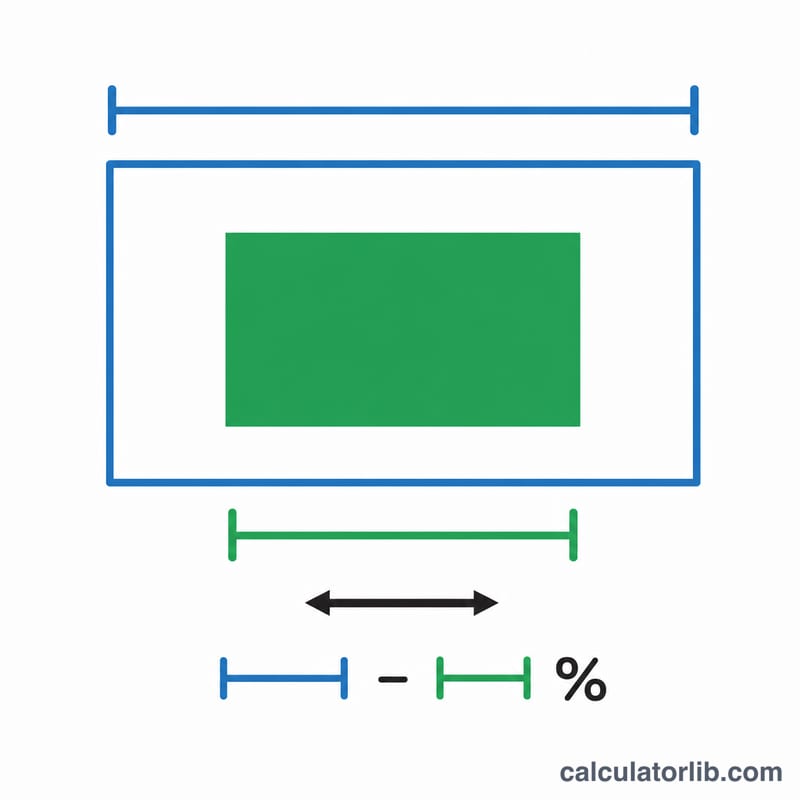
- Shrinkage factor = 1 − (Shrinkage % ÷ 100)
- Final dimension = Initial dimension × shrinkage factor (applied to width, thickness and length)
- Initial volume = Width × Thickness × Length
- Final volume = Final width × Final thickness × Final length
- Volume change = Initial volume − Final volume
- Volume change % = (Volume change ÷ Initial volume) × 100
Worked Example
Suppose you have a board 6 inches wide, 2 inches thick and 8 feet long, with an expected shrinkage of 5%.
- Shrinkage factor = \(1 - 0.05 = 0.95\)
- Final width = \(6 \times 0.95 = 5.7\) in
- Final thickness = \(2 \times 0.95 = 1.9\) in
- Final length = \(8 \times 0.95 = 7.6\) ft
- Initial volume = \(6 \times 2 \times 8 = 96\)
- Final volume = \(5.7 \times 1.9 \times 7.6 = 82.31\)
- Volume change \(\approx 13.69\), or about \(14.26\%\)
Because shrinkage applies to all three dimensions, the volume drop (≈14.3%) is roughly three times the linear shrinkage (5%).
Frequently Asked Questions
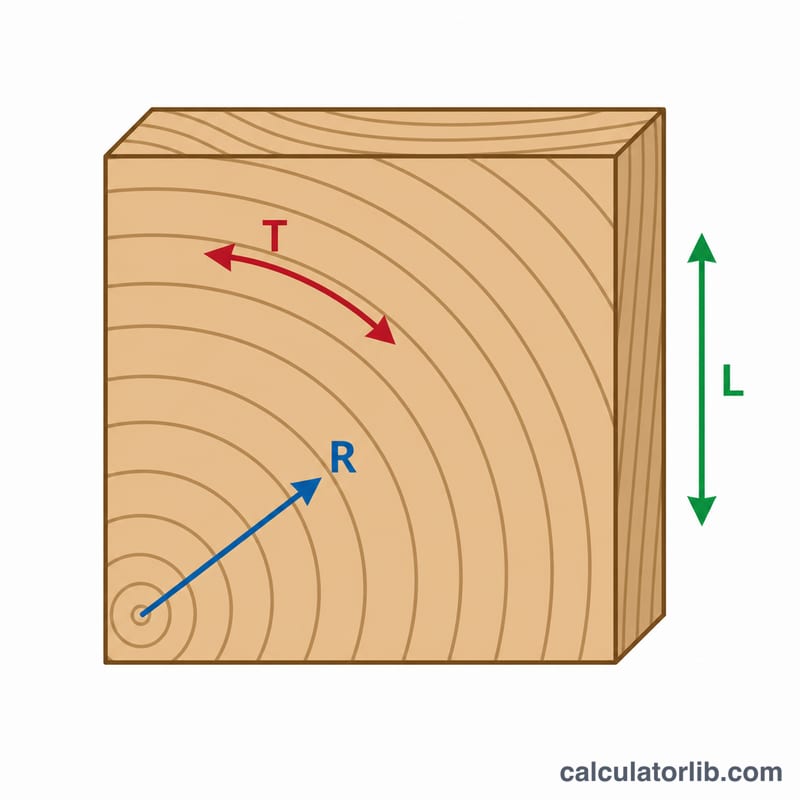
Does real lumber shrink equally in every direction? No. In practice wood shrinks most across the grain (tangentially), less radially, and very little along its length. This tool applies one uniform percentage to keep the estimate simple, so treat the length figure as a worst-case approximation.
What shrinkage percentage should I use? It depends on species and the change in moisture content. Many softwoods and hardwoods fall in the 3–8% range from green to dry. Check species shrinkage data and adjust accordingly.
Why is the volume change percentage bigger than my input? Because the same factor multiplies width, thickness and length together, the percentage losses compound, producing a larger overall volume reduction than the single-dimension figure.