
What the Fertilizer Calculator Does
This Fertilizer Calculator helps lawn owners and gardeners work out exactly how much fertilizer product to buy and spread, based on the nutrient strength of the bag and how much nutrient your lawn needs. It uses the standard US lawn-care convention of measuring application rates in pounds per 1,000 square feet, so it is built around imperial units (square feet and pounds). Instead of guessing, you get the total fertilizer weight to apply plus a breakdown of nitrogen (N), phosphorus (P) and potassium (K).
The Inputs You Provide
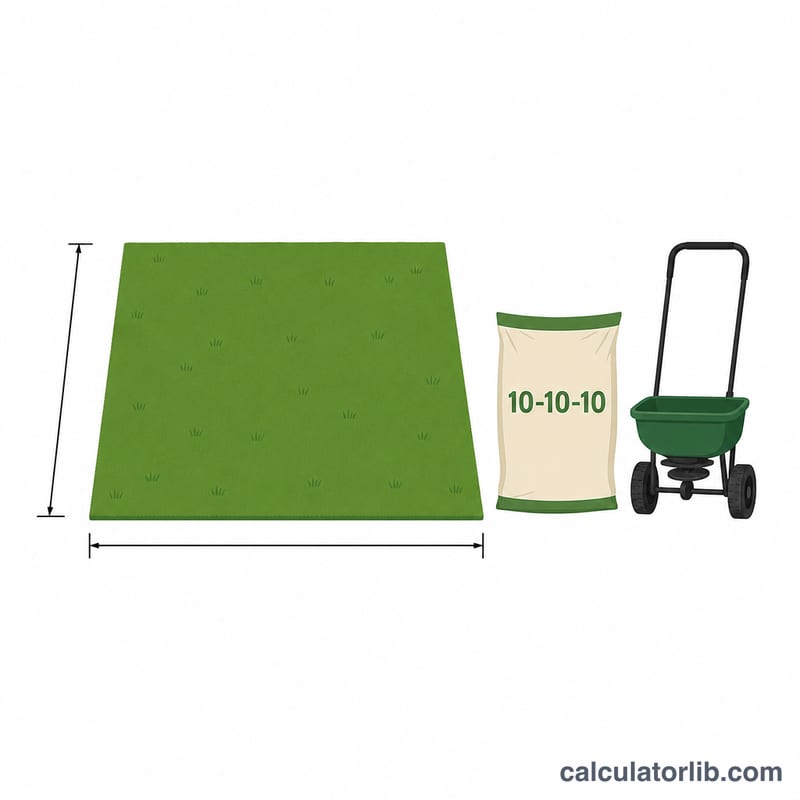
- Lawn Size (square feet): the total area you want to treat.
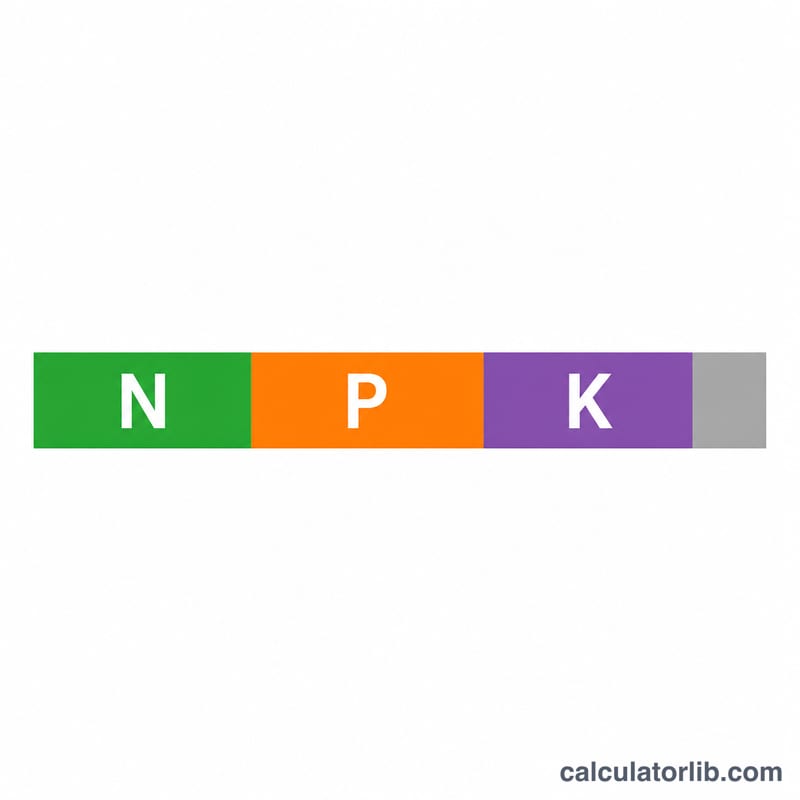
- Fertilizer N-P-K Ratio (N, P, K): the three numbers printed on the bag, e.g. 10-10-10 or 16-4-8. Each represents the percentage of that nutrient by weight.
- Application Rate (lbs per 1,000 sq ft): the amount of actual nutrient you want to deliver per 1,000 square feet — typically the target pounds of nitrogen.
The Formula Explained
The calculator works in three steps:
- Nutrient needed: \( \text{fertilizeRate} = \left( \dfrac{\text{Lawn Size}}{1{,}000} \right) \times \text{Application Rate} \)
- Total fertilizer: \( \text{totalFertilizer} = \dfrac{\text{fertilizeRate}}{\text{totalRatio} \div 100} \), where \( \text{totalRatio} = N + P + K \)
- Nutrient split: \( \text{each nutrient amount} = \text{totalFertilizer} \times \dfrac{\text{that ratio}}{\text{totalRatio}} \)
Because the bag's numbers only describe a fraction of its weight, the calculator "grosses up" the nutrient target into the actual product weight you must spread.
Worked Example
Suppose you have a 5,000 sq ft lawn, a 10-10-10 fertilizer (N=10, P=10, K=10, so totalRatio = 30), and an application rate of 2 lbs per 1,000 sq ft.
- $$ \text{fertilizeRate} = \left( \frac{5{,}000}{1{,}000} \right) \times 2 = 10 \text{ lbs of nutrient} $$
- $$ \text{totalFertilizer} = \frac{10}{30 \div 100} = \frac{10}{0.30} = 33.33 \text{ lbs of product} $$
- $$ \text{Nitrogen} = 33.33 \times \frac{10}{30} = 11.11 \text{ lbs}; \quad \text{phosphorus and potassium each} = 11.11 \text{ lbs} $$
So you would spread about 33.3 pounds of the 10-10-10 product across the lawn.
Frequently Asked Questions
What do the N-P-K numbers mean? They are the percentage by weight of nitrogen, phosphorus and potassium in the bag. A 16-4-8 bag is 16% N, 4% P and 8% K, with the rest being filler and carrier material.
Why does the total weight exceed my application rate? The application rate is the nutrient you want to deliver, but the bag is only part nutrient. Dividing by the combined ratio percentage converts that target into the larger amount of actual product to spread.
What application rate should I use? Many cool-season lawns target around 1 lb of nitrogen per 1,000 sq ft per feeding. Check your bag's label and local guidance, then enter that figure as the application rate.