
What the EV Mileage Calculator Does
This calculator works out how far your electric vehicle travels per unit of energy by measuring how much of your battery you actually used over a trip. Instead of relying on the manufacturer's estimate, it uses your real driving data — the distance covered and the change in your state of charge — to reveal true efficiency. It works with any unit system, but the inputs below assume miles for distance, so the result is expressed as miles per kilowatt-hour (mi/kWh).
The Inputs You Provide
- Total Distance (miles): how far you drove during the measured trip.
- Battery Capacity (kWh): the usable size of your battery pack, e.g. 60 kWh.
- Initial Charge (%): the battery percentage when you started.
- Final Charge (%): the battery percentage when you finished.
The Formula Explained
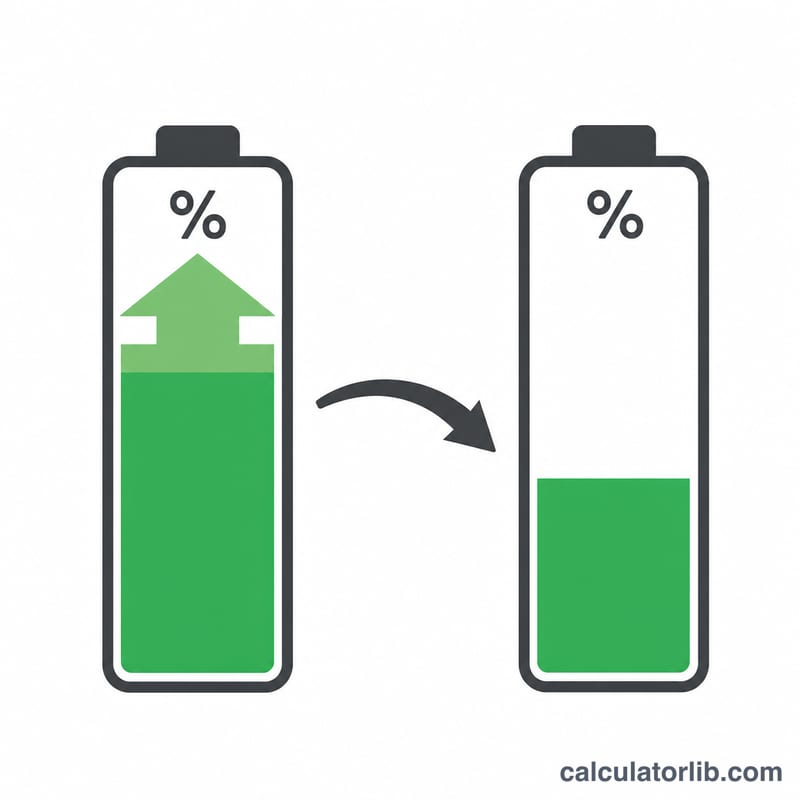
The tool first finds the energy you consumed:
$$\text{Energy Used (kWh)} = \text{Battery Capacity} \times \frac{\text{Initial Charge} - \text{Final Charge}}{100}$$
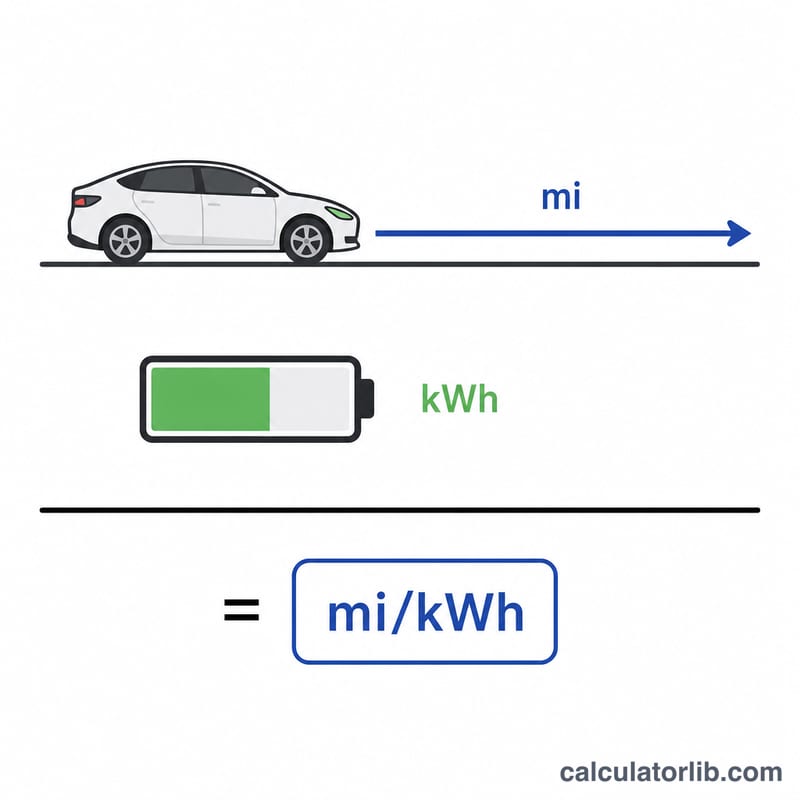
It then divides distance by that energy to get your mileage:
$$\text{Mileage} = \frac{\text{Distance}}{\text{Energy Used}}$$
It also reports an efficiency figure — energy used per mile, shown as a percentage scale (\(\text{Energy Used} \div \text{Distance} \times 100\)), which helps compare consumption across trips.
Worked Example
Suppose you drove 120 miles in a car with a 60 kWh battery, starting at 90% and ending at 50%.
- Charge used: \(90 - 50 = 40\%\)
- Energy used: \(60 \times 40 \div 100 = 24 \text{ kWh}\)
- Mileage: \(120 \div 24 =\) 5 mi/kWh
- Efficiency value: \(24 \div 120 \times 100 = 20\) (i.e. 0.2 kWh per mile)
So your EV achieved 5 miles for every kilowatt-hour — a strong efficiency figure for typical mixed driving.
Frequently Asked Questions
What is a good mi/kWh figure? Most EVs deliver between 3 and 4.5 mi/kWh in everyday conditions. Higher numbers mean better efficiency; cold weather, high speeds and aggressive acceleration lower it.
Why must initial charge be higher than final charge? The formula assumes you discharged the battery during the trip. If the final charge equals or exceeds the initial charge, energy used becomes zero or negative and the result is invalid.
Can I convert the result to kWh per 100 miles? Yes — divide 100 by your mi/kWh. In the example, \(100 \div 5 = 20\) kWh per 100 miles, matching the efficiency reading.