What is a gas mileage calculator?
A gas mileage calculator measures how efficiently your vehicle uses fuel. By comparing the distance you traveled with the amount of fuel you burned, it tells you your fuel economy. Two common ways to express this are miles per gallon (MPG), used in the United States, and liters per 100 kilometers (L/100km), used in most other countries. The tool works for cars, motorcycles, trucks, and any fuel-powered vehicle.
How to use it
Fill your tank completely and reset your trip odometer. Drive normally until you need to refuel, then fill up again. Enter the distance shown on the trip odometer and the amount of fuel it took to refill the tank. Choose your unit system and the calculator returns your MPG, L/100km, and distance traveled per unit of fuel.
The formula explained
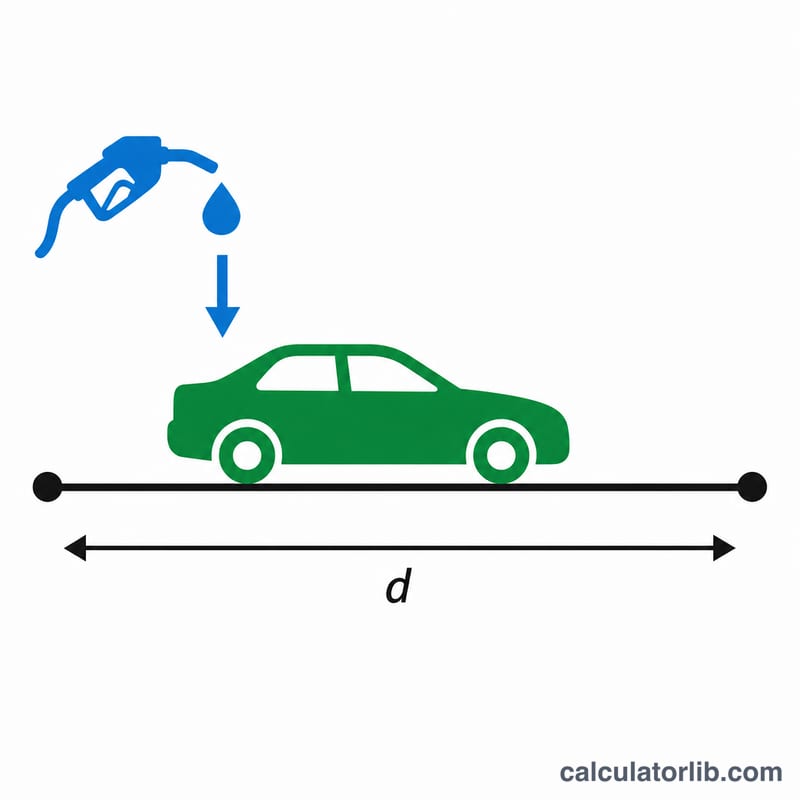
Fuel economy is simply a ratio. To get MPG, divide the distance by the fuel used: \(\text{MPG} = \dfrac{\text{distance}}{\text{fuel}}\). To express consumption in metric terms, divide fuel by distance and scale to 100 km: \(\text{L/100km} = \dfrac{\text{fuel}}{\text{distance}} \times 100\). A higher MPG means better efficiency, while a lower L/100km means better efficiency.
$$\text{MPG} = \dfrac{\text{distance}}{\text{fuel used}} \qquad \text{L/100km} = \dfrac{\text{fuel used}}{\text{distance}} \times 100$$Worked example
Suppose you drove 300 miles and used 12 gallons of gas. Your mileage is \(300 \div 12 = \) 25 MPG. If those same numbers were 300 km on 12 liters, your consumption would be \((12 \div 300) \times 100 = \) 4 L/100km, and your distance per liter would be 25 km/L.
$$300 \div 12 = 25 \text{ MPG} \qquad (12 \div 300) \times 100 = 4 \text{ L/100km}$$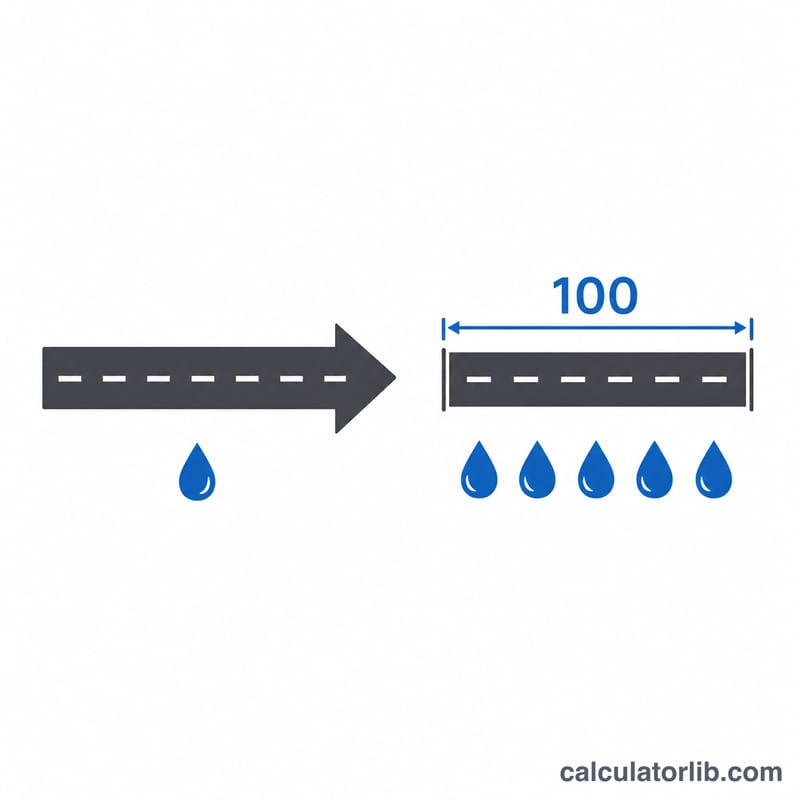
MPG to L/100km Conversion Table
MPG measures distance per unit of fuel (higher is more efficient), while L/100km measures fuel per distance (lower is more efficient). The two are inversely related, so the conversion is a division, not a multiplication. Note that US and imperial (UK) gallons differ in size, so the same MPG number means different efficiency depending on which gallon is used.
US gallons: \(\text{L/100km} = \dfrac{235.215}{\text{MPG (US)}}\). Imperial gallons: \(\text{L/100km} = \dfrac{282.481}{\text{MPG (UK)}}\).
| MPG | L/100km (US gal) | km/L (US gal) | L/100km (imperial gal) | km/L (imperial gal) |
|---|---|---|---|---|
| 10 | 23.52 | 4.25 | 28.25 | 3.54 |
| 15 | 15.68 | 6.38 | 18.83 | 5.31 |
| 20 | 11.76 | 8.50 | 14.12 | 7.08 |
| 25 | 9.41 | 10.63 | 11.30 | 8.85 |
| 30 | 7.84 | 12.75 | 9.42 | 10.62 |
| 35 | 6.72 | 14.88 | 8.07 | 12.39 |
| 40 | 5.88 | 17.01 | 7.06 | 14.16 |
| 50 | 4.70 | 21.26 | 5.65 | 17.70 |
To get km/L from L/100km, divide 100 by the L/100km value. As a shortcut, km/L = MPG (US) × 0.425144, or MPG (UK) × 0.354006. Values are rounded to two decimals.
Conversion Constants Used
| Constant | Value |
|---|---|
| 1 US gallon | 3.785411784 L (exact by definition) |
| 1 imperial gallon | 4.54609 L (exact by definition) |
| 1 mile (international) | 1.609344 km (exact by definition) |
| US conversion constant | 235.215 (L/100km × MPG) |
| Imperial conversion constant | 282.481 (L/100km × MPG) |
The derived constants come from converting 100 km into miles and one gallon into liters:
$$\frac{3.785411784 \times 100}{1.609344} \approx 235.215 \qquad \frac{4.54609 \times 100}{1.609344} \approx 282.481$$
Because \(\text{MPG} = \dfrac{\text{miles}}{\text{gallons}}\), multiplying MPG by L/100km always gives the same constant for a given gallon type, which is why the same constant converts in both directions.
Typical Fuel Economy Ranges by Vehicle Type
The ranges below are rough, general combined (city and highway) figures for gasoline vehicles, based on the kind of data published by the US EPA (fueleconomy.gov). They use US gallons, are approximate, and vary widely by model, year, engine, and driving conditions. They are not figures for any specific model. Check official ratings for the vehicle you care about.
| Vehicle class | Approx. MPG (US) | Approx. L/100km |
|---|---|---|
| Compact car | 28–38 | 6.2–8.4 |
| Midsize sedan | 25–35 | 6.7–9.4 |
| SUV | 18–30 | 7.8–13.1 |
| Pickup truck | 15–25 | 9.4–15.7 |
| Hybrid (car) | 40–55 | 4.3–5.9 |
| Motorcycle | 40–70 | 3.4–5.9 |
Real-world mileage is often lower than official ratings in cold weather, with aggressive driving, heavy loads, towing, under-inflated tires, or lots of short trips. For the most reliable personal figure, fill the tank, record the odometer, and calculate over several full tanks. Note that official test procedures differ by region (for example EPA in the US versus WLTP in Europe), so ratings from different standards are not directly comparable.
Fuel prices this week: United States
Average retail prices of regular gasoline and diesel across the United States, week of 2026-11-09, taxes included, as published by the U.S. Energy Information Administration. Use them as the fuel price in the calculator above.
- Regular gasoline (2026-11-09)
- $3.995/gal +30.7% since 2025-11-10
- Diesel (2026-11-09)
- $6.127/gal +59.7% since 2025-11-10
World crude oil prices, October 2026
World market prices of crude oil in U.S. dollars per barrel, monthly averages from the World Bank. These are commodity prices, not pump prices: the price at the pump also includes refining, distribution and taxes, and it differs from country to country.
- Crude oil, average of Brent, Dubai and WTI (2026-10)
- $108.50/bbl +72.2% since 2025-10
- Brent (2026-10)
- $125.00/bbl +93.2% since 2025-10
- WTI (2026-10)
- $97.70/bbl +62.3% since 2025-10
- Dubai (2026-10)
- $102.70/bbl +59.7% since 2025-10
Pump prices in the EU, week of 2026-11-09
Pump prices of petrol (Euro-super 95) and diesel by EU country, week of 2026-11-09, taxes included. Use them as the fuel price in the calculator above.
- EU average (petrol)
- 1.877 €/L
| Country | Petrol 95 (€/L) | Diesel (€/L) |
|---|---|---|
| Denmark | 2.391 | 2.435 |
| Netherlands | 2.196 | 2.361 |
| Finland | 2.144 | 2.485 |
| France | 2.088 | 2.178 |
| Germany | 2.067 | 2.253 |
| Greece | 2.042 | 2.099 |
| Italy | 1.995 | 2.218 |
| Ireland | 1.958 | 2.119 |
| Portugal | 1.922 | 2.135 |
| Latvia | 1.846 | 2.083 |
| Romania | 1.844 | 2.033 |
| Belgium | 1.844 | 2.357 |
| Lithuania | 1.843 | 2.225 |
| Estonia | 1.805 | 2.084 |
| Croatia | 1.749 | 2.025 |
| Spain | 1.730 | 1.898 |
| Cyprus | 1.699 | 2.000 |
| Slovakia | 1.691 | 1.965 |
| Hungary | 1.673 | 1.985 |
| Austria | 1.670 | 2.087 |
| Czechia | 1.653 | 1.899 |
| Slovenia | 1.634 | 1.950 |
| Luxembourg | 1.627 | 1.987 |
| Bulgaria | 1.582 | 1.896 |
| Sweden | 1.437 | 1.954 |
| Poland | 1.384 | 1.753 |
| Malta | 1.340 | 1.210 |
Latest figure: 2026-11-09 Data last updated 2026-11-11 · current
Source: U.S. Energy Information Administration (EIA), Gasoline and Diesel Fuel Update Public domain (U.S. government work); World Bank, Commodity Markets (Pink Sheet), modified CC BY 4.0; © European Union, Weekly Oil Bulletin (European Commission) CC BY 4.0
Prices per litre are converted by CalculatorLib from the bulletin's prices per 1,000 litres. Changes over one year are computed by CalculatorLib.
Source details and methodology
- U.S. Energy Information Administration (EIA), Gasoline and Diesel Fuel Update — Weekly retail gasoline and diesel prices
- World Bank, Commodity Markets (Pink Sheet), modified — Commodity Markets (Pink Sheet), monthly prices
- © European Union, Weekly Oil Bulletin (European Commission)
FAQ
Is higher MPG better? Yes — more miles per gallon means you use less fuel to travel the same distance.
How do I convert MPG to L/100km? They are inverse-style measures; this calculator shows both at once so you do not have to convert manually.
Why is my real-world mileage lower than the sticker? City driving, idling, heavy loads, and aggressive acceleration all reduce efficiency below the rated figure.