
What Is a Gas Mileage (MPG) Calculator?
This calculator measures your vehicle's fuel economy in miles per gallon (MPG). MPG tells you how far your car travels on a single gallon of fuel — a higher number means better efficiency and lower running costs. It uses US gallons by default and also reports the metric equivalents (L/100km and km/L) used in most of the world.
How to Use It
Fill up your tank completely and reset your trip odometer (or note the mileage). Drive normally until you need fuel again, then fill up once more. Record the miles driven on that tank and the gallons it took to refill. Enter both numbers above and the calculator returns your MPG instantly.
The Formula Explained
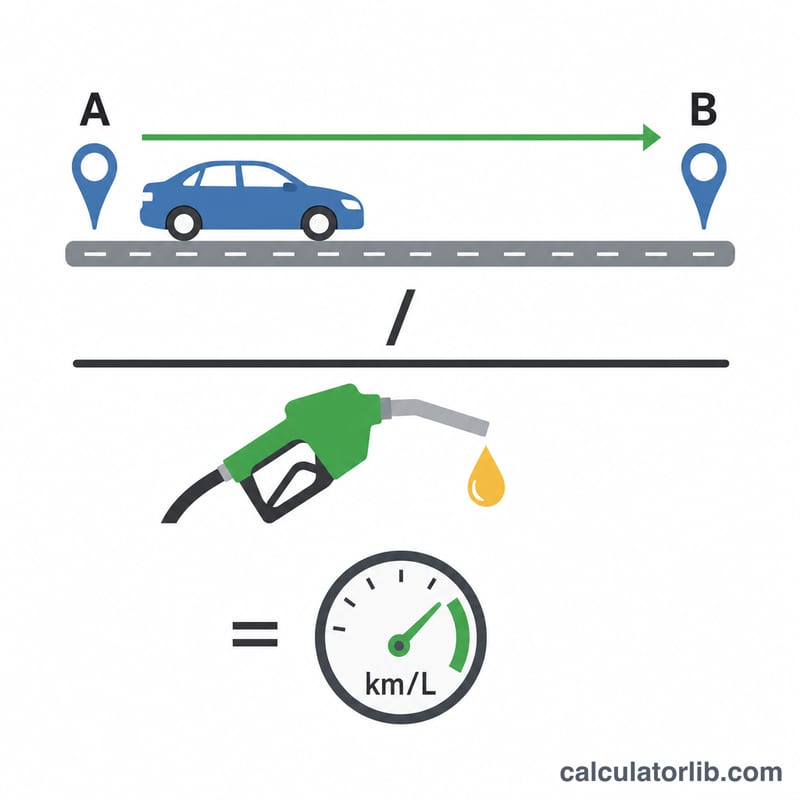
The core equation is simply:
$$\text{MPG} = \frac{\text{Miles Driven}}{\text{Gallons Used}}$$
To convert to the metric standard, the calculator uses L/100km = 235.215 ÷ MPG, where 235.215 is the constant that converts US miles-per-gallon into liters consumed per 100 kilometers.
Worked Example
Suppose you drove 300 miles and it took 12 gallons to refill your tank. Your gas mileage is $$300 \div 12 = 25 \text{ MPG}$$ In metric terms that's about \(235.215 \div 25 = 9.41\) L/100km, or roughly 10.63 km per liter.
FAQ
Does this use US or UK gallons? It uses US gallons. A US gallon is about 3.785 liters, while an Imperial (UK) gallon is about 4.546 liters, so the same car shows a higher MPG number in the UK system.
What is a good MPG? Modern compact cars often achieve 30–40 MPG, while hybrids can exceed 50 MPG. Trucks and SUVs are typically 15–25 MPG.
Why is my real-world MPG lower than the sticker? City driving, cold weather, aggressive acceleration, low tire pressure, and roof racks all reduce fuel economy compared to the EPA test figures.