
What This MPG Calculator Does
This tool calculates your vehicle's fuel economy in miles per gallon (MPG), the standard fuel-efficiency measure used in the United States. You enter two numbers, and it instantly returns your MPG along with two helpful metric conversions: kilometres per litre (km/L) and litres per 100 km (L/100km). That makes it useful whether you drive in the US or want to compare against fuel ratings used elsewhere in the world.
The Two Inputs You Need
- Miles Driven — the distance covered between two fill-ups. The cleanest way to measure this is to reset your trip odometer when you fill the tank.
- Gallons of Fuel Used — the amount of fuel you put in at the next fill-up to top the tank back to full. These are US gallons.
The Formula Explained
The core calculation is simple:
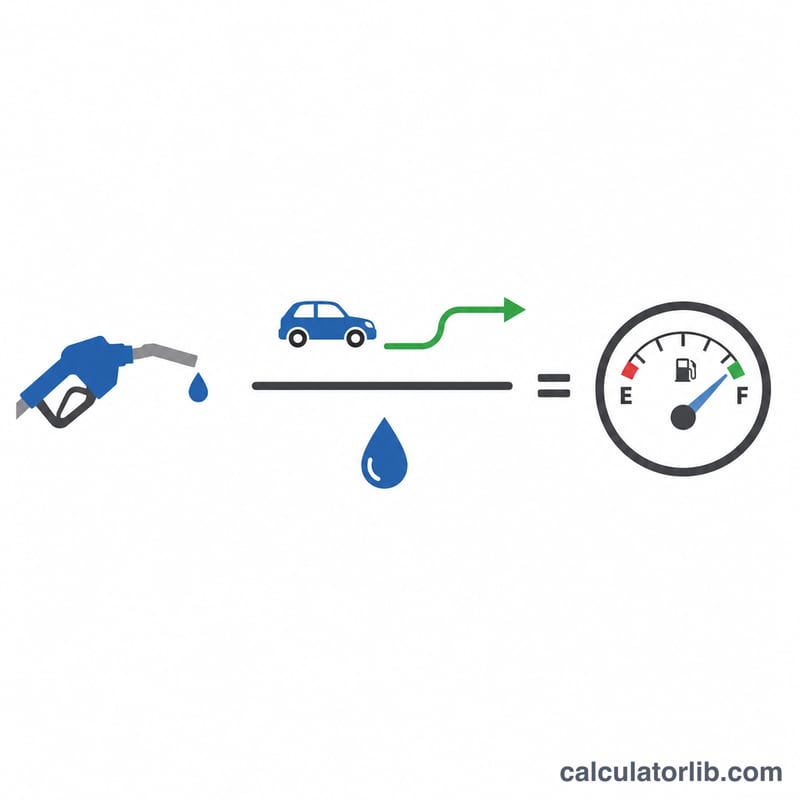
- MPG = Miles ÷ Gallons
- km/L = MPG × 0.425144 (converting miles-per-US-gallon to kilometres-per-litre)
- L/100km = (100 × 3.78541 × Gallons) ÷ (1.60934 × Miles), which converts gallons to litres (3.78541 L per gallon) and miles to kilometres (1.60934 km per mile)
If gallons is zero or blank, the calculator returns 0 to avoid dividing by zero.
Worked Example
Suppose you drove 300 miles and used 12 gallons of fuel:
- MPG = 300 ÷ 12 = 25 MPG
- km/L = 25 × 0.425144 = 10.63 km/L
- L/100km = (100 × 3.78541 × 12) ÷ (1.60934 × 300) = 4542.49 ÷ 482.80 = 9.41 L/100km
So this trip returned 25 MPG, or about 9.4 litres per 100 kilometres.
Frequently Asked Questions
Is this US gallons or UK (Imperial) gallons? The calculator uses US gallons (3.78541 litres each). An Imperial gallon is larger (about 4.546 litres), so don't mix the two or your result will be off.
How do I get an accurate reading? Fill the tank completely, reset your trip meter, drive normally, then refill to full again. The fuel added equals the gallons used over the miles shown on your trip meter.
Why is lower L/100km better but higher MPG better? They measure efficiency in opposite directions. MPG counts distance per fuel (more is better), while L/100km counts fuel per distance (less is better). Both describe the same trip.