
What Is the MPG to L/100km Converter?
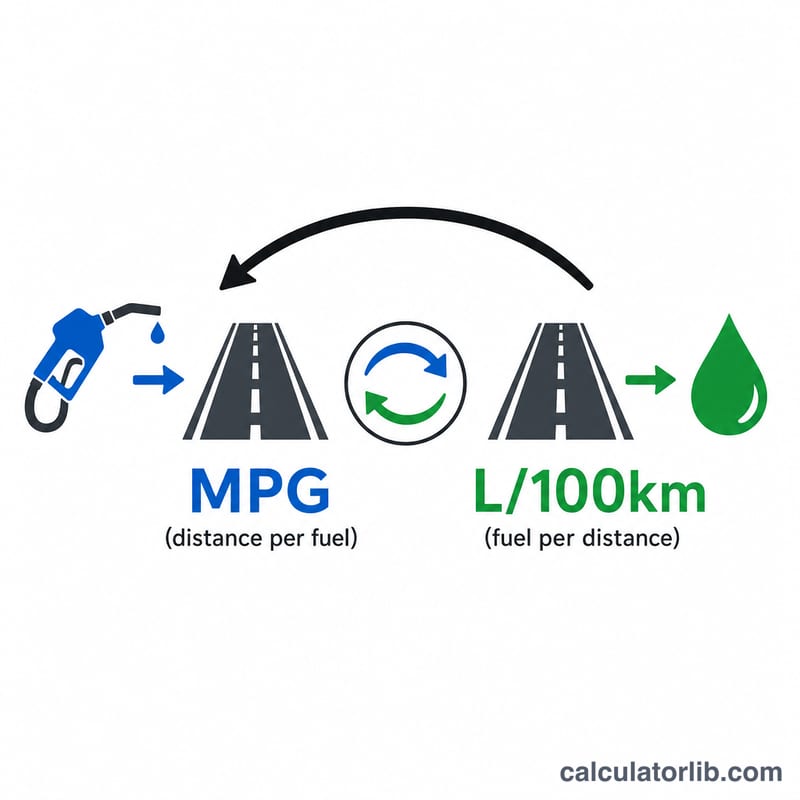
Fuel economy is measured differently around the world. The United States and (informally) the United Kingdom use miles per gallon (MPG) — higher is better. Most of the rest of the world uses liters per 100 kilometers (L/100km) — lower is better. This converter translates an MPG figure into its L/100km equivalent so you can compare vehicles across regions and unit systems.
How to Use It
Enter your vehicle's fuel economy in miles per gallon, then choose whether the figure is a US gallon (3.785 L) or an Imperial/UK gallon (4.546 L). The calculator instantly returns the consumption in liters per 100 km. Note that the same MPG number means a thirstier engine when measured in US gallons, because a US gallon is smaller than an Imperial one.
The Formula Explained
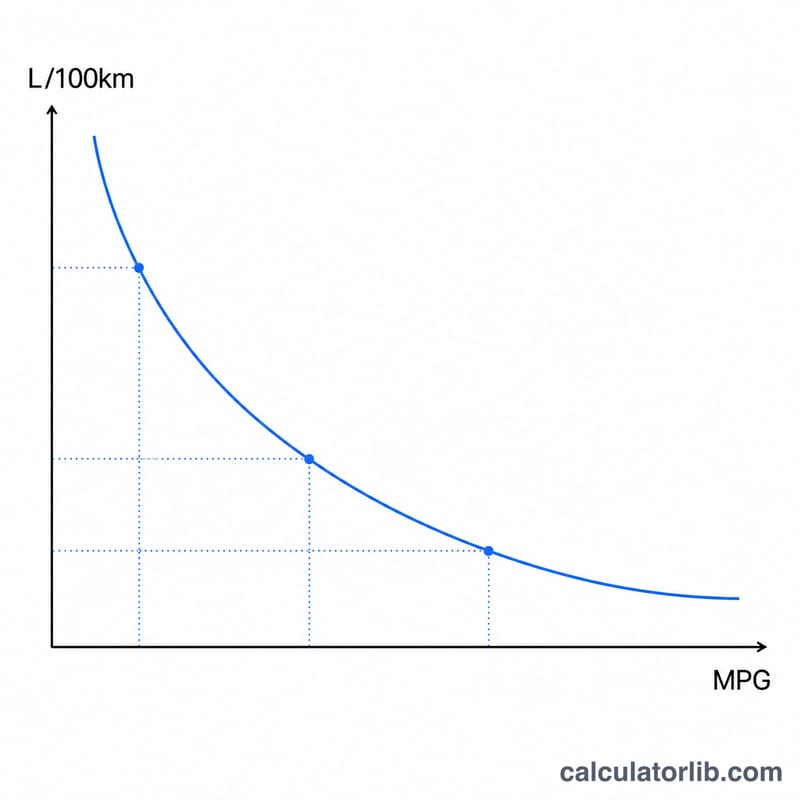
Because MPG and L/100km are inversely related, you divide a constant by the MPG value:
US: $$\text{L/100km} = \frac{235.214583}{\text{MPG}}$$ The constant comes from converting one mile to kilometers and one US gallon to liters: \(100 \times 3.785411784 \div 1.609344 \approx 235.214583\).
Imperial: $$\text{L/100km} = \frac{282.481}{\text{MPG}}$$ using the larger 4.54609 L gallon.
Worked Example
A car rated at 30 US MPG: $$235.214583 \div 30 = 7.84 \text{ L/100km}$$ The same 30 MPG measured in Imperial gallons: $$282.481 \div 30 = 9.42 \text{ L/100km}$$ meaning the UK figure describes a more efficient car for the same number.
FAQ
Why is the relationship inverse? MPG measures distance per unit of fuel, while L/100km measures fuel per unit of distance, so one rises as the other falls.
Which gallon should I pick? Use US for North American figures and Imperial for UK figures. A UK gallon is about 20% larger than a US gallon.
Is a lower L/100km better? Yes — fewer liters to travel 100 km means a more fuel-efficient vehicle.