
What is the MPG to L/100km Converter?
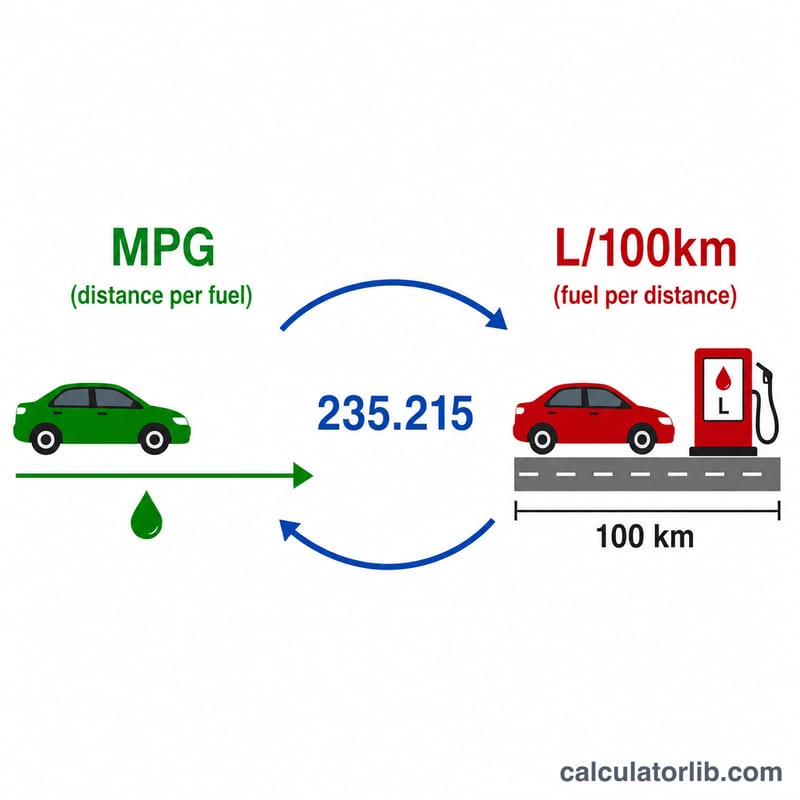
This tool converts a vehicle's fuel economy expressed in miles per gallon (MPG) into litres per 100 kilometres (L/100km), the metric standard used across Europe and most of the world. Because the US gallon and the UK (Imperial) gallon differ in size, the converter lets you pick which standard your MPG figure uses so the result is accurate.
How to use it
Enter your fuel economy in MPG, choose whether the figure is based on the US gallon (3.785 L) or the UK Imperial gallon (4.546 L), and read the equivalent L/100km value. A lower L/100km number means a more efficient vehicle, while a higher MPG number means the same thing — the two scales move in opposite directions.
The formula explained
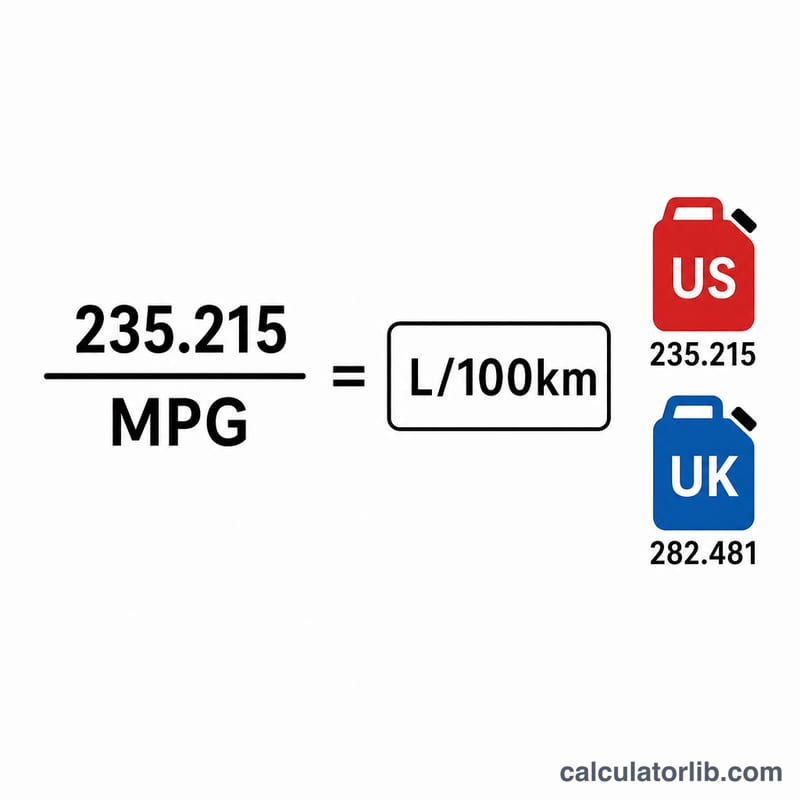
The two quantities are inversely related, so the conversion is a simple division by a constant. For US gallons, $$\text{L/100km} = \frac{235.215}{\text{MPG}}$$ For UK gallons, $$\text{L/100km} = \frac{282.481}{\text{MPG}}$$ These constants combine the miles-to-kilometres factor (\(1.609344\)) with the gallon-to-litre factor for each standard, scaled to 100 km.
Worked example
Suppose a car achieves 30 MPG (US). Dividing 235.215 by 30 gives \(\frac{235.215}{30} = 7.84\) L/100km. The same numeric MPG measured under the UK standard (30 MPG UK) gives \(\frac{282.481}{30} = 9.42\) L/100km, reflecting the larger Imperial gallon.
FAQ
Why are US and UK results different? The Imperial gallon is about 20% larger than the US gallon, so the same MPG number represents a different real-world efficiency.
Is a higher or lower L/100km better? Lower is better — it means the vehicle uses less fuel to travel 100 km.
Can I convert back? Yes — divide the same constant by the L/100km value to return to MPG.