
What this converter does
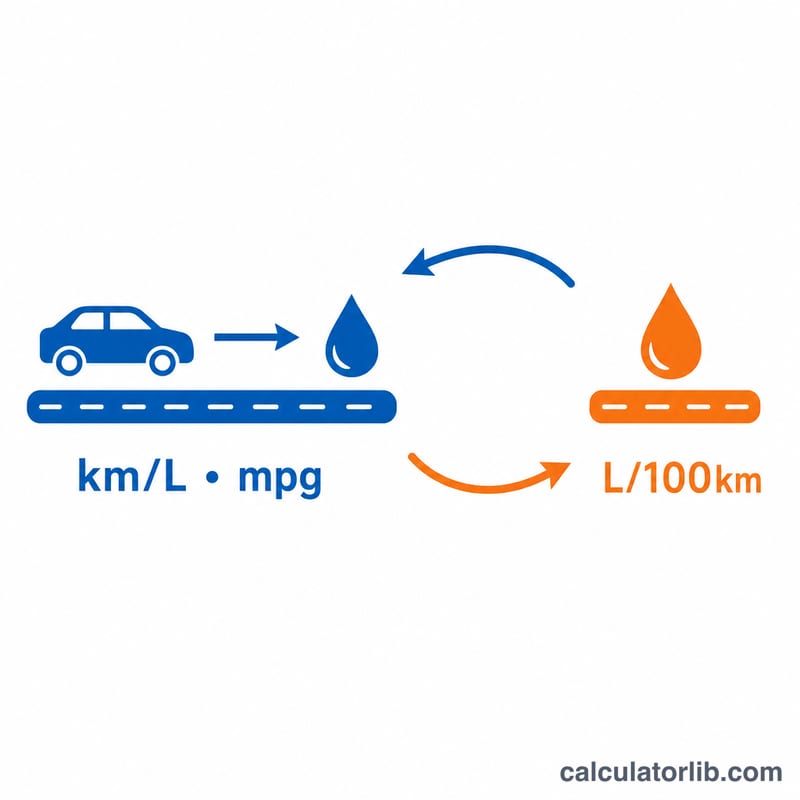
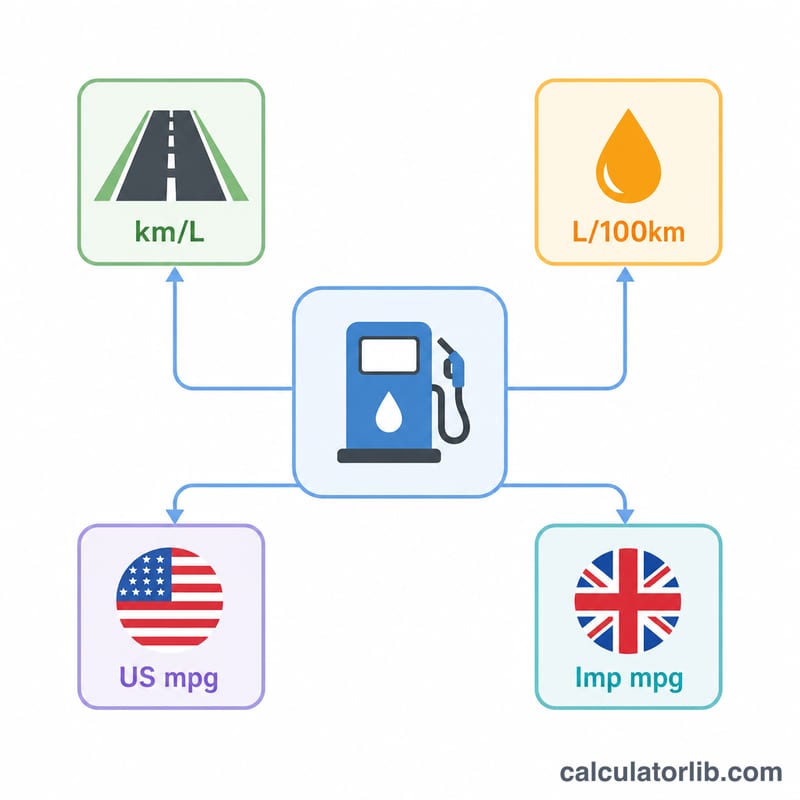
Fuel efficiency is reported in many incompatible units around the world. Some are "economy" units (higher is better) such as kilometers per liter and miles per gallon, while others are "consumption" units (lower is better) such as liters per 100 kilometers. This tool takes a single figure in any one of eight units and instantly shows the equivalent value in all of them, so you can compare cars or specs regardless of how they were quoted. It is a pure unit conversion and applies identically everywhere; the only regional distinction is the US gallon versus the larger Imperial gallon, both of which are provided.
How to use it
Type the fuel economy figure, choose the unit your number is in from the dropdown, and read the full conversion table. For example, US window stickers use US mpg, the UK quotes Imperial mpg, and most of the world uses L/100km or km/L. Enter the value as published and the converter handles the rest.
The formula explained
Every input is first normalized to a single canonical quantity, kilometers per liter (km/L). The three exact constants used are 1 mile = 1.609344 km, 1 US gallon = 3.785411784 L, and 1 Imperial gallon = 4.54609 L. From the canonical km/L the tool derives each output: reciprocal units like L/100km use \(\dfrac{100}{\text{km/L}}\), while mpg uses \(\text{km/L} \times \dfrac{\text{gallon-liters}}{\text{mile-km}}\). Constants are kept full precision and only the displayed result is rounded.
Worked example
Enter 20 km/L. The canonical value is 20 km/L. Then $$\text{L/100km} = \frac{100}{20} = 5$$ $$\text{US mpg} = 20 \times \frac{3.785411784}{1.609344} = 47.0429$$ $$\text{Imperial mpg} = 20 \times \frac{4.54609}{1.609344} = 56.4962$$ So 20 km/L is roughly 47 US mpg or 56.5 Imperial mpg.
FAQ
Why is US mpg lower than Imperial mpg for the same car? An Imperial gallon (4.546 L) is about 20% larger than a US gallon (3.785 L), so the same car travels farther on one Imperial gallon, giving a higher number.
Why can't I enter zero or a negative number? Fuel economy is physically positive, and several conversions divide by the value, so zero or negative inputs are rejected to avoid undefined results.
Are L/100km and km/L just opposites? Yes, they are reciprocals scaled by 100 — one measures distance per fuel, the other fuel per distance.