
What this calculator does
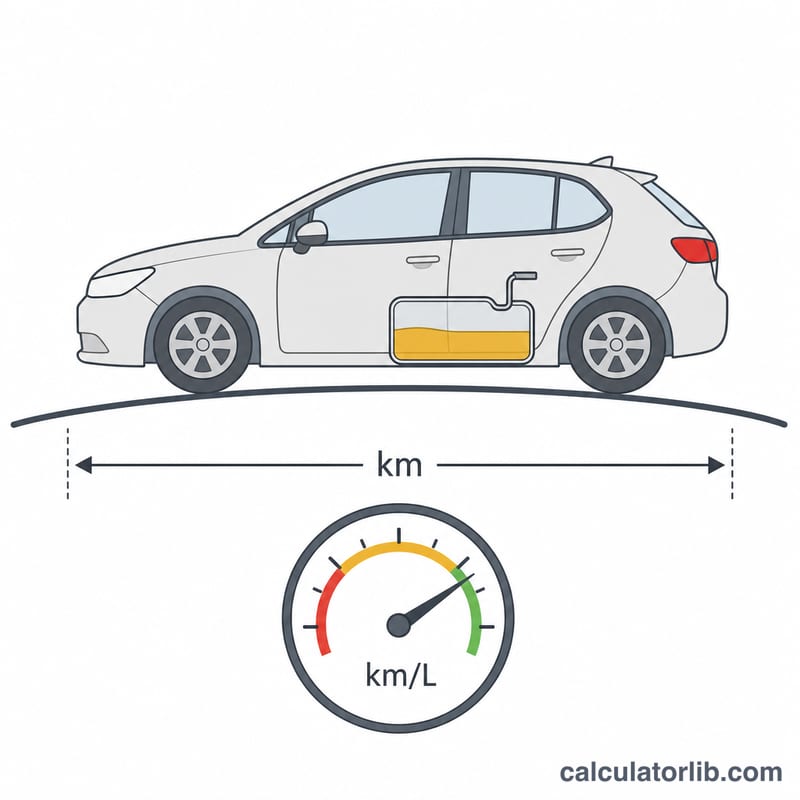
This tool turns two simple measurements from a real trip - how much fuel you burned and how far you drove - into two useful numbers: your car's fuel economy in kilometres per litre (km/L) and the carbon dioxide (CO2) emitted per kilometre driven. The CO2 emission factors used (2.32 kg-CO2/L for gasoline and 2.58 kg-CO2/L for diesel) come from the Guideline for calculating total greenhouse gas emissions published by Japan's Ministry of the Environment. Because these are tank-to-wheel combustion values rooted in the chemistry of burning fuel, they apply to vehicles anywhere, not only in Japan.
How to use it
Enter the amount of fuel consumed over the trip (for example, a tank you refueled), choose the fuel type so the correct CO2 factor is applied, and enter the driving distance covered with that fuel. Press calculate to see your km/L and your kg-CO2 per kilometre. Both fuel volume and distance must be greater than zero.
The formula explained
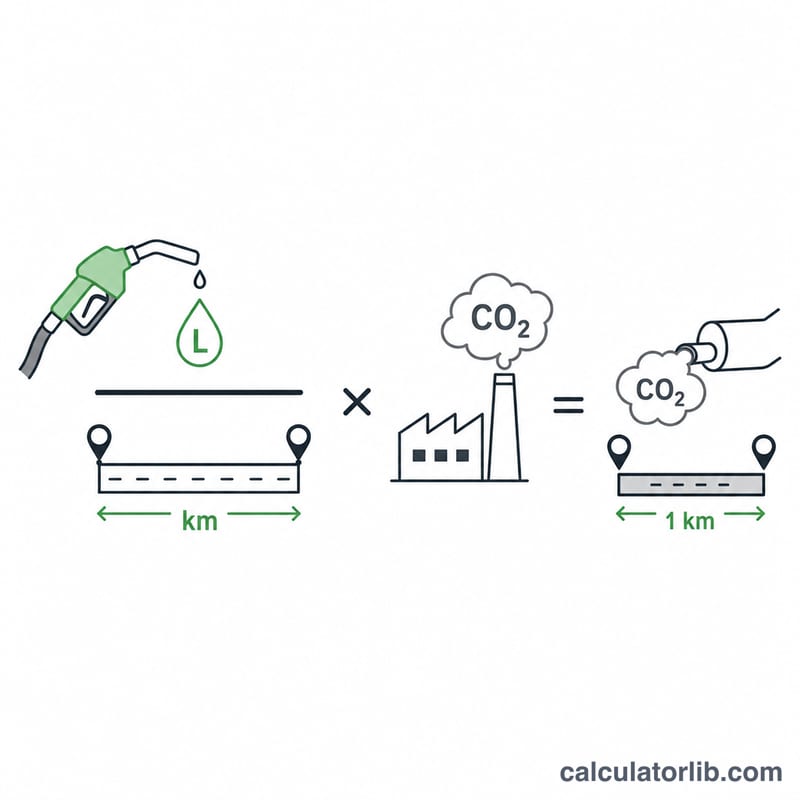
Fuel economy is simply distance divided by fuel volume: $$\text{km/L} = \frac{\text{distance}}{\text{fuelVolume}}$$ For emissions, burning each litre releases a fixed mass of CO2 (the factor), so the whole trip emits \(\text{co2Factor} \times \text{fuelVolume}\) kilograms. Dividing that total by the distance gives CO2 per km. Equivalently, \(\text{CO2/km} = \frac{\text{co2Factor}}{\text{km/L}}\) - the more efficient the car, the lower the emissions per kilometre.
Worked example
Suppose you burned 40 L of gasoline (factor 2.32) over 500 km. Fuel economy = $$500 / 40 = 12.5 \text{ km/L}$$ Total trip CO2 = $$2.32 \times 40 = 92.8 \text{ kg}$$ CO2 per km = $$92.8 / 500 = 0.1856 \text{ kg-CO2/km}$$ or about 185.6 g-CO2/km.
FAQ
Why are gasoline and diesel factors different? Diesel (light oil) is denser and carbon-richer per litre, so a litre emits more CO2 (2.58 vs 2.32 kg), even though diesel cars are often more efficient overall.
Do these factors include fuel production? No. They are tank-to-wheel combustion factors only and exclude well-to-tank emissions from refining and transporting the fuel.
How do I get grams per kilometre? Multiply the kg-CO2/km value by 1000; the result table already shows this conversion for you.