What Is a Drug Half-Life Calculator?
A drug's half-life (t½) is the time it takes for the amount of the substance in the body to fall to half its original value. This calculator uses exponential decay to estimate how much of a dose remains after any amount of time has elapsed. It is a general pharmacokinetic model intended for education and rough estimation — it is not medical advice, and individual metabolism, organ function, and drug interactions can change real-world results.
How to Use It
Enter the initial amount or dose (in any consistent unit such as mg), the drug's half-life in hours, and the time elapsed in hours. The calculator returns the amount remaining, the percent remaining and eliminated, and how many half-lives have passed.
The Formula Explained
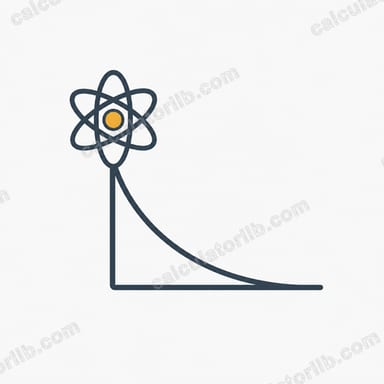
The model is simple exponential decay: $$\text{Remaining} = \text{Initial} \times \left(\frac{1}{2}\right)^{\frac{t}{t\frac{1}{2}}}$$ The exponent \(t / t\tfrac{1}{2}\) counts how many half-lives have elapsed. Each whole half-life halves the amount, so after 1 half-life you have 50%, after 2 you have 25%, after 3 you have 12.5%, and so on. The equivalent natural-exponential form, $$C = C_0 \cdot e^{-0.693 \cdot t / t\frac{1}{2}}$$ uses the elimination rate constant \(k = 0.693 / t\tfrac{1}{2}\) (since \(\ln 2 \approx 0.693\)).

Worked Example
Suppose you take a 100 mg dose of a drug with a 4-hour half-life and want to know how much remains after 8 hours. Half-lives elapsed = \(8 / 4 = 2\). $$\text{Remaining} = 100 \times \left(\frac{1}{2}\right)^{2} = 100 \times 0.25 = 25 \text{ mg}$$ That means 75 mg (75%) has been eliminated.

Typical Half-Lives of Common Drugs and Substances
The elimination half-life (\(t_{1/2}\)) is the time needed for the amount of drug in the body to fall by half. The values below are population averages compiled from standard pharmacology references and manufacturer product labeling (for example Goodman & Gilman's The Pharmacological Basis of Therapeutics and approved prescribing information). They are starting estimates only: a real half-life varies with age, body composition, renal and hepatic function, genetic polymorphisms in metabolising enzymes (notably CYP2C9, CYP2C19, CYP2D6, NAT2), pregnancy, co-administered drugs, and — for saturable drugs — the dose itself. Drug naming also differs by country; "acetaminophen" (US/Japan) and "paracetamol" (UK/EU/Australia and the INN) are the same molecule.
| Substance | Typical elimination half-life | Notes |
|---|---|---|
| Caffeine | ~3–7 h | Much longer in pregnancy and in neonates; shorter in smokers (CYP1A2 induction). |
| Ethanol (alcohol) | No meaningful half-life | Zero-order (saturable) elimination at ordinary drinking levels — falls at a roughly constant rate, commonly cited near 0.015 g/100 mL per hour. This calculator's exponential model does not apply to alcohol. |
| Ibuprofen | ~2 h | Short plasma half-life; anti-inflammatory effect outlasts plasma levels. |
| Acetaminophen / paracetamol | ~2–3 h | Prolonged in overdose and in significant hepatic impairment. |
| Aspirin (as salicylate) | ~2–3 h at low dose | Aspirin itself is hydrolysed within ~15–20 min. Salicylate elimination becomes saturable at anti-inflammatory or toxic doses, where apparent half-life lengthens markedly. |
| Amoxicillin | ~1–1.5 h | Renally cleared; substantially prolonged in renal impairment. |
| Diazepam | ~20–100 h | Active metabolite nordiazepam (desmethyldiazepam) can reach ~100 h, so effective persistence far exceeds the parent drug. |
| Fluoxetine | ~1–4 days | Active metabolite norfluoxetine ~4–16 days; explains slow washout and the lack of an abrupt discontinuation syndrome. |
| Morphine | ~2–4 h | Active metabolite morphine-6-glucuronide accumulates in renal impairment. |
| Warfarin | ~20–60 h | Anticoagulant effect is driven by clotting-factor turnover, not by the warfarin level; enantiomers differ (S-warfarin is the active one). |
| Digoxin | ~36–48 h | Longer in renal impairment; narrow therapeutic index. |
| Levothyroxine | ~7 days | One of the longest of common drugs; dose changes take ~4–6 weeks to show full effect. |
| Prednisone | ~2–3 h | Plasma half-life is short, but the biologic (genomic) effect lasts far longer — an intermediate-acting glucocorticoid. |
| Metformin | ~4–9 h | Renally excreted unchanged; accumulates when kidney function declines. |
Where a range is shown, use the low end for a healthy young adult and the high end when elimination is likely impaired. For any drug with an active metabolite, the metabolite's half-life — not the parent's — governs how long effects persist.
Key Terms and Variables
- Half-life (\(t_{1/2}\)), hours
- Time for the amount or concentration of drug in the body to fall by 50% during first-order elimination. Constant and dose-independent for linear kinetics.
- Elimination rate constant (\(k\)), per hour (h⁻¹)
- Fractional loss per unit time. Related to half-life by $$k = \frac{\ln 2}{t_{1/2}}, \qquad t_{1/2} = \frac{\ln 2}{k}$$ The equivalent exponential form of the model is \(A = A_0 e^{-kt}\). Example: \(t_{1/2} = 5\) h gives \(k = 0.6931/5 = 0.1386\) h⁻¹ (about 13.9% of the remaining amount per hour).
- \(\ln 2 \approx 0.6931\)
- The natural logarithm of 2 — the dimensionless constant converting between half-life and rate constant.
- First-order (exponential) elimination
- A constant fraction is removed per unit time; rate is proportional to the amount present. Most drugs at therapeutic doses. Straight line on a semi-log plot.
- Zero-order (constant-rate) elimination
- A constant amount is removed per unit time because the clearing enzymes or transporters are saturated. Ethanol, phenytoin at high concentration, high-dose salicylate. No fixed half-life; this calculator does not apply.
- \(C_0\) / initial amount (\(A_0\)), mg (or mg/L)
- The starting amount or concentration at \(t = 0\) — the "Dose" input here. For an intravenous bolus, \(C_0 = \text{Dose}/V_d\).
- Half-lives elapsed (\(n = t/t_{1/2}\)), dimensionless
- The exponent in the decay equation. Both \(t\) and \(t_{1/2}\) must use the same time unit (hours in this tool).
- Percent remaining vs percent eliminated
- Percent remaining \(= 100 \times (1/2)^{n}\); percent eliminated \(= 100 - \text{percent remaining}\). They always sum to 100%.
- Clearance (CL), volume/time (e.g. L/h or mL/min)
- The volume of plasma effectively cleared of drug per unit time — the primary physiological determinant of elimination, with \(t_{1/2} = 0.693 \, V_d / CL\).
- Volume of distribution (\(V_d\)), L or L/kg
- Apparent volume relating total drug in the body to plasma concentration. Large \(V_d\) means extensive tissue distribution and, for a given clearance, a longer half-life.
- Steady state
- On repeated dosing, the state where the amount entering per interval equals the amount eliminated, so peaks and troughs stop rising. Reached after roughly 4–5 half-lives.
- Accumulation
- Build-up when the dosing interval is short relative to the half-life; the accumulation ratio grows as the interval shrinks below \(t_{1/2}\).
- Active metabolite
- A pharmacologically active breakdown product, sometimes with a much longer half-life than the parent drug (nordiazepam from diazepam; norfluoxetine from fluoxetine). It, not the parent, then governs duration.
- Distribution vs terminal half-life
- Multi-compartment drugs show an early, fast distribution (alpha) phase as drug moves into tissues, then a slower terminal (beta) elimination phase. Published half-lives usually refer to the terminal phase, which is what this single-exponential model approximates.
- Bioavailability (F), fraction or %
- Proportion of an administered dose reaching systemic circulation unchanged. \(F = 1\) for intravenous dosing and often much lower orally because of incomplete absorption and first-pass metabolism — so the amount actually in the body may be well below the dose entered.
FAQ
How many half-lives until a drug is "gone"? Clinically, a drug is considered effectively cleared after about 4–5 half-lives, when roughly 94–97% has been eliminated.
Does this account for repeated dosing? No — it models a single dose. With regular dosing, drug levels accumulate toward a steady state over about 4–5 half-lives.
What units should I use? Any consistent units work for the amount (mg, µg, etc.). Half-life and elapsed time must both be in hours.