What is the IVIG Dose Calculator?
Intravenous immunoglobulin (IVIG) is dosed by body weight, typically expressed in grams per kilogram (g/kg). This calculator converts a prescribed dose per kilogram into the total grams of IVIG required for a patient, and then translates that into the actual infusion volume in milliliters based on the concentration of the IVIG product being used. It is intended as a clinical decision-support aid; always verify against local protocols, product labeling, and prescriber orders.
How to use it
Enter three values: the patient's weight in kilograms, the prescribed dose in grams per kilogram, and the concentration of the IVIG product in milligrams per milliliter. Common regimens include 0.4 g/kg daily for several days (immune deficiency) or up to 2 g/kg for immunomodulation. Products are commonly supplied at concentrations of 50, 100, or 200 mg/mL. The calculator returns the total dose in grams and the corresponding volume to administer.
The formula explained
The total dose is simply the dose per kilogram multiplied by the weight: $$\text{Dose (g)} = D \text{ (g/kg)} \times W \text{ (kg)}$$. To find the volume, the dose in grams is converted to milligrams (\(\times 1000\)) and divided by the concentration in mg/mL: $$\text{Volume (mL)} = \frac{\text{Dose (g)} \times 1000}{C \text{ (mg/mL)}}$$. The factor of 1000 reconciles grams with the milligram-based concentration.
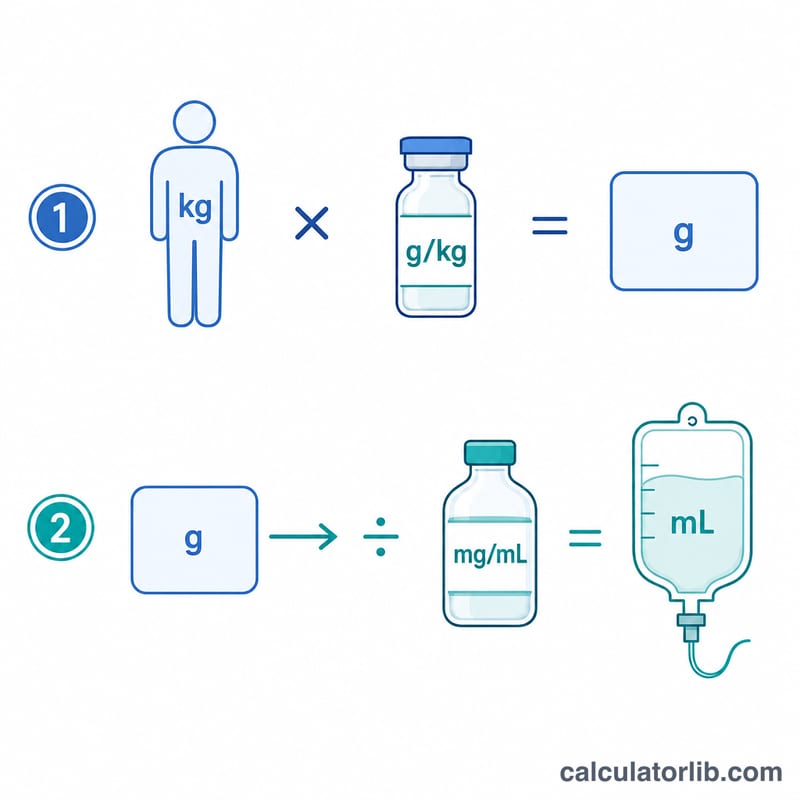
Worked example
For an 80 kg patient prescribed 0.4 g/kg using a 100 mg/mL product: Total dose = \(0.4 \times 80 = 32\) g. Volume = \(\dfrac{32 \times 1000}{100} = 320\) mL.
IVIG Dose and Volume Across Common Regimens and Concentrations
The total dose is \(\text{Dose (g/kg)} \times \text{Weight (kg)}\), and the volume is \(\dfrac{ \text{Total Dose (g)} \times 1000}{\text{Concentration (mg/mL)}}\). The table applies these formulas to a few example regimens at the three most common product concentrations (5%, 10% and 20%).
| Weight | Dose per kg | Total dose | Volume at 50 mg/mL (5%) | Volume at 100 mg/mL (10%) | Volume at 200 mg/mL (20%) |
|---|---|---|---|---|---|
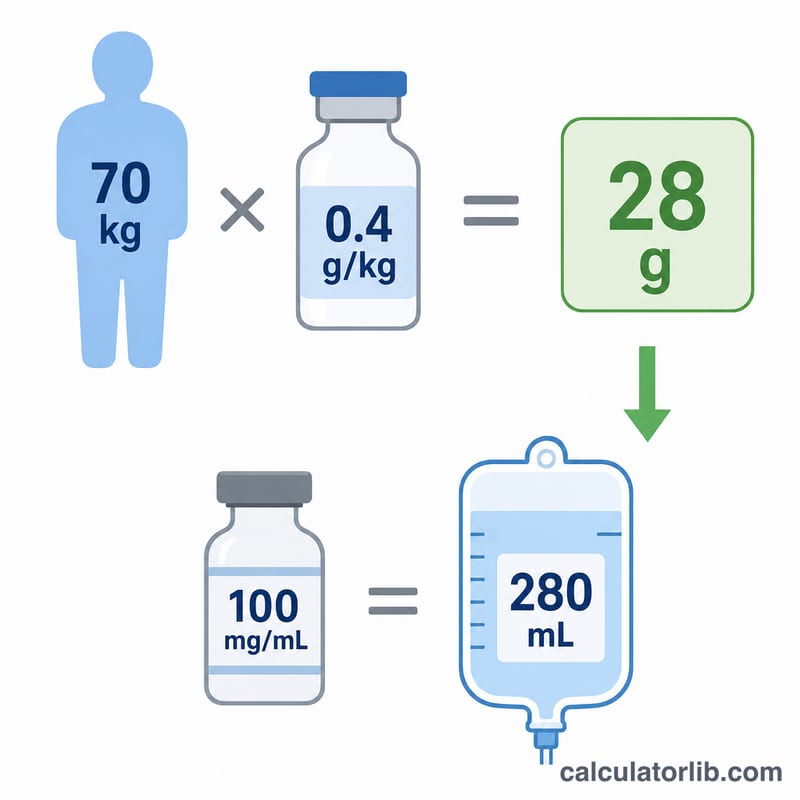
| 70 kg | 0.4 g/kg | 28 g | 560 mL | 280 mL | 140 mL |
| 70 kg | 1 g/kg | 70 g | 1,400 mL | 700 mL | 350 mL |
| 70 kg | 2 g/kg | 140 g | 2,800 mL | 1,400 mL | 700 mL |
| 80 kg | 0.4 g/kg | 32 g | 640 mL | 320 mL | 160 mL |
Example substitution: 70 kg × 0.4 g/kg = 28 g, and 28 g × 1000 = 28,000 mg. Dividing by 100 mg/mL gives 280 mL.
Note: this is illustrative arithmetic only, not a prescribing recommendation. Actual doses, infusion rates and products must come from the prescriber, the product labeling and institutional protocols.
Typical IVIG Dosing Ranges by Indication
The regimens below are commonly published approximate ranges, given as general reference only. They vary by guideline, country and product.
| Indication | Commonly published regimen |
|---|---|
| Primary immunodeficiency (replacement) | About 0.3–0.8 g/kg every 3–4 weeks (commonly 0.4–0.6 g/kg) |
| Immune thrombocytopenia (ITP) | About 1 g/kg for 1–2 days, or 0.4 g/kg daily for 5 days |
| Kawasaki disease | 2 g/kg as a single infusion |
| CIDP | About 2 g/kg total, divided over 2–5 days (for initial treatment) |
| Guillain-Barré syndrome | 0.4 g/kg daily for 5 days (2 g/kg total) |
Typical product concentrations
- 5% solution = 50 mg/mL
- 10% solution = 100 mg/mL
- 20% solution = 200 mg/mL
Exact dosing depends on product labeling, institutional protocols, the patient's clinical situation and the prescriber's orders. Dosing weight (actual, ideal or adjusted) is also set by local policy. This is general information, not medical advice.
Concentration Conversion: Percent to mg/mL
A percent solution here means grams per 100 mL. So 1% = 1 g/100 mL = 10 mg/mL, and mg/mL = percent × 10.
| Concentration (%) | mg/mL | g/100 mL | Volume per 10 g of IVIG |
|---|---|---|---|
| 3% | 30 mg/mL | 3 g | ≈ 333 mL |
| 5% | 50 mg/mL | 5 g | 200 mL |
| 6% | 60 mg/mL | 6 g | ≈ 167 mL |
| 10% | 100 mg/mL | 10 g | 100 mL |
| 12% | 120 mg/mL | 12 g | ≈ 83 mL |
| 20% | 200 mg/mL | 20 g | 50 mL |
Example: 10 g = 10,000 mg. At 50 mg/mL that is 10,000 ÷ 50 = 200 mL. At 100 mg/mL it is 100 mL, and at 200 mg/mL it is 50 mL. Always confirm the concentration on the specific product label.
FAQ
Should I use actual or ideal body weight? In obese patients many protocols use an adjusted or ideal body weight to avoid overdosing; follow your institutional guideline.
What concentration should I enter? Use the concentration printed on the specific product vial — it varies by brand and formulation.
Is rounding needed? Vials come in fixed sizes, so the final dispensed amount is usually rounded to the nearest vial; treat this output as the calculated target.